Thank you for visiting SNEWPapers!
Sign up free
Letter to Editor
February 24, 1823
The Alexandria Herald
Alexandria, Virginia
What is this article about?
A mechanic writes to the printer defending a proposed bill extending the jurisdiction of justices of the peace in the District of Columbia to handle debt recovery cases up to $50, arguing it aids honest creditors against dishonest debtors and critics like 'A Friend to the Poor.' The full bill text is included, detailing procedures, appeals, and fees.
Clipping
OCR Quality
95%
Excellent
Full Text
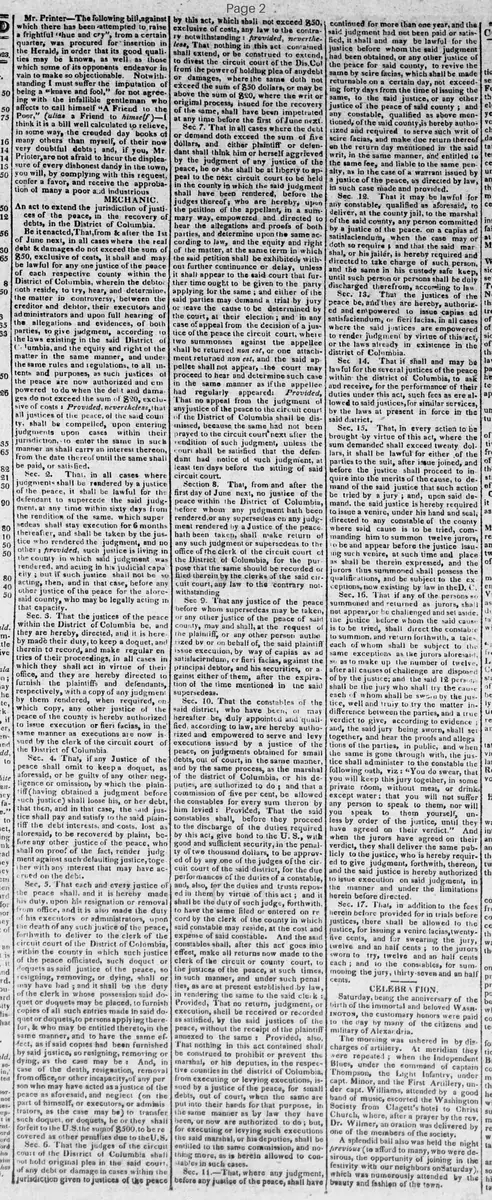
Mr. Printer--The following bill, against which there has been attempted to raise a frightful 'hue and cry', from a certain quarter; was procured for insertion in the Herald, in order that its good qualities may be known, as well, as those which some of its opponents endeavor in vain to make so objectionable. Notwithstanding I must suffer the imputation of being a 'knave and fool,' for not agreeing with the infallible gentleman who affects to call himself 'A Friend to the Poor,' (alias a Friend to himself)--I think it is a bill well calculated to relieve, in some way, the crowded day books of many others than myself, of their now very doubtful debts; and, if you, Mr. Printer are not afraid to incur the displeasure of every dishonest dandy in the town, you will, by complying with this request, confer a favor, and receive the approbation of many a poor and industrious MECHANIC.
An act to extend the jurisdiction of justices of the peace, in the recovery of debts, in the District of Columbia.
Be it enacted, That, from & after the 1st of June next, in all cases where the real debt & damages do not exceed the sum of $50, exclusive of costs, it shall and may be lawful for any one justice of the peace of each respective county within the District of Columbia, wherein the debtor doth reside, to try, hear, and determine, the matter in controversy, between the creditor and debtor, their executors and administrators and upon full hearing of the allegations and evidences, of both parties, to give judgment, according to the laws existing in the said District of Columbia, and the equity and right of the matter in the same manner, and under the same rules and regulations, to all intents and purposes, as such justices of the peace are now authorized and empowered to do when the debt and damages do not exceed the sum of $20, exclusive of costs: Provided, nevertheless that all justices of the peace, of the said county, shall be compelled, upon entering judgments upon cases within their jurisdiction, to enter the same in such manner as shall carry an interest thereon, from the date thereof until the same shall be paid, or satisfied.
Sec. 2. That, in all cases where judgments shall be rendered by a justice of the peace, it shall be lawful for the defendant to supersede the said judgment, at any time within sixty days from the rendition of the same, which supersedeas shall stay execution for 6 months thereafter, and shall be taken by the justice who rendered the judgment, and no other: provided, such justice is living in the county in which said judgment was rendered, and acting in his judicial capacity; but if such justice shall not be so acting, then, and in that case, before any other justice of the peace for the aforesaid county, who may be legally acting in that capacity.
Sec. 3. That the justices of the peace within the District of Columbia be, and they are hereby, directed, and it is hereby made their duty, to keep a docket, and therein to record, and make regular entries of their proceedings, in all cases in which they shall act in virtue of their office, and they are hereby directed to furnish the plaintiffs and defendants, respectively, with a copy of any judgment by them rendered, when required, on which copy, any other justice of the peace of the county is hereby authorized to issue execution or fieri facias, in the same manner as executions are now issued by the clerk of the circuit court of the District of Columbia.
Sec. 4. That, if any Justice of the peace shall omit to keep a docket, as aforesaid, or be guilty of any other negligence or omission, by which the plaintiff (having obtained a judgment before such justice) shall lose his, or her debt, that then, and in that case, the said justice shall pay and satisfy to the said plaintiff the debt, interest, and costs, lost as aforesaid, to be recovered by plaint, before any other justice of the peace, who shall on proof of the fact, render judgment against such defaulting justice, together with any interest that may have accrued on the debt.
Sec. 5. That each and every justice of the peace shall, and it is hereby made his duty, upon his resignation or removal from office, and it is also made the duty of his executors or administrators, upon the death of any such justice of the peace, forthwith to deliver to the clerk of the circuit court of the District of Columbia, within the county in which such justice of the peace officiated, such docket or dockets as said justice of the peace, so resigning, removing, or dying, shall or may have had; and it shall be the duty of the clerk in whose possession said docket or dockets may be placed, to furnish copies of all such entries made in said docket or dockets, to persons applying therefor, & who may be entitled thereto, in the same manner, and to have the same effect, as if said copies had been furnished by said justice, so resigning, removing or dying, as the case may be: And, in case of the death, resignation, removal from office, or other incapacity, of any person who may have acted as a justice of the peace as aforesaid, and neglect (on the part of himself, or executors, or administrators, as the case may be) to transfer such docket, or dockets, he or they shall forfeit to the U. S. the sum of $500, to be recovered as other penalties due to the U. S.
Sec. 6. That the judges of the circuit court of the District of Columbia shall not hold original plea in the said court, of any debt or damage in cases within the jurisdiction given to justices of the peace by this act, which shall not exceed $50, exclusive of costs, any law to the contrary notwithstanding: provided, nevertheless, That nothing in this act contained shall extend, or be construed to extend, to divest the circuit court of the Dis. Col. from the power of holding plea of any debt or damages, where the same doth not exceed the sum of $50 dollars, or may be above the sum of $50, where the writ or original process, issued for the recovery of the same, shall have been impetrated at any time before the first of June next.
Sec 7. That in all cases where the debt or demand doth exceed the sum of five dollars, and either plaintiff or defendant shall think him or herself aggrieved by the judgment of any justice of the peace, he or she shall be at liberty to appeal to the next circuit court to be held in the county in which the said judgment shall have been rendered, before the judges thereof; who are hereby, upon the petition of the appellant, in a summary way, empowered and directed to hear the allegations and proofs of both parties, and determine upon the same according to law, and the equity and right of the matter, at the same term in which the said petition shall be exhibited without further continuance or delay, unless it shall appear to the said court that further time ought to be given to the party applying for the same; and either of the said parties may demand a trial by jury or leave the cause to be determined by the court, at their election; and in any case of appeal from the decision of a justice of the peace the circuit court, where two summonses against the appellee shall be returned non est, or one attachment returned non est, and the said appellee shall not appear, the court may proceed to hear and determine such case in the same manner as if the appellee had regularly appeared: Provided, That no appeal from the judgment of any justice of the peace to the circuit court of the District of Columbia shall be dismissed, because the same had not been prayed to the circuit court next after the rendition of such judgment, unless the court shall be satisfied that the defendant had notice of such judgment, at least ten days before the sitting of said circuit court.
Section 8. That, from and after the first day of June next, no justice of the peace within the District of Columbia, before whom any judgment hath been rendered, or any supersedeas on any judgment rendered by a Justice of the peace, hath been taken, shall make return of any such judgment or supersedeas to the office of the clerk of the circuit court of the District of Columbia, for the purpose that the same should be recorded or filed therein by the clerks of the said circuit court, any law to the contrary notwithstanding.
Sec 9. That any justice of the peace before whom supersedeas may be taken, or any other justice of the peace of said county, may and shall, at the request of the plaintiff, or any other person authorized by or on behalf of the said plaintiff issue execution, by way of capias ad satisfaciendum, or fieri facias, against the principal debtor, and his securities, or against either of them, after the expiration of the time mentioned in the said supersedeas.
Sec. 10. That the constables of the said district, who have been, or may hereafter be, duly appointed and qualified, according to law, are hereby authorized and empowered to serve and levy executions issued by a justice of the peace, on judgments obtained for small debts, out of court, in the same manner, and by the same process, as the marshal of the district of Columbia, or his deputies, are authorized to do; and that a commission of five per cent, be allowed the constables for every sum thereon by him levied: Provided, That the said constables shall, before they proceed to the discharge of the duties required by this act, give bond to the U. S., with good and sufficient security, in the penalty of two thousand dollars, to be approved of by any one of the judges of the circuit court of the said district, for the due performances of the duties of a constable, and, also, for the duties and trusts reposed in them by virtue of this act; and it shall be the duty of such judge, forthwith, to have the same filed or entered on record by the clerk of the county in which said constable may reside, at the cost and expense of said constable. And the said constables shall, after this act goes into effect, make all returns now made to the clerk of the circuit or county court, to the justices of the peace, at such times, in such manner, and under such penalties, as are at present established by law, in rendering the same to the said clerk: Provided, That no return, judgment, or execution, shall be received or recorded as satisfied, by the said justices of the peace, without the receipt of the plaintiff annexed to the same: Provided, also, That nothing in this act contained shall be construed to prohibit or prevent the marshal, or his deputies, in the respective counties in the district of Columbia, from executing or levying executions, issued by a justice of the peace, for small debts, out of court, when the same are put into their hands for that purpose, in the same manner as by law they have been, or now are authorized to do; but, for executing or levying such executions the said marshal, or his deputies, shall be entitled to the same commission, and nothing more, as is herein allowed to constables in such cases.
Sec. 11. That, where any judgment, before any justice of the peace, shall have continued for more than one year, and the said judgment had not been paid or satisfied, it shall and may be lawful for the justice before whom the said judgment had been obtained, or any other justice of the peace for said county, to revive the same by scire facias, which shall be made returnable on a certain day, not exceeding forty days from the time of issuing the same, to the said justice, or any other justice of the peace of said county; and any constable, qualified as above mentioned, of the said county, is hereby authorized and required to serve such writ of scire facias, and make due return thereof on the return day mentioned in the said writ, in the same manner, and entitled to the same fee, and liable to the same penalty, as in the case of a warrant issued by a justice of the peace, as directed by law, in such case made and provided.
Sec. 12. That it may be lawful for any constable, qualified as aforesaid, to deliver, at the county jail, to the marshal of the said county, any person committed by a justice of the peace, on a capias ad satisfaciendum, when the case may or doth so require; and that the said marshal, or his jailer, is hereby required and directed to take charge of such person, and the same in his custody safe keep, until such person or persons shall be duly discharged therefrom, according to law.
Sec. 13. That the justices of the peace be, and they are hereby, authorized and empowered to issue capias ad satisfaciendum, or fieri facias, in all cases where the said justices are empowered to render judgment by virtue of this act, or the laws already in existence in the district of Columbia.
Sec 14. That it shall and may be lawful for the several justices of the peace within the district of Columbia, to ask and receive, for the performance of their duties under this act, such fees as are allowed to said justices, for similar services, by the laws at present in force in the said district.
Sec. 15. That, in every action to be brought by virtue of this act, where the sum demanded shall exceed twenty dollars, it shall be lawful for either of the parties to the suit, after issue joined, and before the justice shall proceed to inquire into the merits of the cause, to demand of the said justice that such action be tried by a jury; and, upon said demand, the said justice is hereby required to issue a venire, under his hand and seal; directed to any constable of the county where said cause is to be tried, commanding him to summon twelve jurors, to be and appear before the justice issuing such venire, at such time and place as shall be therein expressed, and the jurors thus summoned shall possess the qualifications, and be subject to the exceptions, now existing by law in the D. C.
Sec. 16. That if any of the persons so summoned and returned as jurors, shall not appear, or be challenged and set aside, the justice before whom the said cause is to be tried, shall direct the constable to summon, and return forthwith, a tales de circumstantibus, each of whom shall be subject to the same exceptions as the jurors aforesaid, so as to make up the number of twelve, after all causes of challenge are disposed of by the justice; and the said 12 persons, shall be the jury who shall try the cause each of whom shall be sworn by the justice, well and truly to try the matter in difference between the parties, and a true verdict to give, according to evidence; and, the said jury being sworn, shall set together, and hear the proofs and allegations of the parties, in public, and when the same is gone through with, the justice shall administer to the constable the following oath, viz: 'You do swear, that you will keep this jury together, in some private room, without meat, or drink except water: that you will not suffer any person to speak to them, nor will you speak to them yourself, unless by order of the justice, until they have agreed on their verdict.' And when the jurors have agreed on their verdict, they shall deliver the same publicly to the justice, who is hereby required to give judgment, forthwith, thereon, and the said justice is hereby authorized to issue execution on said judgment, in the manner and under the limitations herein before directed.
Sec. 17. That, in addition to the fees herein before provided for in trials before justices, there shall be allowed to the justice, for issuing a venire facias, twenty-five cents, and for swearing the jury, twelve and a half cents; to the jurors sworn to try, twelve and a half cents each; and to the constables, for summoning the jury, thirty-seven and a half cents.
An act to extend the jurisdiction of justices of the peace, in the recovery of debts, in the District of Columbia.
Be it enacted, That, from & after the 1st of June next, in all cases where the real debt & damages do not exceed the sum of $50, exclusive of costs, it shall and may be lawful for any one justice of the peace of each respective county within the District of Columbia, wherein the debtor doth reside, to try, hear, and determine, the matter in controversy, between the creditor and debtor, their executors and administrators and upon full hearing of the allegations and evidences, of both parties, to give judgment, according to the laws existing in the said District of Columbia, and the equity and right of the matter in the same manner, and under the same rules and regulations, to all intents and purposes, as such justices of the peace are now authorized and empowered to do when the debt and damages do not exceed the sum of $20, exclusive of costs: Provided, nevertheless that all justices of the peace, of the said county, shall be compelled, upon entering judgments upon cases within their jurisdiction, to enter the same in such manner as shall carry an interest thereon, from the date thereof until the same shall be paid, or satisfied.
Sec. 2. That, in all cases where judgments shall be rendered by a justice of the peace, it shall be lawful for the defendant to supersede the said judgment, at any time within sixty days from the rendition of the same, which supersedeas shall stay execution for 6 months thereafter, and shall be taken by the justice who rendered the judgment, and no other: provided, such justice is living in the county in which said judgment was rendered, and acting in his judicial capacity; but if such justice shall not be so acting, then, and in that case, before any other justice of the peace for the aforesaid county, who may be legally acting in that capacity.
Sec. 3. That the justices of the peace within the District of Columbia be, and they are hereby, directed, and it is hereby made their duty, to keep a docket, and therein to record, and make regular entries of their proceedings, in all cases in which they shall act in virtue of their office, and they are hereby directed to furnish the plaintiffs and defendants, respectively, with a copy of any judgment by them rendered, when required, on which copy, any other justice of the peace of the county is hereby authorized to issue execution or fieri facias, in the same manner as executions are now issued by the clerk of the circuit court of the District of Columbia.
Sec. 4. That, if any Justice of the peace shall omit to keep a docket, as aforesaid, or be guilty of any other negligence or omission, by which the plaintiff (having obtained a judgment before such justice) shall lose his, or her debt, that then, and in that case, the said justice shall pay and satisfy to the said plaintiff the debt, interest, and costs, lost as aforesaid, to be recovered by plaint, before any other justice of the peace, who shall on proof of the fact, render judgment against such defaulting justice, together with any interest that may have accrued on the debt.
Sec. 5. That each and every justice of the peace shall, and it is hereby made his duty, upon his resignation or removal from office, and it is also made the duty of his executors or administrators, upon the death of any such justice of the peace, forthwith to deliver to the clerk of the circuit court of the District of Columbia, within the county in which such justice of the peace officiated, such docket or dockets as said justice of the peace, so resigning, removing, or dying, shall or may have had; and it shall be the duty of the clerk in whose possession said docket or dockets may be placed, to furnish copies of all such entries made in said docket or dockets, to persons applying therefor, & who may be entitled thereto, in the same manner, and to have the same effect, as if said copies had been furnished by said justice, so resigning, removing or dying, as the case may be: And, in case of the death, resignation, removal from office, or other incapacity, of any person who may have acted as a justice of the peace as aforesaid, and neglect (on the part of himself, or executors, or administrators, as the case may be) to transfer such docket, or dockets, he or they shall forfeit to the U. S. the sum of $500, to be recovered as other penalties due to the U. S.
Sec. 6. That the judges of the circuit court of the District of Columbia shall not hold original plea in the said court, of any debt or damage in cases within the jurisdiction given to justices of the peace by this act, which shall not exceed $50, exclusive of costs, any law to the contrary notwithstanding: provided, nevertheless, That nothing in this act contained shall extend, or be construed to extend, to divest the circuit court of the Dis. Col. from the power of holding plea of any debt or damages, where the same doth not exceed the sum of $50 dollars, or may be above the sum of $50, where the writ or original process, issued for the recovery of the same, shall have been impetrated at any time before the first of June next.
Sec 7. That in all cases where the debt or demand doth exceed the sum of five dollars, and either plaintiff or defendant shall think him or herself aggrieved by the judgment of any justice of the peace, he or she shall be at liberty to appeal to the next circuit court to be held in the county in which the said judgment shall have been rendered, before the judges thereof; who are hereby, upon the petition of the appellant, in a summary way, empowered and directed to hear the allegations and proofs of both parties, and determine upon the same according to law, and the equity and right of the matter, at the same term in which the said petition shall be exhibited without further continuance or delay, unless it shall appear to the said court that further time ought to be given to the party applying for the same; and either of the said parties may demand a trial by jury or leave the cause to be determined by the court, at their election; and in any case of appeal from the decision of a justice of the peace the circuit court, where two summonses against the appellee shall be returned non est, or one attachment returned non est, and the said appellee shall not appear, the court may proceed to hear and determine such case in the same manner as if the appellee had regularly appeared: Provided, That no appeal from the judgment of any justice of the peace to the circuit court of the District of Columbia shall be dismissed, because the same had not been prayed to the circuit court next after the rendition of such judgment, unless the court shall be satisfied that the defendant had notice of such judgment, at least ten days before the sitting of said circuit court.
Section 8. That, from and after the first day of June next, no justice of the peace within the District of Columbia, before whom any judgment hath been rendered, or any supersedeas on any judgment rendered by a Justice of the peace, hath been taken, shall make return of any such judgment or supersedeas to the office of the clerk of the circuit court of the District of Columbia, for the purpose that the same should be recorded or filed therein by the clerks of the said circuit court, any law to the contrary notwithstanding.
Sec 9. That any justice of the peace before whom supersedeas may be taken, or any other justice of the peace of said county, may and shall, at the request of the plaintiff, or any other person authorized by or on behalf of the said plaintiff issue execution, by way of capias ad satisfaciendum, or fieri facias, against the principal debtor, and his securities, or against either of them, after the expiration of the time mentioned in the said supersedeas.
Sec. 10. That the constables of the said district, who have been, or may hereafter be, duly appointed and qualified, according to law, are hereby authorized and empowered to serve and levy executions issued by a justice of the peace, on judgments obtained for small debts, out of court, in the same manner, and by the same process, as the marshal of the district of Columbia, or his deputies, are authorized to do; and that a commission of five per cent, be allowed the constables for every sum thereon by him levied: Provided, That the said constables shall, before they proceed to the discharge of the duties required by this act, give bond to the U. S., with good and sufficient security, in the penalty of two thousand dollars, to be approved of by any one of the judges of the circuit court of the said district, for the due performances of the duties of a constable, and, also, for the duties and trusts reposed in them by virtue of this act; and it shall be the duty of such judge, forthwith, to have the same filed or entered on record by the clerk of the county in which said constable may reside, at the cost and expense of said constable. And the said constables shall, after this act goes into effect, make all returns now made to the clerk of the circuit or county court, to the justices of the peace, at such times, in such manner, and under such penalties, as are at present established by law, in rendering the same to the said clerk: Provided, That no return, judgment, or execution, shall be received or recorded as satisfied, by the said justices of the peace, without the receipt of the plaintiff annexed to the same: Provided, also, That nothing in this act contained shall be construed to prohibit or prevent the marshal, or his deputies, in the respective counties in the district of Columbia, from executing or levying executions, issued by a justice of the peace, for small debts, out of court, when the same are put into their hands for that purpose, in the same manner as by law they have been, or now are authorized to do; but, for executing or levying such executions the said marshal, or his deputies, shall be entitled to the same commission, and nothing more, as is herein allowed to constables in such cases.
Sec. 11. That, where any judgment, before any justice of the peace, shall have continued for more than one year, and the said judgment had not been paid or satisfied, it shall and may be lawful for the justice before whom the said judgment had been obtained, or any other justice of the peace for said county, to revive the same by scire facias, which shall be made returnable on a certain day, not exceeding forty days from the time of issuing the same, to the said justice, or any other justice of the peace of said county; and any constable, qualified as above mentioned, of the said county, is hereby authorized and required to serve such writ of scire facias, and make due return thereof on the return day mentioned in the said writ, in the same manner, and entitled to the same fee, and liable to the same penalty, as in the case of a warrant issued by a justice of the peace, as directed by law, in such case made and provided.
Sec. 12. That it may be lawful for any constable, qualified as aforesaid, to deliver, at the county jail, to the marshal of the said county, any person committed by a justice of the peace, on a capias ad satisfaciendum, when the case may or doth so require; and that the said marshal, or his jailer, is hereby required and directed to take charge of such person, and the same in his custody safe keep, until such person or persons shall be duly discharged therefrom, according to law.
Sec. 13. That the justices of the peace be, and they are hereby, authorized and empowered to issue capias ad satisfaciendum, or fieri facias, in all cases where the said justices are empowered to render judgment by virtue of this act, or the laws already in existence in the district of Columbia.
Sec 14. That it shall and may be lawful for the several justices of the peace within the district of Columbia, to ask and receive, for the performance of their duties under this act, such fees as are allowed to said justices, for similar services, by the laws at present in force in the said district.
Sec. 15. That, in every action to be brought by virtue of this act, where the sum demanded shall exceed twenty dollars, it shall be lawful for either of the parties to the suit, after issue joined, and before the justice shall proceed to inquire into the merits of the cause, to demand of the said justice that such action be tried by a jury; and, upon said demand, the said justice is hereby required to issue a venire, under his hand and seal; directed to any constable of the county where said cause is to be tried, commanding him to summon twelve jurors, to be and appear before the justice issuing such venire, at such time and place as shall be therein expressed, and the jurors thus summoned shall possess the qualifications, and be subject to the exceptions, now existing by law in the D. C.
Sec. 16. That if any of the persons so summoned and returned as jurors, shall not appear, or be challenged and set aside, the justice before whom the said cause is to be tried, shall direct the constable to summon, and return forthwith, a tales de circumstantibus, each of whom shall be subject to the same exceptions as the jurors aforesaid, so as to make up the number of twelve, after all causes of challenge are disposed of by the justice; and the said 12 persons, shall be the jury who shall try the cause each of whom shall be sworn by the justice, well and truly to try the matter in difference between the parties, and a true verdict to give, according to evidence; and, the said jury being sworn, shall set together, and hear the proofs and allegations of the parties, in public, and when the same is gone through with, the justice shall administer to the constable the following oath, viz: 'You do swear, that you will keep this jury together, in some private room, without meat, or drink except water: that you will not suffer any person to speak to them, nor will you speak to them yourself, unless by order of the justice, until they have agreed on their verdict.' And when the jurors have agreed on their verdict, they shall deliver the same publicly to the justice, who is hereby required to give judgment, forthwith, thereon, and the said justice is hereby authorized to issue execution on said judgment, in the manner and under the limitations herein before directed.
Sec. 17. That, in addition to the fees herein before provided for in trials before justices, there shall be allowed to the justice, for issuing a venire facias, twenty-five cents, and for swearing the jury, twelve and a half cents; to the jurors sworn to try, twelve and a half cents each; and to the constables, for summoning the jury, thirty-seven and a half cents.
What sub-type of article is it?
Persuasive
Informative
Political
What themes does it cover?
Economic Policy
Politics
What keywords are associated?
Debt Recovery
Justices Of The Peace
District Of Columbia
Small Debts
Mechanics
Bill Defense
Supersedeas
Jury Trials
What entities or persons were involved?
Mr. Printer
Letter to Editor Details
Recipient
Mr. Printer
Main Argument
the bill extends jurisdiction of justices of the peace to $50 for debt recovery, helping creditors like mechanics collect doubtful debts, and counters objections from self-interested critics like 'a friend to the poor.'
Notable Details
Opposes 'A Friend To The Poor' (Alias A Friend To Himself)
Imputation Of Being A 'Knave And Fool' For Disagreement
Aimed At Relieving Crowded Day Books Of Doubtful Debts
Effective From 1st Of June Next