Thank you for visiting SNEWPapers!
Sign up free
Story
January 11, 1938
The Daily Alaska Empire
Juneau, Juneau County, Alaska
What is this article about?
Article on the proposed Alaska Highway project, detailing costs, routes through British Columbia and Yukon, economic benefits like tourism and resource access, historical surveys, and improving Canada-US cooperation in 1936 amid prosperity.
Clipping
OCR Quality
98%
Excellent
Full Text
The International Highway
(The Rotarian)
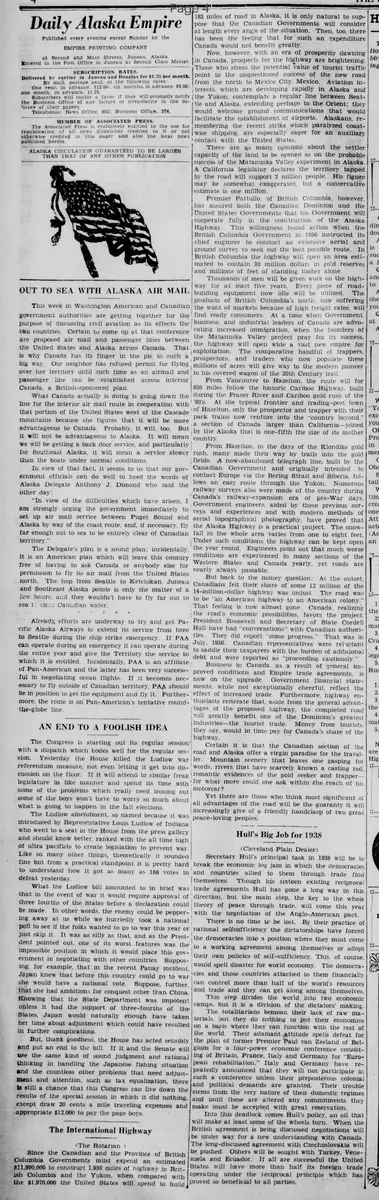
Since the Canadian and the Province of British Columbia Governments must expend an estimated $11,990,000 to construct 1,930 miles of highway in British Columbia and the Yukon, when compared with the $1,970,000 the United States will spend to build 183 miles of road in Alaska, it is only natural to suppose that the Canadian Governments will consider at length every angle of the situation. Then, too, there has been the feeling that for such an expenditure Canada would not benefit greatly.
Now, however, with an era of prosperity dawning in Canada, prospects for the highway are brightening. Those who stress the potential value of tourist traffic point to the unquestioned success of the new road from the north to Mexico City, Mexico. Aviation interests, which are developing rapidly in Alaska and the Yukon, contemplate a regular line between Seattle and Alaska, extending perhaps to the Orient; they would welcome ground communications that would facilitate the establishment of airports. Alaskans, remembering the recent strike which paralyzed coastwise shipping, are especially eager for an auxiliary contact with the United States.
There are as many opinions about the settler capacity of the land to be opened as on the probable success of the Matanuska Valley experiment in Alaska. A California legislator declares the territory tapped by the road will support 3 million people. His figure may be somewhat exaggerated, but a conservative estimate is one million.
Premier Pattullo of British Columbia, however, has assured both the Canadian Dominion and the United States Governments that his Government will cooperate fully in the construction of the Alaska Highway. This willingness found action when the British Columbia Government in 1936 instructed its chief engineer to conduct an extensive aerial and ground survey to seek out the best possible route. In British Columbia the highway will open an area estimated to contain 30 million dollars in gold reserves and millions of feet of standing timber alone.
Thousands of men will be given work on the highway for at least five years. Every piece of road-building equipment now idle will be utilized. The products of British Columbia's north, now suffering the want of markets because of high freight rates, will find ready consumers. At a time when Government business and industrial leaders of Canada are advocating increased immigration, when the founders of the Matanuska Valley project pray for its success, the highway will open wide a vast new empire for exploitation. The comparative handful of trappers, prospectors, and traders who now populate these millions of acres will give way to the modern pioneer in his covered wagon of the 20th Century trail.
From Vancouver to Hazelton, the route will for 830 miles follow the historic Cariboo Highway, built during the Fraser River and Cariboo gold rush of the '80s. At the typical frontier and trading-post town of Hazelton, only the prospector and trapper with their pack trains now venture into the "country beyond," a section of Canada larger than California—joined by the Alaska that is one-fifth the size of its mother country.
From Hazelton, in the days of the Klondike gold rush, many made their way by trails into the gold fields. A now-abandoned telegraph line, built by the Canadian Government and originally intended to contact Europe via the Bering Strait and Siberia, follows an easy route through the Yukon. Numerous railway surveys also were made of the country during Canada's railway-expansion era of pre-War days.
Government engineers, aided by these previous surveys and experiences and with modern methods of aerial topographical photography, have proved that the Alaska Highway is a practical project. The snowfall in the whole area varies from one to eight feet. Under such conditions the highway can be kept open the year round. Engineers point out that much worse conditions are experienced in many sections of the Western States and Canada yearly, yet roads are nearly always passable.
But back to the money question: At the outset Canadians felt their share of some 12 million of the 14-million-dollar highway was unjust. The road was to be "an American highway to an American colony." That feeling is now almost gone. Canada, realizing the road's economic possibilities, favors the project. President Roosevelt and Secretary of State Cordell Hull have had "conversations" with Canadian authorities. They did report "some progress." That was in July, 1936. Canadian representatives were reluctant to saddle their taxpayers with the burden of additional debt and were reported as "proceeding cautiously."
Business in Canada, as a result of general improved conditions and Empire trade agreements, is now on the upgrade. Government financial statements, while not exceptionally cheerful, reflect the effect of increased trade. Furthermore, highway enthusiasts reiterate that, aside from the general advantages of the proposed highway, the completed road will greatly benefit one of the Dominion's greatest industries—the tourist trade. Money from tourists, they say, would in time pay for Canada's share of the highway.
Certain it is that the Canadian section of the road and Alaska offer a virgin paradise for the traveler. Mountain scenery that leaves one gasping for words, rivers that have scarcely known a casting rod, romantic evidences of the gold seeker and trapper—for what more could one ask within the reach of his motorcar?
Yet there are those who think most significant of all advantages of the road will be the guaranty it will increasingly give of a friendly handclasp of two great peace-loving peoples.
(The Rotarian)
Since the Canadian and the Province of British Columbia Governments must expend an estimated $11,990,000 to construct 1,930 miles of highway in British Columbia and the Yukon, when compared with the $1,970,000 the United States will spend to build 183 miles of road in Alaska, it is only natural to suppose that the Canadian Governments will consider at length every angle of the situation. Then, too, there has been the feeling that for such an expenditure Canada would not benefit greatly.
Now, however, with an era of prosperity dawning in Canada, prospects for the highway are brightening. Those who stress the potential value of tourist traffic point to the unquestioned success of the new road from the north to Mexico City, Mexico. Aviation interests, which are developing rapidly in Alaska and the Yukon, contemplate a regular line between Seattle and Alaska, extending perhaps to the Orient; they would welcome ground communications that would facilitate the establishment of airports. Alaskans, remembering the recent strike which paralyzed coastwise shipping, are especially eager for an auxiliary contact with the United States.
There are as many opinions about the settler capacity of the land to be opened as on the probable success of the Matanuska Valley experiment in Alaska. A California legislator declares the territory tapped by the road will support 3 million people. His figure may be somewhat exaggerated, but a conservative estimate is one million.
Premier Pattullo of British Columbia, however, has assured both the Canadian Dominion and the United States Governments that his Government will cooperate fully in the construction of the Alaska Highway. This willingness found action when the British Columbia Government in 1936 instructed its chief engineer to conduct an extensive aerial and ground survey to seek out the best possible route. In British Columbia the highway will open an area estimated to contain 30 million dollars in gold reserves and millions of feet of standing timber alone.
Thousands of men will be given work on the highway for at least five years. Every piece of road-building equipment now idle will be utilized. The products of British Columbia's north, now suffering the want of markets because of high freight rates, will find ready consumers. At a time when Government business and industrial leaders of Canada are advocating increased immigration, when the founders of the Matanuska Valley project pray for its success, the highway will open wide a vast new empire for exploitation. The comparative handful of trappers, prospectors, and traders who now populate these millions of acres will give way to the modern pioneer in his covered wagon of the 20th Century trail.
From Vancouver to Hazelton, the route will for 830 miles follow the historic Cariboo Highway, built during the Fraser River and Cariboo gold rush of the '80s. At the typical frontier and trading-post town of Hazelton, only the prospector and trapper with their pack trains now venture into the "country beyond," a section of Canada larger than California—joined by the Alaska that is one-fifth the size of its mother country.
From Hazelton, in the days of the Klondike gold rush, many made their way by trails into the gold fields. A now-abandoned telegraph line, built by the Canadian Government and originally intended to contact Europe via the Bering Strait and Siberia, follows an easy route through the Yukon. Numerous railway surveys also were made of the country during Canada's railway-expansion era of pre-War days.
Government engineers, aided by these previous surveys and experiences and with modern methods of aerial topographical photography, have proved that the Alaska Highway is a practical project. The snowfall in the whole area varies from one to eight feet. Under such conditions the highway can be kept open the year round. Engineers point out that much worse conditions are experienced in many sections of the Western States and Canada yearly, yet roads are nearly always passable.
But back to the money question: At the outset Canadians felt their share of some 12 million of the 14-million-dollar highway was unjust. The road was to be "an American highway to an American colony." That feeling is now almost gone. Canada, realizing the road's economic possibilities, favors the project. President Roosevelt and Secretary of State Cordell Hull have had "conversations" with Canadian authorities. They did report "some progress." That was in July, 1936. Canadian representatives were reluctant to saddle their taxpayers with the burden of additional debt and were reported as "proceeding cautiously."
Business in Canada, as a result of general improved conditions and Empire trade agreements, is now on the upgrade. Government financial statements, while not exceptionally cheerful, reflect the effect of increased trade. Furthermore, highway enthusiasts reiterate that, aside from the general advantages of the proposed highway, the completed road will greatly benefit one of the Dominion's greatest industries—the tourist trade. Money from tourists, they say, would in time pay for Canada's share of the highway.
Certain it is that the Canadian section of the road and Alaska offer a virgin paradise for the traveler. Mountain scenery that leaves one gasping for words, rivers that have scarcely known a casting rod, romantic evidences of the gold seeker and trapper—for what more could one ask within the reach of his motorcar?
Yet there are those who think most significant of all advantages of the road will be the guaranty it will increasingly give of a friendly handclasp of two great peace-loving peoples.
What sub-type of article is it?
Historical Event
Journey
What themes does it cover?
Exploration
Triumph
What keywords are associated?
Alaska Highway
Highway Construction
Tourist Traffic
Gold Reserves
Timber
Immigration
Economic Development
What entities or persons were involved?
Premier Pattullo
President Roosevelt
Secretary Of State Cordell Hull
Where did it happen?
British Columbia, Yukon, Alaska
Story Details
Key Persons
Premier Pattullo
President Roosevelt
Secretary Of State Cordell Hull
Location
British Columbia, Yukon, Alaska
Event Date
1936
Story Details
The article discusses the planning and benefits of constructing the Alaska Highway, connecting the US to Alaska via Canada, highlighting economic advantages, tourism potential, resource exploitation, and historical context from gold rushes.