Thank you for visiting SNEWPapers!
Sign up free
Editorial
April 21, 1916
The Caldwell Tribune
Caldwell, Canyon County, Idaho
What is this article about?
This editorial mocks Theodore Roosevelt's belief that he could win a Republican presidential nomination, citing his past failures, the decline of his Progressive party, and the damage from his 1912 bolt that aided Democrats. It suggests a credible withdrawal via Progressives could rehabilitate his standing.
Clipping
OCR Quality
98%
Excellent
Full Text
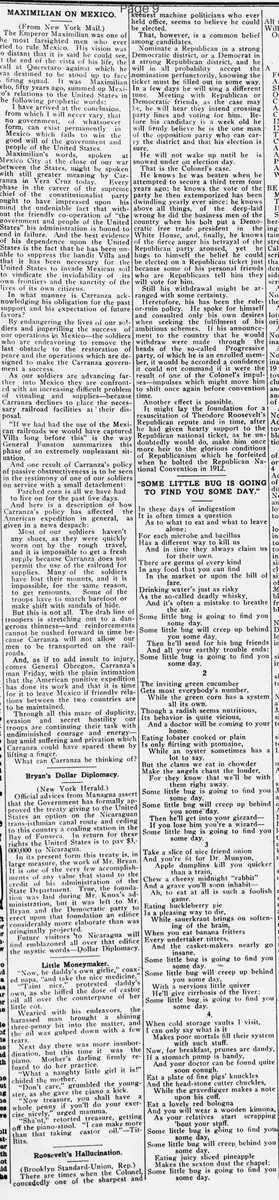
Roosevelt's Hallucination.
(Brooklyn Standard-Union, Rep.)
There are times when the Colonel, concededly one of the sharpest and keenest machine politicians who ever held office, seems to believe he could be elected.
That, however, is a common belief among candidates.
Nominate a Republican in a strong Democratic district, or a Democrat in a strong Republican district, and he will in all probability accept the nomination perfunctorily, knowing the ticket must be filled out in some way.
In a few days he will sing a different tune.
Meeting with Republican or Democratic friends, as the case may be, he will hear they intend crossing party lines and voting for him. Before his candidacy is a week old he will firmly believe he is the one man of the opposition party who can carry the district and that his election is sure.
He will not wake up until he is snowed under on election day.
That is the Colonel's case.
He knows he was beaten when he attempted to secure a third term four years ago; he knows the vote of the party he then extemporized has been dwindling yearly ever since; he knows above all things of the deep-laid wrong he did the business men of the country when his bolt put a Democratic free trade president in the White House, and, finally, he knows of the fierce anger his betrayal of the Republican party aroused, yet he hugs to himself the belief he could be elected on a Republican ticket just because some of his personal friends who are Republicans tell him they will vote for him.
Still his withdrawal might be arranged with some certainty.
Heretofore, his has been the rule-or-ruin policy. He spoke for himself and consulted only his own desires when seeking the fulfilment of his ambitious schemes. If his announcement to the country that he would withdraw were made through the heads of the so-called Progressive party, of which he is an enrolled member, it would be accorded a confidence it could not command if it were the result of one of the Colonel's impulses—impulses which might move him to shift once again before convention time.
Another effect is possible.
It might lay the foundation for a resuscitation of Theodore Roosevelt's Republican repute and in time, after he had given hearty support to the Republican national ticket, as he undoubtedly would do, make him once more heir to the glorious conditions of Republicanism which he forfeited when he bolted the Republican National Convention in 1912.
(Brooklyn Standard-Union, Rep.)
There are times when the Colonel, concededly one of the sharpest and keenest machine politicians who ever held office, seems to believe he could be elected.
That, however, is a common belief among candidates.
Nominate a Republican in a strong Democratic district, or a Democrat in a strong Republican district, and he will in all probability accept the nomination perfunctorily, knowing the ticket must be filled out in some way.
In a few days he will sing a different tune.
Meeting with Republican or Democratic friends, as the case may be, he will hear they intend crossing party lines and voting for him. Before his candidacy is a week old he will firmly believe he is the one man of the opposition party who can carry the district and that his election is sure.
He will not wake up until he is snowed under on election day.
That is the Colonel's case.
He knows he was beaten when he attempted to secure a third term four years ago; he knows the vote of the party he then extemporized has been dwindling yearly ever since; he knows above all things of the deep-laid wrong he did the business men of the country when his bolt put a Democratic free trade president in the White House, and, finally, he knows of the fierce anger his betrayal of the Republican party aroused, yet he hugs to himself the belief he could be elected on a Republican ticket just because some of his personal friends who are Republicans tell him they will vote for him.
Still his withdrawal might be arranged with some certainty.
Heretofore, his has been the rule-or-ruin policy. He spoke for himself and consulted only his own desires when seeking the fulfilment of his ambitious schemes. If his announcement to the country that he would withdraw were made through the heads of the so-called Progressive party, of which he is an enrolled member, it would be accorded a confidence it could not command if it were the result of one of the Colonel's impulses—impulses which might move him to shift once again before convention time.
Another effect is possible.
It might lay the foundation for a resuscitation of Theodore Roosevelt's Republican repute and in time, after he had given hearty support to the Republican national ticket, as he undoubtedly would do, make him once more heir to the glorious conditions of Republicanism which he forfeited when he bolted the Republican National Convention in 1912.
What sub-type of article is it?
Partisan Politics
What keywords are associated?
Roosevelt
Election
Republican
Progressive
Candidacy
Bolt
Withdrawal
Party Betrayal
What entities or persons were involved?
Theodore Roosevelt
Republican Party
Progressive Party
Democratic Free Trade President
Editorial Details
Primary Topic
Theodore Roosevelt's Misguided Belief In His Electability As A Republican Candidate
Stance / Tone
Critical And Mocking Of Roosevelt's Political Ambitions
Key Figures
Theodore Roosevelt
Republican Party
Progressive Party
Democratic Free Trade President
Key Arguments
Roosevelt Believes He Could Be Elected Despite Past Defeats
His Third Term Attempt Four Years Ago Failed
The Progressive Party's Vote Has Dwindled Yearly
His Bolt From Republicans Enabled A Democratic Free Trade President
His Betrayal Aroused Fierce Anger In The Republican Party
Personal Friends' Support Fuels His Delusion
Withdrawal Should Be Announced Through Progressive Party Leaders For Credibility
Such Withdrawal Could Restore His Republican Reputation Over Time