Thank you for visiting SNEWPapers!
Sign up free
Alexandria Gazette
Alexandria, Alexandria County, District Of Columbia
What is this article about?
In the U.S. House, Mr. Biddle of Pennsylvania criticizes the rushed $1 million appropriation for the Seminole War, defends General Scott's recall as unjust, and highlights mismanagement leading to wasted resources and lives in Florida.
Clipping
OCR Quality
Full Text
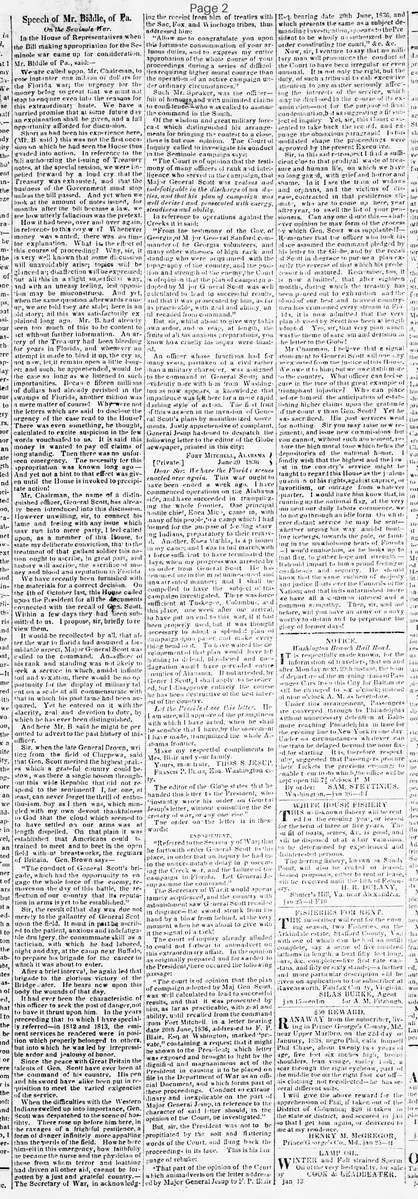
On the Seminole War.
In the House of Representatives when the Bill making appropriation for the Seminole war came up for consideration, Mr. Biddle of Pa., said:—
We are called upon, Mr. Chairman, to vote instanter one million of dollars for the Florida war; the urgency for the money being so great that we must not stop to enquire even into the reasons for this extraordinary haste. We have a hurried promise that at some future day an explanation shall be given, and a full opportunity afforded for discussion. Short as had been his experience here, (Mr. B said.) this was not the first occasion on which he had seen the House thus goaded into action. In reference to the bill authorizing the issuing of Treasury notes, at the special session, we were impelled forward by a loud cry that the Treasury was exhausted, and that the business of the Government must stop unless the bill passed. And yet when we took at the amount of notes issued, for months after the bill became a law, we see how utterly fallacious was the pretext. How it had been, over and over again, in reference to this very war? Whenever money was wanted, there was no time for explanation. What is the effect of this course of proceeding? Why, sir, it is very well known that some discussion will unavoidably arise; topics will be glanced at; disaffection will be expressed: but all this in a slight superficial way, and with an uneasy feeling, lest opposition may be misconstrued. And yet, when the same question afterwards came up, we are told they are stale; here is an old story; all this was satisfactorily explained long ago. Mr. B. had already seen too much of this to be content to act without further information. An artery of the Treasury had been bleeding for years in Florida, and whenever an attempt is made to bind it up, the cry is, not now. let it remain open a little longer: and such, he apprehended, would be the case so long as we listened to such importunities. Because fifteen millions of dollars had already perished in the swamps of Florida, another million was a mere matter of course! Why were not the letters which are said to disclose the urgency of the case read to the House? There was even something, he thought, calculated to excite suspicion in the few words vouchsafed to us. It is said this money is wanted to pay off claims of long standing. Then there was no unforeseen emergency. The necessity for this appropriation was known long ago— And yet not a hint to that effect was given until the House is invoked to precipitate action!
Mr. Chairman, the name of a distinguished officer, General Scott, has already been introduced into this discussion. However unwilling, sir, to connect his fame and feeling with any issue which may run into mere party, I feel called upon, as a member of this House, to state my deliberate conviction, that to the treatment of that gallant soldier this nation ought to ascribe, in great part, and history will ascribe, the sacrifice of money and blood and reputation in Florida We have recently been furnished with the materials for a correct decision. On the 4th of October last, this House called upon the President for all the documents connected with the recall of Gen. Scott Within a few days they had been submitted to us. I propose, sir, briefly to review them.
It would be recollected by all, that after the war in Florida had assumed a formidable aspect, Major General Scott was called to the command. An officer of his rank and standing was not likely to seek a service in which, amidst infinite toil and vexation, there would be no opportunity for the display of military talent on a scale at all commensurate with that in which his past fame had been acquired. Yet he entered on it with the alacrity, zeal and devotion to duty, by which he has ever been distinguished. And here Mr. B said he might be permitted to advert to the past history of this officer.
Sir, when the late General Brown, writing from the field of Chippewa, said that Gen. Scott merited the highest praises which a grateful country could bestow, was there a single bosom throughout this wide Republic that did not respond to the sentiment? I, for one, at least, can never forget the thrill of enthusiasm, boy as I then was, which mingled with my own devout thankfulness to God that the cloud which seemed to have settled on our arms was at length dispelled. On that plain it was established that Americans could be trained to meet and to beat in the open field without breastworks, the regulars of Britain. Gen. Brown says—
"The conduct of General Scott's brigade, which had the opportunity to engage the whole force of the enemy, removes on the day of this battle, the reproach of our country that its reputation in arms is yet to be established."
Sir, the result of that day was due not merely to the gallantry of General Scott upon the field. It must in part be ascribed to the patient, anxious and indefatigable drudgery, the consummate skill as a tactician, with which he had labored, night and day, at the camp near Buffalo, to prepare his brigade for the career in which it was about to enter.
After a brief interval, he again led that brigade to the glorious victory of the Bridge water. He bears now upon this body the wounds of that day.
It had ever been the characteristic of this officer to seek the post of danger, not to have it thrust upon him. In the years preceding that to which I have specially referred—in 1812 and 1813, the eminent services he rendered were in positions which properly belonged to others, but into which he was led by irrepressible ardor and jealousy of honor.
Since the peace with Great Britain the talents of Gen. Scott have ever been at the command of his country. His pen and his sword have alike been put in requisition to meet the varied exigencies of the service.
When the difficulties with the Western Indians swelled up into importance, Gen. Scott was despatched to the scene of hostility. There rose up before him here, in the ravages of a frightful pestilence, a form of danger infinitely more appalling than the perils of the field. How he bore himself in this emergency, how faithfully he became the nurse and the physician of those from whom terror and loathing had driven all other aid, cannot be forgotten by a just and grateful country.— The Secretary of War, in acknowledging the receipt from him of treaties with the Sac, Fox, and Winnebago tribes, thus addressed him:
"Allow me to congratulate you upon this fortunate consummation of your arduous duties, and to express my entire approbation of the whole course of your proceedings during a series of difficulties requiring higher moral courage than the operation of an active campaign under ordinary circumstances."
Such Mr. Speaker, was the officer—full of honors, and with unlimited claims to confidence—who was called to assume the command in the South.
Of the wisdom and great military forecast which distinguished his arrangements for bringing the contest to a close, there is but one opinion. The Court of Inquiry called to investigate his conduct in the Seminole campaign says:
"The Court is of opinion that the testimony of many officers of rank and intelligence who served in the campaign, that Major General Scott was zealous and indefatigable in the discharge of his duties, and that his plan of campaign was well devised and prosecuted with energy steadiness and ability."
In reference to operations against the Creeks it is said:
"From the testimony of the Gov. of Georgia, of Major General Sanford, commander of the Georgia volunteers, and many other witnesses of high rank and standing who were acquainted with the topography of the country, and the position and strength of the enemy, the Court is of opinion that the plan of campaign adopted by Major General Scott was well calculated to lead to successful results, and that it was prosecuted by him, as far as practicable, with zeal and ability until recalled from command."
But, sir, whilst about to give way to his own ardor, and to reap, at length, the fruits of all his anxious preparations, you know how cruelly his hopes were blasted.
An officer whose functions had for many years, partaken of a civil rather than a military character, was assigned to the command of General Scott; and evidently more with him from Washington as now appears, a knowledge that impatience was felt here for a more rapid dashing style of action. The first fruit of this was seen in the invasion of General Scott's plans by unauthorized movements. Justly apprehensive of complaint, General Jesup hastened to despatch the following letter to the editor of the Globe newspaper, printed in this city:
FORT MITCHELL, ALABAMA
[Private.]
June 20 1836
Dear Sir: We have the Florida scenes enacted over again. This war ought to have been ended a week ago. I have commenced operations on the Alabama side, and have succeeded in tranquilizing the whole frontier. One principal hostile chief, Eneah Micco, came in, with many of his people, to a camp which I had formed for the purpose of swelling starving Indians, preparatory to their removal. Another, Eneah Vahlha, is a prisoner in my camp; and I was in full march, with force sufficient to have terminated the war, when my progress was arrested by an order from General Scott. He has censured me in the most unmeasured and unwarranted manner; and I shall be compelled to have the subject of this campaign investigated. There was force sufficient at Tuskegee, Columbus, and this place, one week after our arrival, to have put an end to this war, if it had been properly used, but it was thought necessary to adopt a splendid plan of campaign upon paper, and make every thing bend to it. To have waited the development of that plan would have left nothing to defend, bloodshed and conflagration would have pervaded entire counties of Alabama. If not arrested, by General Scott, I shall apply to be relieved, for I disapprove entirely the course he has been destructive of the best interests of the country.
Let the President see this letter, I am sure, he will approve of the promptness with which I have acted, when he shall be sensible that I have, by the movements these made, tranquilized the whole Alabama frontier.
Make my respectful compliments to Mrs. Blair and your family.
Yours, most truly, THOS S. JESUP
Francis P. Blair, Esq. Washington city.
The editor of the Globe states that he handed this letter to the President, who "instantly wrote his order on General Jesup's letter, without consulting the Secretary of war, or any one else." The order on the letter is in these words:
ENDORSEMENT.
"Referred to the Secretary of War: that he forthwith order General Scott to this place, in order that an inquiry be had into the unaccountable delay in prosecuting the Creek war, and the failure of the campaign in Florida. Let General Jesup assume the command."
The Secretary of War, it would appear tamely acquiesced, and the country with astonishment saw General Scott recalled in disgrace—the sword struck from his hand by a blow from behind, at the very moment when he was about to give with it the signal of attack!
The court of inquiry already alluded to could not forbear to animadvert on this extraordinary affair. In the opinion as originally prepared and forwarded to the President, there occurred the following passage:
"The court is of opinion that the plan of campaign adopted by Maj Gen Scott, was well calculated to lead to successful results, and that it was prosecuted by him, as far as practicable, with zeal and ability, until recalled from the command from Fort Mitchell, in a letter bearing date 20th June, 1836, addressed to F. P. Blair, Esq. at Washington, marked "private," containing a request that it might be shown to the President; which letter was exposed and brought to light by the dignified and magnanimous act of the President in causing it to be placed on file in the Department of War as an official Document, and which forms part of these proceedings. Conduct so extraordinary and inexplicable on the part of Major General Jesup, in reference to the character of said letter should, in the opinion of the Court, be investigated."
But, sir, the President was not to be propitiated by the soft and flattering words of the Court, and flung back the proceedings in its face. This is his language of rebuke:
"That part of the opinion of the Court which animadverts on the letter addressed by Major General Jesup to F. P. Blair Esq. bearing date 20th June, 1836, and which presents the same as a subject demanding investigation, appears to the President to be wholly unauthorized by the order constituting the court." &c. &c.
Now, sir, I venture to say that no military man will pronounce the conduct of the Court to have been irregular or even unusual. It is not only the right, but the duty, of such a tribunal to call executive attention to any matter seriously affecting the interests of the service, which may be disclosed in the course of its examination—not for the purpose of final condemnation, but as suggesting a fit subject of inquiry Yet, sir, this Court consented to take back the record, and expunge the obnoxious paragraph! In this mutilated shape the proceedings were approved by the present Executive.
Sir, in this sad retrospect I find a sufficient clue to that prodigal waste of treasure and human life, on which we have so long gazed, with grief and horror and shame. In it I see the train of widows and orphans, and the victims of disease, contracted in that pestiferous climate, who are to come up here, year after year, to swell the list of your pensioners. Can any one doubt this—whatever opinion he may form of the process by which Gen. Scott was supplanted?— Remember that the officer who took his place assumed the command pledged by his letter to the Globe, and by the recall of Scott in disgrace to pursue a plan exactly the reverse of that which his predecessor had matured. Remember, too, it is now admitted, that after eighteen months, during which the treasury has been poured out to exhaustion, and the blood of our best and bravest countrymen has crimsoned every stream in Florida, it is now admitted that the very plan devised by Scott has been at length adopted Yes, sir, that very plan which was the theme of sareasm and derision in the letter to the Globe!
Mr Chairman, I believe that a signal atonement to General Scott will one day be extorted from the justice of this House. We owe it to him; but we owe it still more to the country. What officer can feel secure in the face of that great example of triumphant injustice? Who can place before himself the anticipation of establishing higher claims upon the gratitude of the country than Gen. Scott? Yet he was sacrificed. His past services went for nothing. Sir you may raise new regiments, and issue new commissions but you cannot, without such atonement, restore the high moral tone which befits the depositories of the national honor. I fondly wish that the highest and the lowest in the country's service might be taught to regard this House as the jealous guardian of his rights, against caprice, or favoritism, or outrage from whatever quarter. I would have him know that, in running up the national flag, at the very moment our daily labors commence, we do not go through an idle form On whatever distant service be may be sent— whether urging his way amidst tumbling icebergs, towards the pole, or fainting in the unwholesome heats of Florida —I would enable him, as he looks up to that flag, to gather hope and strength— It should impart to him a proud feeling of confidence and security. He should know that the same emblem of majesty and justice floats over the councils of the Nation; and that in its untarnished lustre we have all a common interest and a common sympathy. Then, sir, and not before, will you have an army or a navy worthy to sustain and to perpetuate the glory of former days!
What sub-type of article is it?
What keywords are associated?
What entities or persons were involved?
Where did it happen?
Domestic News Details
Primary Location
House Of Representatives
Event Date
After 4th Of October
Key Persons
Outcome
prodigal waste of treasure and human life; fifteen millions of dollars perished; blood of countrymen crimsoned streams in florida; train of widows and orphans; victims of disease
Event Details
Mr. Biddle delivers a speech criticizing the rushed appropriation of one million dollars for the Seminole War, questioning the haste and lack of explanation, defending General Scott's command and plan which was undermined leading to his recall, and calling for atonement to Scott for the mismanagement and waste in the Florida campaign.