Thank you for visiting SNEWPapers!
Sign up free
The Virginia Gazette
Richmond, Williamsburg, Richmond County, Virginia
What is this article about?
A letter to the London Daily-Post warns against encouraging increased importation of bar-iron from American colonies, arguing it would foster colonial manufacturing independence, reducing British exports of iron and other goods, and harming England's economy and trade interests.
Merged-components note: These two components form a single continuous letter to the editor from PHILOBRITANNIE on American iron trade, with sequential reading orders and direct text continuation. The original label of the second component was 'editorial', but it is part of the letter, so relabeled to 'letter_to_editor'.
Clippings
1 of 2
OCR Quality
Full Text
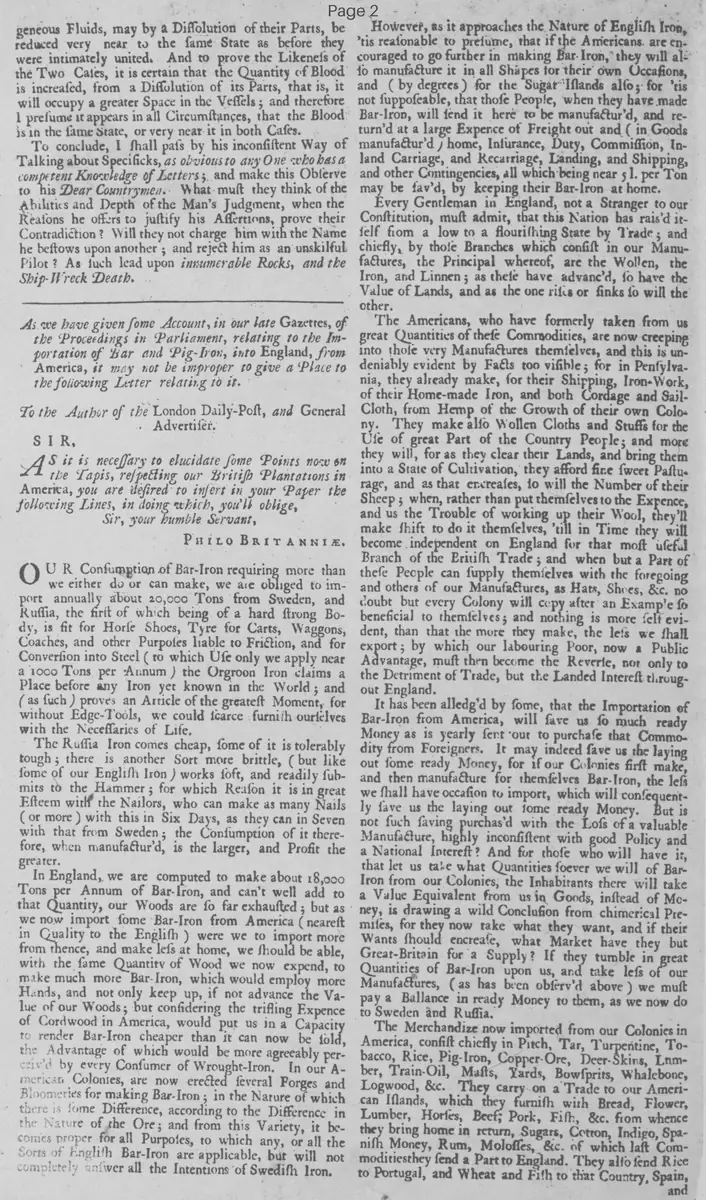
To the Author of the London Daily-Post, and General Advertiser.
SIR,
S it is necessary to elucidate some Points now on the Tapis, respecting our British Plantations in America, you are desired to insert in your Paper the following Lines, in doing which, you'l oblige,
Sir, your humble Servant,
PHILOBRITANNIE.
Our Consumption of Bar-Iron requiring more than we either do or can make, we are obliged to import annually about 20,000 Tons from Sweden, and Russia, the first of which being of a hard strong Body, is fit for Horse Shoes, Tyre for Carts, Waggons, Coaches, and other Purposes liable to Friction, and for Conversion into Steel ( to which Use only we apply near a 1000 Tons per Annum ) the Orgroon Iron claims a Place before any Iron yet known in the World; and ( as such ) proves an Article of the greatest Moment, for without Edge-Tools, we could scarce furnish ourselves with the Necessaries of Life.
The Russia Iron comes cheap, some of it is tolerably tough; there is another Sort more brittle, (but like some of our English Iron ) works oft, and readily submits to the Hammer ; for which Reason it is in great Esteem with the Nailors, who can make as many Nails ( or more) with this in Six Days, as they can in Seven with that from Sweden : the Consumption of it therefore, when manufactur'd, is the larger, and Profit the greater.
In England, we are computed to make about 18,000 Tons per Annum of Bar-Iron, and can't well add to that Quantity, our Woods are so far exhausted; but as we now import some Bar-Iron from America (nearest in Quality to the English ) were we to import more from thence, and make less at home, we should be able, with the same Quantity of Wood we now expend, to make much more Bar-Iron, which would employ more Hands, and not only keep up, if not advance the Value of our Woods; but considering the trifling Expence of Cordwood in America, would put us in a Capacity to render Bar-Iron cheaper than it can now be sold, the Advantage of which would be more agreeably perceived by every Consumer of Wrought-Iron. In our American Colonies, are now erected several Forges and Bloomeries for making Bar-Iron ; in the Nature of which there is some Difference, according to the Difference in the Nature of the Ore; and from this Variety, it becomes proper for all Purposes, to which any, or all the Sorts of English Bar-Iron are applicable, but will not completely answer all the Intentions of Swedish Iron.
However, as it approaches the Nature of English Iron. 'tis reasonable to presume, that if the Americans. are encouraged to go further in making Bar- Iron, "they will al- so manufacture it in all Shapes for their own Occasions, and ( by degrees) for the Sugar-Islands also; for 'tis not supposable, that those People, when they have made Bar-Iron, will send it here to be manufactur'd, and re- turn'd at a large Expence of Freight out and ( in Goods manufactur'd home, Insurance, Duty, Commission,In- land Carriage, and Recarriage, Landing, and Shipping, and other Contingencies, all which being near 5 l. per Ton may be sav'd, by keeping their Bar-Iron at home.
Every Gentleman in England, not a Stranger to our Constitution, must admit, that this Nation has rais'd it- self from a low to a flourishing State by Trade; and chiefly, by those Branches which consist in our Manu- factures, the Principal whereof, are the Woollen, the Iron, and Linnen; as these have advanc'd, so have the Value of Lands, and as the one rises or sinks so will the other.
The Americans, who have formerly taken from us great Quantities of these Commodities, are now creeping into those very Manufactures themselves, and this is un- deniably evident by Facts too visible; for in Pensylva- nia, they already make, for their Shipping, Iron-Work, of their Home-made Iron, and both Cordage and Sail- Cloth, from Hemp of the Growth of their own Colo- ny. They make also Woollen Cloths and Stuffs for the Use of great Part of the Country People; and more they will, for as they clear their Lands, and bring them into a State of Cultivation, they afford fine sweet Pastu- rage, and as that increases, so will the Number of their Sheep ; when, rather than put themselves to the Expence, and us the Trouble of working up their Wool, they'll make Shift to do it themselves, 'till in Time they will become .independent on England for that most useful Branch of the British Trade ; and when but a Part of these People can supply themselves with the foregoing and others of ourManufactures, as Hats, Shoes, &c. no doubt but every Colony will copy after an Example so beneficial to themselves; and nothing is more self evi- dent, than that the more they make, the less we shall export; by which our Labouring Poor, now a Public Advantage, must then become the Reverse, not only to the Detriment of Trade, but the Landed Interest throug- hout England.
It has been alledg'd by some, that the Importation of Bar-Iron from America, will save us so much ready Money as is yearly sent out to purchase that Commo- dity from Foreigners. It may indeed save us the laying out some ready Money, for if our Colonies first make, and then manufacture for themselves Bar-Iron, the less we shall have occasion to import, which will consequent- ly save us the laying out some ready Money. But is not such saving purchas'd with the Loss ofa valuable ManufaCture, highly inconsistent with good Policy and a National Interest? And for those who will have it, that let us take what Quantities soever we will of Bar- Iron from our Colonies, the Inhabitants there will take a Value Equivalent from us in Goods, instead of Mo- ney, is drawing a wild Conclusion from chimerical Pre- mises, for they now take what they want, and if their Wants should increase, what Market have they but Great-Britain for a Supply? If they tumble in great Quantities of Bar-Iron upon us, and take less of our Manufactures, (as has been observ'd above )we must pay a Ballance in ready Money to them, as we now do to Sweden and Russia.
The Merchandize now imported from our Colonies in America, consist chiefly in Pitch, Tar, Turpentine, To- bacco, Rice, Pig-Iron, Copper-Ore, Deer-Skins, Lum- ber, Train-Oil, Masts, Yards, Bowsprits, Whalebone, Logwood, &c. They carry on a Trade to our Ameri- can Islands, which they furnish with Bread, Flower, Lumber, Horses, Beef; Pork, Fish, &c. from whence they bring home in return, Sugars, Cotton, Indigo, Spa- nish Money, Rum, Molasses. &c. of which last Com- modities they send a Part to England. They also send Rice to Portugal, and Wheat and Fish to that Country. Spain,
and Italy. As the Markets give Encouragement, and if their Exports for Pig-Iron (exclusive of Bar) are enlarged, they will have Effects, in all Probability, sufficient to purchase more than all the Merchandize they'll want from Great-Britain. If not, they may go upon Hemp as an additional Article, which grows well in several Parts of that Country (where the Land is worth next to nothing) and a large Bounty being allow'd on it here, it might therefore be cultivated to good Advantage to the Planter, and exported to us, would not interfere with our Domestick Manufactures; the Palatines have made a pretty good Progress (their Infant Days consider'd) in this Commodity, and the English having good Lands, much nearer to Navigation; might be better; but neglecting this Article, of which we are told several Hundred Tons are annually sent from England to our Colonies; it plainly indicates, that the Americans stand in need of no additional Branch of Trade to purchase Commodities from us.
We have been prompted in a late Sort of an Essay on the American Trade, to get Encouragement for importing Bar-Iron from the Plantations, as a Means to lessen the Imports from our Northern Neighbours, and yet told by the same Author, that our Plantation Iron can never be made and imported cheap enough to prejudice our home-made Iron; how then can it keep our Iron from the Baltick, which for the most Part is cheaper than the English? There is much more like Reasoning in the same Paper, which is referr'd to the Judgment of those, who (if to be found) can comprehend such Logick.
That our Subjects in the American Colonies are Children of the State, and to be treated as such, no one denies; but it can't reasonably be admitted, that the Mother should impoverish herself to enrich her Children, nor that Great-Britain should weaken herself to strengthen America, lest such a Procedure should, in Time, furnish us with a Subject for a melancholy Reflection.
What sub-type of article is it?
What themes does it cover?
What keywords are associated?
What entities or persons were involved?
Letter to Editor Details
Author
Philobritannie
Recipient
The Author Of The London Daily Post, And General Advertiser
Main Argument
increasing imports of bar-iron from american colonies would encourage them to develop their own manufacturing industries, leading to reduced demand for british goods, loss of trade balance, and eventual economic independence that harms england's interests.
Notable Details