Thank you for visiting SNEWPapers!
Sign up free
Gazette Of The United States, & Philadelphia Daily Advertiser
Philadelphia, Philadelphia County, Pennsylvania
What is this article about?
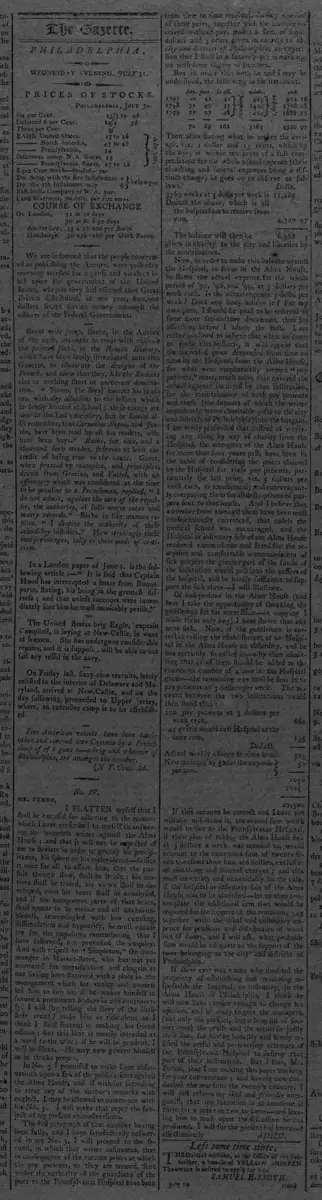
In this installment (No. IV) of a series, the anonymous writer addresses Mr. Fenno, defending Philadelphia's Alms House against critics. He refutes claims of charity from the Pennsylvania Hospital, provides cost calculations showing high expenses for outsourcing sick paupers, and advocates for an internal infirmary to manage funds efficiently.
Merged-components note: The table presents numerical data (patient weeks and costs) directly referenced and embedded within the letter to the editor discussing Alms House finances; merging as a single logical unit.
Clipping
OCR Quality
Full Text
MR. FENNO,
I FLATTER myself that I shall be excused for adhering to the manner which I have prescribed to myself in answering the nameless writer against the Alms House; and that it will not be expected of me to deviate in order to gratify his precipitance, his spleen or his malevolence suffice it once for all to assure him, that the pursuit though slow, shall be steady: his motives shall be traced, his views shall be developed, even his heart shall be analysed, and if the component parts of that heart, shall appear to be malice and all uncharitableness, intermingled with low cunning, dissimulation and hypocrisy, he must excuse me for the exposure, remembering that I have followed, not provoked the enquiry.
And with respect to "Simpleton," the iron-monger in Market-street, who has not yet recovered his mortification and chagrin at not having been flattered with a place in the management which his vanity and conceit led him to aim at, if he makes himself in future a prominent feature in this controversy, I will (by telling the story of the little port trunk) make him as ridiculous as I think I shall succeed in making his friend odious; but this hint is merely intended as a word to the wise: if he will be prudent, I will be silent. He may now govern himself as he thinks proper.
In No. 3 I promised to make some observations upon a few of the publications against the Alms House, and if without intending to treat any of the author's remarks with neglect, I may be allowed to commence with his No. 5. I will make that paper the subject of my present animadversions.
The first paragraph of that number having been fully, and I hope satisfactorily answered in my No. 3, I will proceed to the second, in which that writer insinuates, that in consequence of the various prices at which the pay patients, as they are termed, sent under the authority of the guardians of the poor to the Pennsylvania Hospital have been from time to time received,—during a period of three years, together with the number received without pay, makes a sum of $6968 dollars and 3 cents given in charity to the city and district of Philadelphia, an expression that I shall in a future paper remark upon with some degree of freedom.
But in order that both he and I may be understood, the following is his statement.
72 89 161
3763
4320 97
Then after stating what he makes the average, viz. 1 dollar and 15 cents, which by the bye, is within ten cents of a full compensation for the whole actual expense (their cloathing and funeral expenses being a distinct charge) he goes on to observe as follows.
Dolls.
3763 weeks at 3 dolls per week is 11,289
Deduct the above, which is all the hospital are to receive from you,
4,320 97
The balance will then be
6,968 3
given in charity to the city and liberties by the contributors.
Now, in order to make this balance against the Hospital, in favor of the Alms House, he states the actual expense for the whole period of '97, '98, and '99, at 3 dollars per week each. Is the actual expense 3 dolls. per week? Does any body believe it? For my own part, I should be glad to be referred to some more satisfactory document; than his assertion, before I admit the fact. I am rather inclined to believe that when we come to probe this business, it will appear that the increased price demanded from time to time by the Hospital, from the Alms House, for what were emphatically termed "pay patients," more, much more than covered the actual expense incurred by that institution, for the maintenance of both pay patients and those (the support of which the writer impudently terms charitable gifts to the city and districts of Philadelphia) into the bargain.
I am verily persuaded that instead of receiving any thing by way of charity from the Hospital, the managers of the Alms House for more than four years past, have been in the habit of considering the prices claimed by the Hospital for their pay patients, particularly the last price, viz. 3 dollars per week each, as exorbitantly and extravagantly overpaying them for all descriptions of paupers sent to that house. And I believe that a number from amongst them have been most conscientiously convinced, that unless the medical school was encouraged, and the Hospital or infirmary side of the Alms House rendered commodious and fitted for the reception and comfortable accommodation of sick paupers the greater part of the funds of the institution would pass into the coffers of the hospital, and be hardly sufficient to support the sick alone I will illustrate.
Of 606 persons in the Alms House (and here I take the opportunity of thanking the gentleman for his correction—in copying I made them only 605) I have shewn that 261 were sick. Now, if the gentleman is correct in calling the establishment of an Hospital in the Alms House an absurdity, and he has certainly so called it—why then admitting that 45 of them should be added to the enormous number of 4 now in the Hospital gratis—the remaining 220 must be sent in as pay patients at 3 dollars per week. The account between the two institutions would then stand thus :
220 pay patients at 3 dollars per
week each,
660
45 gratis would cost Hospital at the
same rate,
135
Deduct
Actual weekly charge to alms house
525
Now multiply by 52 for the expense
per ann.
1050
2625
27,300
If this account be correct and I have not wilfully mis-stated it, the annual sum which would be due to the Pennsylvania Hospital. if their plan of taking the Alms House sick at 3 dollars a week was acceded to, would amount to the enormous sum of twenty seven thousand three hundred dollars, exclusive of cloathing and funeral charges ; and this must inevitably and unavoidably be the case, if the hospital or infirmary side of the Alms House was to be abolished—let us then contemplate the additional sum that would be required for the support of the remaining 345 together with the usual and customary expense for pensions and distribution of wood out of doors, and I will ask, what probable sum would be adequate to the support of the poor belonging to the city and districts of Philadelphia.
If there ever was a man who doubted the propriety of establishing and rendering respectable the hospital, or infirmary, in the Alms House of Philadelphia, I think he will now have candor enough to change his opinion, and be ready to give the managers, (not only the present, but a long list of former ones) the praise and the credit so justly their due, for having honestly and firmly resisted the artful and persevering attempts of the Pennsylvania Hospital to destroy that part of their institution. But I fear, Mr. Fenno, that I am making this paper too long for your convenience ; and having now conducted the war into the enemy's country, I will just inform my kind and friendly antagonist, that my intention is to continue it there for a paper or two to come—and leaving him to muse upon the discussion he has produced, I will for the present bid him most affectionately
ADIEU.
| pay. | poor. | in all. | weeks. | cost. | |
| 1797 | 20 | 22 | 42 | 919 | 922 16 |
| 1798 | 31 | 40 | 71 | 1420 | 1716 28 |
| 1799 | 21 | 27 | 48 | 1422 | 1682 53 |
What sub-type of article is it?
What themes does it cover?
What keywords are associated?
What entities or persons were involved?
Letter to Editor Details
Recipient
Mr. Fenno
Main Argument
the writer defends the philadelphia alms house management, arguing that an internal hospital is essential and more economical than sending sick paupers to the pennsylvania hospital at $3 per week, which would cost over $27,000 annually, exposing the opponent's misleading calculations on charity and expenses.
Notable Details