Thank you for visiting SNEWPapers!
Sign up free
Poem
September 5, 1849
The Daily Crescent
New Orleans, Orleans County, Louisiana
What is this article about?
Poem from Punch depicting Ireland as a shivering beggar maid at England's door, beseeching aid amid hunger and dependence. It critiques England's grudging charity, urges empathy and support to foster Ireland's independence through work, portraying them as sisters with mutual forgiveness needed.
Clipping
OCR Quality
70%
Good
Full Text
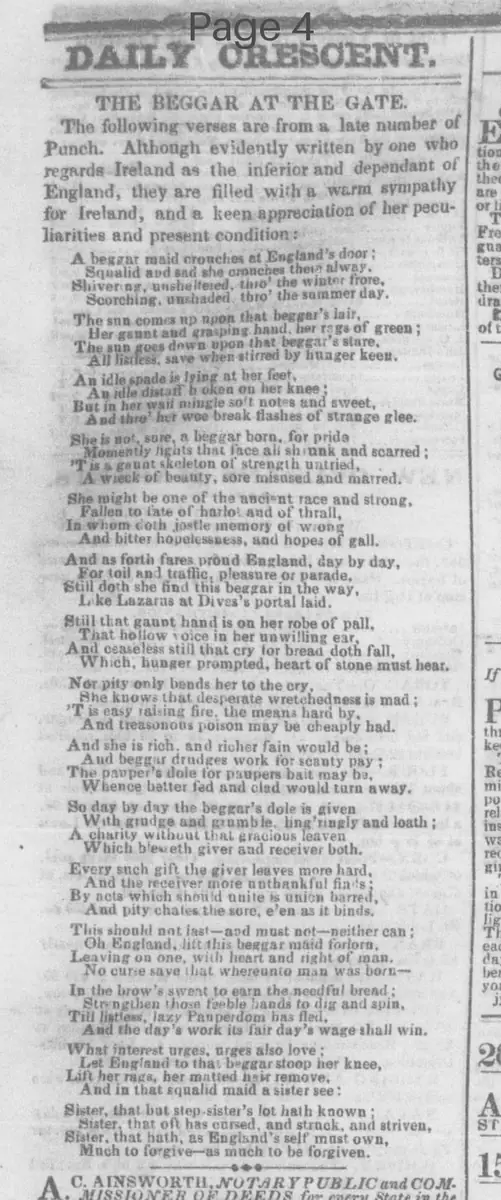
DAILY
CRESCENT.
THE BEGGAR
AT THE GATE
The following verses are from late number of Punch. Although evidently written by one who regards Ireland as the inferior and dependant of England, they are filled with a warm sympathy for Ireland, and a keen appreciation of her peculiarities and present condition:
A beggar maid crouches at England's door;
Shivering and shoeless thro' the winter frore,
She trusts and she approaches them alway.
Beseeching, unabated thro' the summer day.
The sun comes up upon that beggar's lair,
The sun goes down upon that beggar's prayer,
Her gaunt and grasping hand the siege of green:
All justices, save when stirred by hunger keen,
An idle spade is lying at her feet.
But in her wild eyes struggle so wan and sweet,
An idle daughter's head on her knee;
"Aid through her woe breaks flashes of strange glee.
She is not, sure, a Beggar born, for pride
Momentarily mingles in one all shunning and scarred:
The gaunt skeleton of strength untried,
A wick of bounty, sore misused and marred,
She might be one of those ancient race and strong,
Fallen to tale of barter and of thrall,
In whom God's just memory of wrong
And bitter homelessness, and hopes or small.
And as forth fares proud England, day by day,
For toil or traffic, pleasure or parade.
Still doth she find this beggar in the way
Like Lazarus at Dives's portal laid.
Still that gaunt hand is on her robe of pall,
That hollow voice in her unwilling ear
And conscience still that cry for bread doth call,
Which, hunger prompted, heart of stone must hear.
Nor pity only bids her to the cry,
She knows that desperate wretchedness is mad;
'Tis easy sizing fire, the means hard by,
And treacherous poison may be cheaply had.
And she is rich, and richer fain would be;
And beggar drudge work for scanty pay;
The pauper's dole for pauper bait may be,
Whence better aid and God would turn away
So day by day the beggar's dole is given
With grudge and grumble, lingeringly and loath
Charity without that gracious leaven
Which blesseth giver and receiver both.
Every such gift the giver leaves more hard,
And the receiver more unthankful grows;
By acts which should unite in union barred.
And pity chafes the sore, e'en as it binds.
Thus should not last - and must not - neither can:
Oh England, lift this beggar maid forlorn,
Leaving on none, with heart and right of man.
No curse save that whereunto man was born -
In the brow's sweat to earn the needful bread:
Strengthen those feeble hands to dig and spin.
Till listless, lazy Pauperdom has fled.
And the day's work its fair day's wage shall win.
What interest urges, urges also love:
Let England to that beggar stoop her knee,
Lift her rags, her matted hair remove,
And in that squalid maid a sister see:
Sister, that but step-sister's lot hath known:
Sister, that oft has cursed, and struck, and striven,
Sister, that hath, as England's self must own,
Much to forgive as much to be forgiven.
CRESCENT.
THE BEGGAR
AT THE GATE
The following verses are from late number of Punch. Although evidently written by one who regards Ireland as the inferior and dependant of England, they are filled with a warm sympathy for Ireland, and a keen appreciation of her peculiarities and present condition:
A beggar maid crouches at England's door;
Shivering and shoeless thro' the winter frore,
She trusts and she approaches them alway.
Beseeching, unabated thro' the summer day.
The sun comes up upon that beggar's lair,
The sun goes down upon that beggar's prayer,
Her gaunt and grasping hand the siege of green:
All justices, save when stirred by hunger keen,
An idle spade is lying at her feet.
But in her wild eyes struggle so wan and sweet,
An idle daughter's head on her knee;
"Aid through her woe breaks flashes of strange glee.
She is not, sure, a Beggar born, for pride
Momentarily mingles in one all shunning and scarred:
The gaunt skeleton of strength untried,
A wick of bounty, sore misused and marred,
She might be one of those ancient race and strong,
Fallen to tale of barter and of thrall,
In whom God's just memory of wrong
And bitter homelessness, and hopes or small.
And as forth fares proud England, day by day,
For toil or traffic, pleasure or parade.
Still doth she find this beggar in the way
Like Lazarus at Dives's portal laid.
Still that gaunt hand is on her robe of pall,
That hollow voice in her unwilling ear
And conscience still that cry for bread doth call,
Which, hunger prompted, heart of stone must hear.
Nor pity only bids her to the cry,
She knows that desperate wretchedness is mad;
'Tis easy sizing fire, the means hard by,
And treacherous poison may be cheaply had.
And she is rich, and richer fain would be;
And beggar drudge work for scanty pay;
The pauper's dole for pauper bait may be,
Whence better aid and God would turn away
So day by day the beggar's dole is given
With grudge and grumble, lingeringly and loath
Charity without that gracious leaven
Which blesseth giver and receiver both.
Every such gift the giver leaves more hard,
And the receiver more unthankful grows;
By acts which should unite in union barred.
And pity chafes the sore, e'en as it binds.
Thus should not last - and must not - neither can:
Oh England, lift this beggar maid forlorn,
Leaving on none, with heart and right of man.
No curse save that whereunto man was born -
In the brow's sweat to earn the needful bread:
Strengthen those feeble hands to dig and spin.
Till listless, lazy Pauperdom has fled.
And the day's work its fair day's wage shall win.
What interest urges, urges also love:
Let England to that beggar stoop her knee,
Lift her rags, her matted hair remove,
And in that squalid maid a sister see:
Sister, that but step-sister's lot hath known:
Sister, that oft has cursed, and struck, and striven,
Sister, that hath, as England's self must own,
Much to forgive as much to be forgiven.
What sub-type of article is it?
Satire
Ode
What themes does it cover?
Political
Liberty Independence
What keywords are associated?
Ireland Beggar
England Ireland
Sympathy Ireland
Political Dependence
Charity Critique
What entities or persons were involved?
From Late Number Of Punch
Poem Details
Title
The Beggar At The Gate
Author
From Late Number Of Punch
Subject
Sympathy For Ireland's Present Condition As England's Dependent
Form / Style
Rhymed Stanzas
Key Lines
A Beggar Maid Crouches At England's Door;
Oh England, Lift This Beggar Maid Forlorn,
And In That Squalid Maid A Sister See: