Thank you for visiting SNEWPapers!
Sign up free
Ellsworth American
Ellsworth, Hancock County, Maine
What is this article about?
A miserly creditor, Pinchard, attempts to seize a debtor, Cox, fleeing to California by arresting a disguised box at the wharf, but discovers only rocks inside as Cox sails away successfully and later repays the debt.
Merged-components note: Continuation of the same narrative story 'BODDO' across components.
Clipping
OCR Quality
Full Text
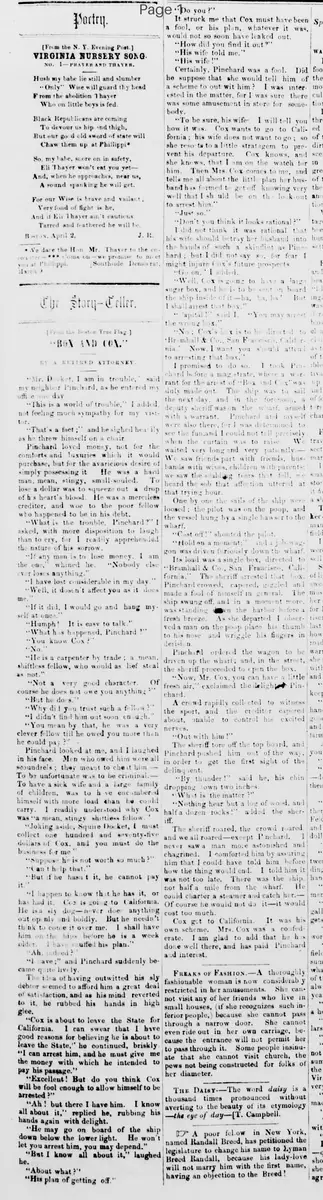
[from the True Flag]
"BODDO."
BY A KILLICK ATTORNEY.
Mr. Docket. I am in trouble,' said my neighbor Pinchard, as he entered my office one day.
"This is a world of trouble." I added, not feeling much sympathy for my visitor.
"That's a fact;" and he sighed heavily as he threw himself on a chair.
Pinchard loved money, not for the comforts and luxuries which it would purchase, but for the avaricious desire of simply possessing it. He was a hard man, mean, stingy, small-souled. To lose a dollar was to squeeze out a drop of his heart's blood. He was a merciless creditor, and woe to the poor fellow who happened to be in his debt.
"What is the trouble, Pinchard?" I asked, with more disposition to laugh than to cry, for I readily apprehended the nature of his sorrow.
"If any man is to lose money, I am the one," whined he.
"Nobody else ever loses anything."
"I have lost considerable in my day."
"Well, it doesn't affect you as it does me."
"If it did, I would go and hang myself at once."
"Humph! It is easy to talk."
"What has happened, Pinchard?"
"You know Cox?"
"No."
"He is a carpenter by trade; a mean, shiftless fellow, who would as lief steal as not."
"Not a very good character. Of course he does not owe you anything."
"But he does."
"Why did you trust such a fellow?"
"I didn't find him out soon enough."
"You mean by that, he was a very clever fellow till he owed you more than he could pay?"
Pinchard looked at me, and I laughed in his face. Men who owed him were all scoundrels: they meant to cheat him. To be unfortunate was to be criminal. To have a sick wife and a large family of children, was to have encumbered himself with more load than he could carry. I readily understood why Cox was 'a mean, stingy shiftless fellow.'
"Joking aside, Squire Docket, I must collect one hundred and seventy-five dollars of Cox, and you must do the business for me."
"Suppose he is not worth so much?"
"Can't help that."
"But if he hasn't it, he cannot pay it."
"I happen to know that he has it, or has had it. Cox is going to California. He is a sly dog—never does anything out openly and boldly. But he needn't think to come it over me. I shall have him on the hips before he is a week older. I have snuffed his plan."
"Ah, indeed?"
"I have;" and Pinchard suddenly became quite lively.
The idea of having outwitted his sly debtor seemed to afford him a great deal of satisfaction, and as his mind reverted to it, he rubbed his hands in high glee.
"Cox is about to leave the State for California. I can swear that I have good reasons for believing he is about to leave the State," he continued, briskly.
"I can arrest him, and he must give me the money with which he intended to pay his passage."
"Excellent! But do you think Cox will be fool enough to allow himself to be arrested?"
"Ah! but there I have him. I know all about it," replied he, rubbing his hands again with delight.
"He may go on board of the ship down below the lower light. He won't let you arrest him, you may depend."
"But I know all about it," laughed he.
"About what?"
"His plan of getting off."
It struck me that Cox must have been a fool, or his plan, whatever it was, would not so soon have leaked out.
"How did you find it out?"
"His wife told me."
"His wife!"
"Certainly. Pinchard was a fool. Did he suppose that she would tell him of a scheme to outwit him? I was interested in the matter, for I was sure there was some amusement in store for somebody.
"To be sure, his wife. I will tell you how it was. Cox wants to go to California; his wife does not want to go; so she resorts to a little stratagem to prevent his departure. Cox knows, and she knows, that I am on the watch for him. Then Mrs. Cox comes to me, and tells me all about the little plan her husband has formed to get off, knowing very well that I should be on the look out to arrest him."
"Just so."
"Don't you think it looks rational?"
I did not think it was rational that his wife should betray her husband into the hands of such a skinflint as Pinchard; but I did not say so, for fear I might injure Cox's future prospects.
"Go on," I added.
"Well, Cox is going to use a large sugar box, and he is to be stowed on board the ship inside of it—ha, ha, but I shall arrest that box."
"Capital!" said I. "You may arrest the wrong box."
"No; Cox's box is to be directed to 'Bramhall & Co., San Francisco, California.' Now, I want you should attend to arresting that box."
I promised to do so. I took Pinchard before a magistrate, where a warrant for the arrest of 'Box and Cox' was duly made out. The ship was to sail the next day, and in the forenoon, a deputy sheriff was on the wharf, armed with a warrant. Pinchard and myself were also there, for I was determined to see the fun, and I could not tell precisely when the curtain was to raise. We waited very long and very patiently. We saw friends part with friends, husbands with wives, children with parents; we saw the scalding tears that fell, heard the sob that affection uttered at that trying hour.
One by one the sails of the ship were loosed: the pilot was on the poop, and the vessel hung by a single hawser to the wharf.
"Cast off!" shouted the pilot.
"Hold on a moment;" and a wagon was driven furiously down the wharf.
Its load was a single box, directed to 'Bramhall & Co., San Francisco, California.' The sheriff seized that box.
Pinchard crowed, capered, giggled and made a fool of himself in general. The ship swung off, and in a moment more, was standing down the harbor before a fresh breeze. As she departed I observed a man on the poop place his thumb to his nose and wriggle his fingers in derision.
Pinchard ordered the wagon to be driven up the wharf; and, in the street, the sheriff proceeded to open the box.
"Now, Mr. Cox, you can have a little fresh air," exclaimed the delighted Pinchard.
A crowd rapidly collected to witness the sport, and the creditor capered about, unable to control his excited nerves.
"Out with him!"
The sheriff tore off the top board, and Pinchard pushed him out of the way, in order to get the first sight of the delinquent.
"By thunder!" said he, his chin dropping down two inches.
"What is the matter?"
"Nothing here but a log of wood, and half a dozen rocks!" added the sheriff.
The sheriff roared, the crowd roared and we all roared—except Pinchard. I never saw a man more astonished and chagrined. I comforted him by assuring him that I could have told him before how the thing would end. I told him it was not too late. There was the ship, not half a mile from the wharf. He could charter a steamer and catch her. Of course he would not do it; it would cost too much.
Cox got to California. It was his own scheme. Mrs. Cox was a confederate. I am glad to add that he has done well there, and has paid Pinchard and interest.
What sub-type of article is it?
What themes does it cover?
What keywords are associated?
What entities or persons were involved?
Where did it happen?
Story Details
Key Persons
Location
Wharf And Harbor
Story Details
Pinchard, a stingy creditor, learns from Mrs. Cox that her husband plans to hide in a sugar box to escape to California without paying his debt. Pinchard arranges to arrest the box on the ship, but it contains only rocks and wood; Cox escapes on the ship and later prospers in California, repaying the debt with interest.