Thank you for visiting SNEWPapers!
Sign up free
The Columbus Journal
Columbus, Platte County, Nebraska
What is this article about?
At the National Irrigation Congress in Ogden, Utah, on Wednesday, delegates debated repealing land laws like the desert land act and homestead clauses, with speeches from George H. Maxwell, Senator Paris Gibson (favoring) and Congressman Mondell (opposing). Resolutions were introduced, consolidation with Trans-Mississippi congress rejected, and morning session focused on colonization methods, featuring Commander Booth-Tucker's Salvation Army plea for government aid.
Clipping
OCR Quality
Full Text
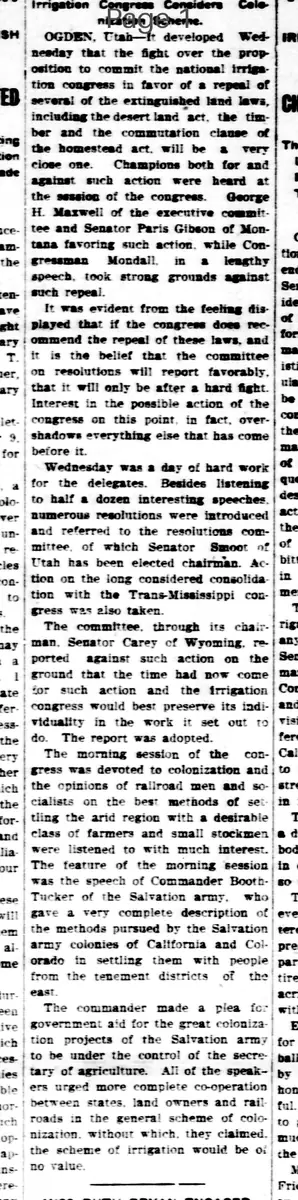
Champions both for and against such action were heard at the session of the congress.
George H. Maxwell of the executive committee and Senator Paris Gibson of Montana favoring such action, while Congressman Mondell, in a lengthy speech, took strong grounds against such repeal.
It was evident from the feeling displayed that if the congress does recommend the repeal of these laws, and it is the belief that the committee on resolutions will report favorably, that it will only be after a hard fight.
Interest in the possible action of the congress on this point, in fact, overshadows everything else that has come before it.
Wednesday was a day of hard work for the delegates. Besides listening to half a dozen interesting speeches, numerous resolutions were introduced and referred to the resolutions committee, of which Senator Scott of Utah has been elected chairman. Action on the long considered consolidation with the TransMississippi congress was also taken.
The committee, through its chairman, Senator Carey of Wyoming reported against such action on the ground that the time had now come for such action and the irrigation congress would best preserve its individuality in the work it set out to do. The report was adopted.
The morning session of the congress was devoted to colonization and the opinions of railroad men and socialists on the best methods of settling the arid region with a desirable class of farmers and small stockmen were listened to with much interest.
The feature of the morning session was the speech of Commander Booth-Tucker of the Salvation army, who gave a very complete description of the methods pursued by the Salvation army colonies of California and Colorado in settling them with people from the tenement districts of the east.
The commander made a plea for government aid for the great colonization projects of the Salvation army to be under the control of the secretary of agriculture. All of the speakers urged more complete co-operation between states, land owners and railroads in the general scheme of colonization, without which, they claimed, the scheme of irrigation would be of no value.
What sub-type of article is it?
What keywords are associated?
What entities or persons were involved?
Where did it happen?
Domestic News Details
Primary Location
Ogden, Utah
Event Date
Wednesday
Key Persons
Outcome
debate on repeal of land laws ongoing and expected to be close; committee reported against consolidation with trans-mississippi congress, report adopted; plea for government aid to salvation army colonization projects.
Event Details
The National Irrigation Congress debated a proposition to repeal land laws including the desert land act, timber and commutation clause of the homestead act, with speeches for and against. Numerous resolutions introduced to committee chaired by Senator Scott. Morning session on colonization featured opinions from railroad men and socialists, and speech by Commander Booth-Tucker on Salvation Army methods in California and Colorado, urging cooperation between states, landowners, and railroads.