Thank you for visiting SNEWPapers!
Sign up free
Story
April 13, 1832
Staunton Spectator
Staunton, Virginia
What is this article about?
Editorial commentary on the Cherokee case, discussing the U.S. Supreme Court's decision, Georgia's refusal to comply, limitations on habeas corpus for imprisoned missionaries, and potential legal remedies under the Judiciary Act of 1789.
Clipping
OCR Quality
98%
Excellent
Full Text
From the National Intelligencer.
THE CHEROKEE CASE.
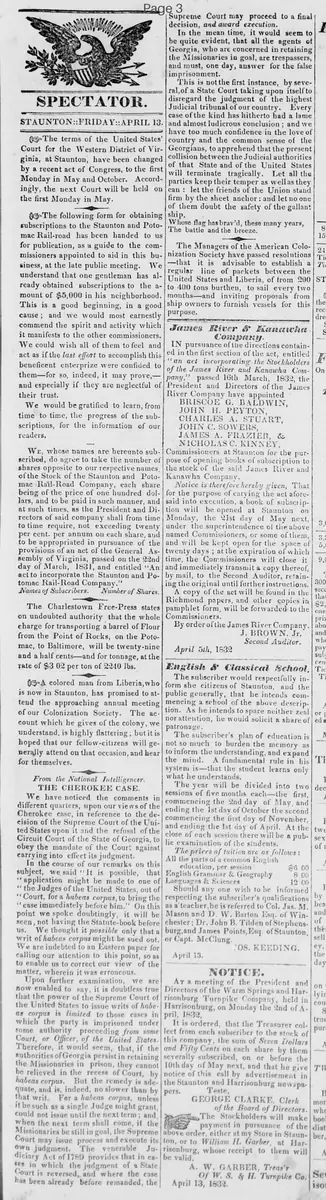
We have noticed the comments in different quarters, upon our views of the Cherokee case, in reference to the decision of the Supreme Court of the United States upon it and the refusal of the Circuit Court of the State of Georgia, to obey the mandate of the Court against carrying into effect its judgment.
In the course of our remarks on this subject, we said "It is possible, that application might be made to one of the Judges of the United States, out of Court, for a habeas corpus, to bring the case immediately before him." On this point we spoke doubtingly, it will be seen, not having the Statute-book before us. We thought it possible only that a writ of habeas corpus might be sued out.
We are indebted to an Eastern paper for calling our attention to this point, so as to enable us to correct our view of the matter, wherein it was erroneous.
Upon further examination, we are now enabled to say, it is doubtless true that the power of the Supreme Court of the United States to issue writs of habeas corpus is limited to those cases in which the party is imprisoned under some authority proceeding from some Court, or Officer, of the United States.
Therefore, it would seem, that, if the authorities of Georgia persist in retaining the Missionaries in prison, they cannot be relieved in the recess of Court, by habeas corpus. But the remedy is adequate, and is, indeed, no slower than by that writ. For a habeas corpus, unless it be such as a single Judge might grant, could not issue until the next term; and when the next term shall come, if the Missionaries be still in goal, the Supreme Court may issue process and execute its own judgment. The venerable Judiciary Act of 1789 provides that in cases in which the judgment of a State Court is reversed, and where the case has been already before remanded, the Supreme Court may proceed to a final decision, and award execution.
In the mean time, it would seem to be quite evident, that all the agents of Georgia, who are concerned in retaining the Missionaries in goal, are trespassers, and must, one day, answer for the false imprisonment.
This is not the first instance, by several, of a State Court taking upon itself to disregard the judgment of the highest Judicial tribunal of our country. Every case of the kind has hitherto had a lame and almost ludicrous conclusion; and we have too much confidence in the love of country and the common sense of the Georgians, to apprehend that the present collision between the Judicial authorities of that State and of the United States will terminate tragically. Let all the parties keep their temper as well as they can: let the friends of the Union stand firm by the sheet anchor: and let no one of them doubt the safety of the gallant ship,
Whose flag has brav'd, these many years,
The battle and the breeze.
THE CHEROKEE CASE.
We have noticed the comments in different quarters, upon our views of the Cherokee case, in reference to the decision of the Supreme Court of the United States upon it and the refusal of the Circuit Court of the State of Georgia, to obey the mandate of the Court against carrying into effect its judgment.
In the course of our remarks on this subject, we said "It is possible, that application might be made to one of the Judges of the United States, out of Court, for a habeas corpus, to bring the case immediately before him." On this point we spoke doubtingly, it will be seen, not having the Statute-book before us. We thought it possible only that a writ of habeas corpus might be sued out.
We are indebted to an Eastern paper for calling our attention to this point, so as to enable us to correct our view of the matter, wherein it was erroneous.
Upon further examination, we are now enabled to say, it is doubtless true that the power of the Supreme Court of the United States to issue writs of habeas corpus is limited to those cases in which the party is imprisoned under some authority proceeding from some Court, or Officer, of the United States.
Therefore, it would seem, that, if the authorities of Georgia persist in retaining the Missionaries in prison, they cannot be relieved in the recess of Court, by habeas corpus. But the remedy is adequate, and is, indeed, no slower than by that writ. For a habeas corpus, unless it be such as a single Judge might grant, could not issue until the next term; and when the next term shall come, if the Missionaries be still in goal, the Supreme Court may issue process and execute its own judgment. The venerable Judiciary Act of 1789 provides that in cases in which the judgment of a State Court is reversed, and where the case has been already before remanded, the Supreme Court may proceed to a final decision, and award execution.
In the mean time, it would seem to be quite evident, that all the agents of Georgia, who are concerned in retaining the Missionaries in goal, are trespassers, and must, one day, answer for the false imprisonment.
This is not the first instance, by several, of a State Court taking upon itself to disregard the judgment of the highest Judicial tribunal of our country. Every case of the kind has hitherto had a lame and almost ludicrous conclusion; and we have too much confidence in the love of country and the common sense of the Georgians, to apprehend that the present collision between the Judicial authorities of that State and of the United States will terminate tragically. Let all the parties keep their temper as well as they can: let the friends of the Union stand firm by the sheet anchor: and let no one of them doubt the safety of the gallant ship,
Whose flag has brav'd, these many years,
The battle and the breeze.
What sub-type of article is it?
Historical Event
What themes does it cover?
Justice
What keywords are associated?
Cherokee Case
Supreme Court
Georgia Refusal
Habeas Corpus
Missionaries Imprisonment
Judiciary Act 1789
What entities or persons were involved?
Missionaries
Georgia Authorities
Where did it happen?
Georgia
Story Details
Key Persons
Missionaries
Georgia Authorities
Location
Georgia
Story Details
Commentary on the Cherokee case where the U.S. Supreme Court ruled against Georgia's actions, but Georgia refused to comply, imprisoning missionaries; discusses habeas corpus limitations and remedies via the Supreme Court under the 1789 Judiciary Act, warning of consequences for false imprisonment.