Thank you for visiting SNEWPapers!
Sign up free
Literary
August 9, 1804
Alexandria Daily Advertiser
Alexandria, Virginia
What is this article about?
The Lay Preacher apologizes for his absence from writing, justifying occasional indolence and the need to venture into society to observe follies, fashions, and news for fresh satirical material. He reflects on the challenges of moral instruction amid human passions and vows to resume his essays.
Clipping
OCR Quality
95%
Excellent
Full Text
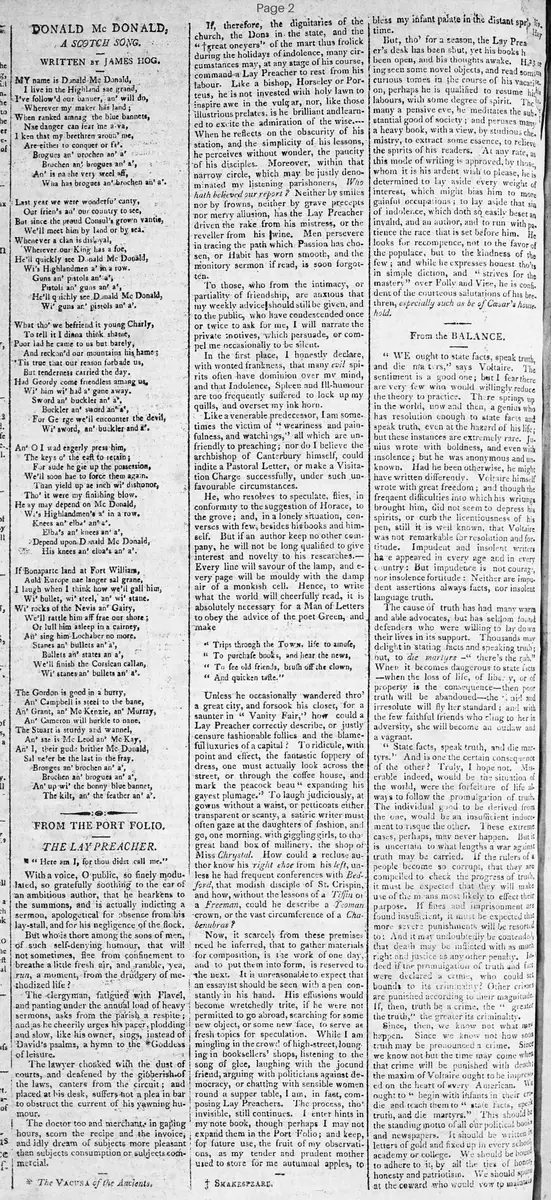
FROM THE PORT FOLIO.
THE LAY PREACHER.
"Here am I, for thou didst call me."
With a voice, O public, so finely modulated, so gratefully soothing to the ear of an ambitious author, that he hearkens to the summons, and is actually inditing a sermon, apologetical for absence from his lay-stall, and for his negligence of the flock. But who is there among the sons of men, of such self-denying humour, that will not sometimes flee from confinement to breathe a little fresh air, and ramble, yea, run, a moment, from the drudgery of methodized life?
The clergyman, fatigued with Flavel, and panting under the annual load of heavy sermons, asks from the parish a respite; and as he cheerily urges his pacer, plodding and slow, like his owner, sings, instead of David's psalms, a hymn to the Goddess of leisure.
The lawyer choaked with the dust of courts, and deafened by the gibberish of the laws, canters from the circuit; and placed at his desk, suffers not a plea in bar to obstruct the current of his yawning humour.
The doctor too and merchant, in gaping hours, scorn the recipe and the invoice; and idly dream of subjects more pleasant than subjects consumption or subjects commercial.
*The Votaries of the Ancients.
If, therefore, the dignitaries of the church, the Dons in the state, and the during the holidays of indolence, many circumstances may, at any stage of his course, command a Lay Preacher to rest from his labour. Like a bishop, Horsley or Porteus, he is not invested with holy lawn to inspire awe in the vulgar, nor, like those illustrious prelates, is he brilliant and learned to excite the admiration of the wise.
When he reflects on the obscurity of his station, and the simplicity of his lessons, he perceives without wonder, the paucity of his disciples. Moreover, within that narrow circle, which may be justly denominated my listening parishioners, Who hath believed our report? Neither by smiles nor by frowns, neither by grave precepts nor merry allusion, has the Lay Preacher driven the rake from his mistress, or the reveller from his wine. Men persevere in tracing the path which Passion has chosen, or Habit has worn smooth, and the monitory sermon if read, is soon forgotten.
To those, who from the intimacy, or partiality of friendship, are anxious that my weekly advice should still be given, and to the public, who have condescended once or twice to ask for me, I will narrate the private motives, which persuade, or compel me occasionally to be silent.
In the first place, I honestly declare, with wonted frankness, that many evil spirits often have dominion over my mind, and that Indolence, Spleen and Ill-humour are too frequently suffered to lock up my quills, and overset my ink horn.
Like a venerable predecessor, I am sometimes the victim of "weariness and painfulness, and watchings," all which are unfriendly to preaching; nor do I believe the archbishop of Canterbury himself, could indite a Pastoral Letter, or make a Visitation Charge successfully, under such unfavourable circumstances.
He, who resolves to speculate, rises, in conformity to the suggestion of Horace, to the grove; and, in a lonely situation, converses with few, besides his books and himself. But if an author keep no other company, he will not be long qualified to give interest and novelty to his researches. Every line will savour of the lamp, and every page will be mouldy with the damp air of a monkish cell. Hence, to write what the world will cheerfully read, it is absolutely necessary for a Man of Letters to obey the advice of the poet Green, -and
"make
Trips thro' the Town, life to amuse
To purchase books, and hear the news,
To see old friends, brush off the clown,
And quicken taste."
Unless he occasionally wandered thro' a great city, and forsook his closet, for a saunter in "Vanity Fair," how could a Lay Preacher correctly describe, or justly censure fashionable follies and the blameful luxuries of a capital? To ridicule, with point and effect, the fantastic foppery of dress, one must actually look across the street, or through the coffee house, and mark the peacock beau "expanding his gayest plumage." To laugh judiciously, at gowns without a waist, or petticoats either transparent or scanty, a satiric writer must often gaze at the daughters of fashion, and go, one morning, with giggling girls, to that great band box of millinery, the shop of Miss Chrystal. How could a recluse author know his right shoe from his left, unless he had frequent conferences with Bedford, that modish disciple of St. Crispin, and how, without the lessons of a Tiffin or a Freeman, could he describe a Tyrolean crown, or the vast circumference of a Chapeau bras?
Now, it scarcely from these premises need he inferred, that to gather materials for composition, is the work of one day, and to put them into form, is reserved to the next. It is unreasonable to expect that an essayist should be seen with a pen constantly in his hand. His effusions would become wretchedly trite, if he were not permitted to go abroad, searching for some new object, or some new face, to serve as fresh topics for speculation. While I am mingling in the crowd of high-street, lounging in booksellers' shops, listening to the song of glee, laughing with the jocund friend, arguing with politicians against democracy, or chatting with sensible women round a supper table, I am, in fact, composing Lay Preachers. The process, tho' invisible, still continues. I enter hints in my note book, though perhaps I may not expand them in the Port Folio; and keep, for future use, the fruit of my observations, as my tender and prudent mother used to store for me autumnal apples, to bless my infant palate in the distant spring-time.
But, tho' for a season, the Lay Preacher's desk has been shut, yet his books have been open, and his thoughts awake. Having seen some novel objects, and read some curious tomes in the course of his vacation, perhaps he is qualified to resume his labours, with some degree of spirit. Tho' to many a pensive eve, he meditates the substantial good of society; and peruses many a heavy book, with a view, by studious chemistry, to extract some essence, to relieve the spirits of his readers. At any rate, as this mode of writing is approved, by those whom it is his ardent wish to please, he is determined to lay aside every weight of interest, which might bias him to more gainful occupations; to lay aside that sin of indolence, which doth so easily beset an invalid, and an author, and to run with patience the race that is set before him. He looks for recompence, not to the favor of the populace, but to the kindness of the few; and while he expresses honest thoughts in simple diction, and "strives for the mastery over Folly and Vice, he is confident of the courteous salutations of his brethren, especially such as be of Cæsar's household.
THE LAY PREACHER.
"Here am I, for thou didst call me."
With a voice, O public, so finely modulated, so gratefully soothing to the ear of an ambitious author, that he hearkens to the summons, and is actually inditing a sermon, apologetical for absence from his lay-stall, and for his negligence of the flock. But who is there among the sons of men, of such self-denying humour, that will not sometimes flee from confinement to breathe a little fresh air, and ramble, yea, run, a moment, from the drudgery of methodized life?
The clergyman, fatigued with Flavel, and panting under the annual load of heavy sermons, asks from the parish a respite; and as he cheerily urges his pacer, plodding and slow, like his owner, sings, instead of David's psalms, a hymn to the Goddess of leisure.
The lawyer choaked with the dust of courts, and deafened by the gibberish of the laws, canters from the circuit; and placed at his desk, suffers not a plea in bar to obstruct the current of his yawning humour.
The doctor too and merchant, in gaping hours, scorn the recipe and the invoice; and idly dream of subjects more pleasant than subjects consumption or subjects commercial.
*The Votaries of the Ancients.
If, therefore, the dignitaries of the church, the Dons in the state, and the during the holidays of indolence, many circumstances may, at any stage of his course, command a Lay Preacher to rest from his labour. Like a bishop, Horsley or Porteus, he is not invested with holy lawn to inspire awe in the vulgar, nor, like those illustrious prelates, is he brilliant and learned to excite the admiration of the wise.
When he reflects on the obscurity of his station, and the simplicity of his lessons, he perceives without wonder, the paucity of his disciples. Moreover, within that narrow circle, which may be justly denominated my listening parishioners, Who hath believed our report? Neither by smiles nor by frowns, neither by grave precepts nor merry allusion, has the Lay Preacher driven the rake from his mistress, or the reveller from his wine. Men persevere in tracing the path which Passion has chosen, or Habit has worn smooth, and the monitory sermon if read, is soon forgotten.
To those, who from the intimacy, or partiality of friendship, are anxious that my weekly advice should still be given, and to the public, who have condescended once or twice to ask for me, I will narrate the private motives, which persuade, or compel me occasionally to be silent.
In the first place, I honestly declare, with wonted frankness, that many evil spirits often have dominion over my mind, and that Indolence, Spleen and Ill-humour are too frequently suffered to lock up my quills, and overset my ink horn.
Like a venerable predecessor, I am sometimes the victim of "weariness and painfulness, and watchings," all which are unfriendly to preaching; nor do I believe the archbishop of Canterbury himself, could indite a Pastoral Letter, or make a Visitation Charge successfully, under such unfavourable circumstances.
He, who resolves to speculate, rises, in conformity to the suggestion of Horace, to the grove; and, in a lonely situation, converses with few, besides his books and himself. But if an author keep no other company, he will not be long qualified to give interest and novelty to his researches. Every line will savour of the lamp, and every page will be mouldy with the damp air of a monkish cell. Hence, to write what the world will cheerfully read, it is absolutely necessary for a Man of Letters to obey the advice of the poet Green, -and
"make
Trips thro' the Town, life to amuse
To purchase books, and hear the news,
To see old friends, brush off the clown,
And quicken taste."
Unless he occasionally wandered thro' a great city, and forsook his closet, for a saunter in "Vanity Fair," how could a Lay Preacher correctly describe, or justly censure fashionable follies and the blameful luxuries of a capital? To ridicule, with point and effect, the fantastic foppery of dress, one must actually look across the street, or through the coffee house, and mark the peacock beau "expanding his gayest plumage." To laugh judiciously, at gowns without a waist, or petticoats either transparent or scanty, a satiric writer must often gaze at the daughters of fashion, and go, one morning, with giggling girls, to that great band box of millinery, the shop of Miss Chrystal. How could a recluse author know his right shoe from his left, unless he had frequent conferences with Bedford, that modish disciple of St. Crispin, and how, without the lessons of a Tiffin or a Freeman, could he describe a Tyrolean crown, or the vast circumference of a Chapeau bras?
Now, it scarcely from these premises need he inferred, that to gather materials for composition, is the work of one day, and to put them into form, is reserved to the next. It is unreasonable to expect that an essayist should be seen with a pen constantly in his hand. His effusions would become wretchedly trite, if he were not permitted to go abroad, searching for some new object, or some new face, to serve as fresh topics for speculation. While I am mingling in the crowd of high-street, lounging in booksellers' shops, listening to the song of glee, laughing with the jocund friend, arguing with politicians against democracy, or chatting with sensible women round a supper table, I am, in fact, composing Lay Preachers. The process, tho' invisible, still continues. I enter hints in my note book, though perhaps I may not expand them in the Port Folio; and keep, for future use, the fruit of my observations, as my tender and prudent mother used to store for me autumnal apples, to bless my infant palate in the distant spring-time.
But, tho' for a season, the Lay Preacher's desk has been shut, yet his books have been open, and his thoughts awake. Having seen some novel objects, and read some curious tomes in the course of his vacation, perhaps he is qualified to resume his labours, with some degree of spirit. Tho' to many a pensive eve, he meditates the substantial good of society; and peruses many a heavy book, with a view, by studious chemistry, to extract some essence, to relieve the spirits of his readers. At any rate, as this mode of writing is approved, by those whom it is his ardent wish to please, he is determined to lay aside every weight of interest, which might bias him to more gainful occupations; to lay aside that sin of indolence, which doth so easily beset an invalid, and an author, and to run with patience the race that is set before him. He looks for recompence, not to the favor of the populace, but to the kindness of the few; and while he expresses honest thoughts in simple diction, and "strives for the mastery over Folly and Vice, he is confident of the courteous salutations of his brethren, especially such as be of Cæsar's household.
What sub-type of article is it?
Essay
Satire
What themes does it cover?
Social Manners
Moral Virtue
Temperance
What keywords are associated?
Lay Preacher
Indolence
Satire
Fashion Follies
Writing Process
Social Observation
Moral Advice
Urban Life
Literary Details
Title
The Lay Preacher.
Subject
Apologetical For Absence From His Lay Stall
Form / Style
Reflective Prose Essay With Satirical Elements
Key Lines
"Here Am I, For Thou Didst Call Me."
"Make Trips Thro' The Town, Life To Amuse To Purchase Books, And Hear The News, To See Old Friends, Brush Off The Clown, And Quicken Taste."
To Ridicule, With Point And Effect, The Fantastic Foppery Of Dress, One Must Actually Look Across The Street, Or Through The Coffee House, And Mark The Peacock Beau "Expanding His Gayest Plumage."
While I Am Mingling In The Crowd Of High Street, Lounging In Booksellers' Shops, Listening To The Song Of Glee, Laughing With The Jocund Friend, Arguing With Politicians Against Democracy, Or Chatting With Sensible Women Round A Supper Table, I Am, In Fact, Composing Lay Preachers.
He Is Determined To Lay Aside Every Weight Of Interest, Which Might Bias Him To More Gainful Occupations; To Lay Aside That Sin Of Indolence, Which Doth So Easily Beset An Invalid, And An Author