Thank you for visiting SNEWPapers!
Sign up free
The Enquirer
Richmond, Henrico County, Virginia
What is this article about?
U.S. House of Representatives proceedings on December 16-17, covering reports on relief bills, committee appointments, debates and amendments to standing rules, referrals of petitions, and discussions on tonnage duties and public lands.
Clipping
OCR Quality
Full Text
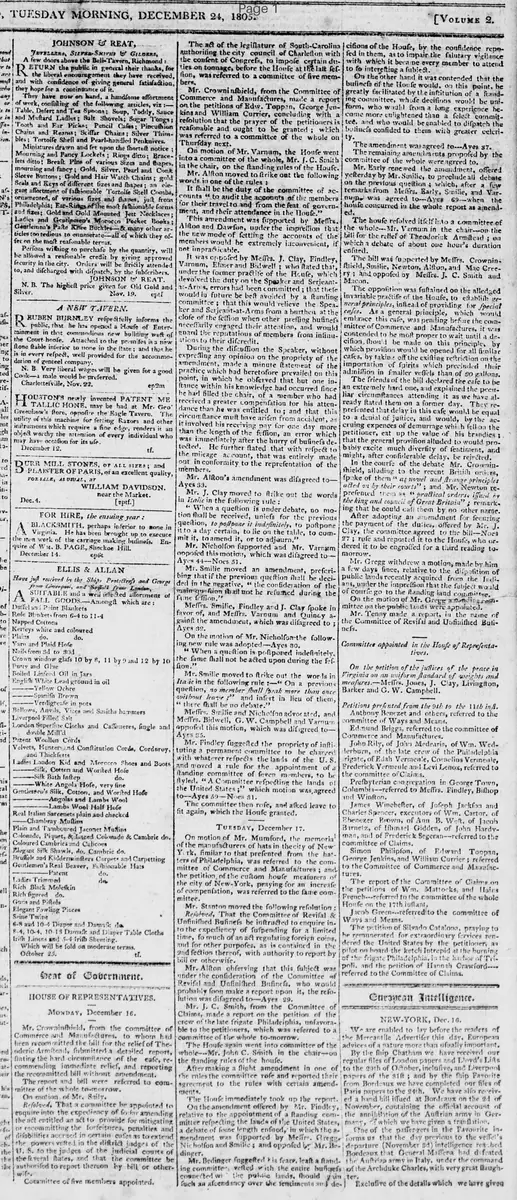
HOUSE OF REPRESENTATIVES.
Monday, December 16.
Mr. Crowninshield, from the committee of Commerce and Manufactures, to whom had been recommitted the bill for the relief of Theodorick Armstead, submitted a detailed report, stating the hard circumstances of the case, recommending immediate relief, and reporting the recommitted bill without amendment.
The report and bill were referred to committee of the whole to-morrow.
On motion of Mr. Sally,
Resolved, That a committee be appointed to enquire into the expediency of so far amending the act entitled an act to provide for mitigating or remitting the forfeitures, penalties and disabilities accrued in certain cases as to extend the powers vested in the district judges of the U. S. to the judges of the judicial courts of the several states, and that the committee be authorised to report thereon by bill or otherwise.
Committee of five members appointed.
The act of the legislature of South-Carolina authorising the city council of Charleston with the consent of Congress, to impose certain duties on tonnage, before the House at the last session, was referred to a committee of five members.
Mr. Crowninshield, from the Committee of Commerce and Manufactures, made a report on the petitions of Edw. Toppan, George Jenkins and William Currier, concluding with a resolution that the prayer of the petitioners is reasonable and ought to be granted: which was referred to a committee of the whole on Thursday next.
On motion of Mr. Varnum, the House went into a committee of the whole, Mr. J. C. Smith in the chair, on the standing rules of the House.
Mr. Alston moved to strike out the following words in one of the rules:
It shall be the duty of the committee of accounts "to audit the accounts of the members for their travel to and from the seat of government, and their attendance in the House."
This amendment was supported by Messrs. Alston and Dawson, under the impression that the new mode of settling the accounts of the members would be extremely inconvenient, if not impracticable.
It was opposed by Messrs. J. Clay, Findley, Varnum, Elmer and Bidwell: who stated that, under the former practice of the House, which devolved the duty on the Speaker and Sergeant-at-Arms, errors had been committed: that these would in future be best avoided by a standing committee: that this would relieve the Speaker and Serjeant-at-Arms from a burthen at the close of the session when other pressing business necessarily engaged their attention, and would guard the reputations of members from imputations to their discredit.
During the discussion the Speaker, without expressing any opinion on the propriety of the amendment, made a minute statement of the practice which had heretofore prevailed on this point, in which he observed that but one instance within his knowledge had occurred since he had filled the chair, of a member who had received a greater compensation for his attendance than he was entitled to; and that this circumstance must have arisen from accident, as it involved his receiving pay for one day more than the length of the session, an error which was immediately after the hurry of business detected. He further stated that with respect to the mileage account, that was entirely made out in conformity to the representation of the members.
Mr. Alston's amendment was disagreed to— Ayes 33.
Mr. J. Clay moved to strike out the words in Italic in the following rule:
"When a question is under debate, no motion shall be received, unless for the previous question, to postpone it indefinitely, to postpone it to a day certain, to lie on the table, to commit it, to amend it, or to adjourn."
Mr. Nicholson supported and Mr. Varnum opposed this motion, which was disagreed to— Ayes 44—Noes 51.
Mr. Smilie moved an amendment, prescribing that if the previous question shall be decided in the negative, "the consideration of the main question shall not be resumed during the same session."
Messrs. Smilie, Findley and J. Clay spoke in favor of, and Messrs. Varnum and Quincy against the amendment, which was disagreed to; Ayes 32.
On the motion of Mr. Nicholson—the following new rule was adopted—Ayes 30.
"When a question is postponed indefinitely, the same shall not be acted upon during the session."
Mr. Smilie moved to strike out the words in Italic in the following rule:—"On a previous question, no member shall speak more than once without leave:" and insert in lieu of them, "there shall be no debate."
Messrs. Smilie and Nicholson advocated, and Messrs. Bidwell, G. W. Campbell and Varnum opposed this motion, which was disagreed to— Ayes 55.
Mr. Findley suggested the propriety of instituting a permanent committee to be charged with whatever respects the lands of the U. S. and moved a rule for the appointment of a standing committee of seven members, to be styled. "A Committee respecting the lands of the United States;" which motion was agreed to—Ayes 59—Noes 51.
The committee then rose, and asked leave to sit again, which the House granted.
Tuesday, December 17.
On motion of Mr. Mumford, the memorial of the manufacturers of hats in the city of New York, similar to that presented from the hatters of Philadelphia, was referred to the committee of Commerce and Manufactures; and the petition of the custom house measurers of the city of New-York, praying for an increase of compensation, was referred to the same committee.
Mr. Stanton moved the following resolution:
Resolved, That the Committee of Revisal & Unfinished Business be instructed to enquire into the expediency of suspending for a limited time, so much of an act regulating foreign coins, and for other purposes. as is contained in the [blank] and section thereof, with authority to report by bill or otherwise.
Mr. Alston observing that this subject was under the consideration of the Committee of Revisal and Unfinished Business, who would probably soon make a report upon it, the resolution was disagreed to—Ayes 29.
Mr. J. C. Smith, from the Committee of Claims, made a report on the petition of the crew of the late frigate Philadelphia, unfavorable to the petitioners, which was referred to a committee of the whole to-morrow.
The House again went into committee of the whole—Mr. John C. Smith in the chair—on the standing rules of the house.
After making a slight amendment in one of the rules the committee rose and reported their agreement to the rules with certain amendments.
The House immediately took up the report.
On the amendment offered by Mr. Findley, relative to the appointment of a standing committee respecting the lands of the United States, a debate of some length ensued, in which the amendment was supported by Messrs. Gregg— Nicholson and Smilie; and opposed by Mr. Bedinger.
Mr. Bedinger suggested his fears, lest a standing committee, vested with the entire business connected with the public lands, should gain such an ascendancy over the sentiments and decisions of the House, by the confidence reposed in them, as to impair the salutary vigilance with which it became every member to attend to so interesting a subject.
On the other hand it was contended that the business of the House would, on this point, be greatly facilitated by the institution of a standing committee, whose decisions would be uniform, who would from a long experience become more enlightened than a select committee. and who would be enabled to dispatch the business consigned to them with greater celerity.
The amendment was agreed to—Ayes 37.
The remaining amendments proposed by the committee of the whole were agreed to.
Mr. Early renewed the amendment, offered yesterday by Mr. Smilie, to preclude all debate on the previous question; which, after a few remarks from Messrs. Early, Smilie, and Varnum, was agreed to—Ayes 69—when the house concurred in the whole report as amended.
The house resolved itself into a committee of the whole—Mr. Varnum in the chair—on the bill for the relief of Theodorick Armstead; on which a debate of about one hour's duration ensued.
The bill was supported by Messrs. Crowninshield. Smilie, Newton, Alston, and Mac Creery; and opposed by Messrs. J. C. Smith and Macon.
The opposition was sustained on the alleged invariable practice of the House, to establish general principles, instead of providing for special cases. As a general principle, which would embrace this case, was pending before the committee of Commerce and Manufactures, it was contended to be most proper to wait until a decision should be made on this principle. by which provision would be opened for all similar cases, by taking off the existing restriction on the importation of spirits which precluded their admission in vessels less than 20 gallons.
The friends of the bill declared the case to be an extremely hard one, and explained the peculiar circumstances attending it as we have already stated them on a former day. They represented that delay in this case would be equal to a denial of justice, and would, by the accruing expenses of demurrage which fell on the petitioner, eat up the value of his brandies; that the general provision alluded to would probably excite much diversity of sentiment, and might, after considerable delay, be rejected.
In the course of the debate Mr. Crowninshield, alluding to the recent British orders, spoke of them "as novel and strange principles acted on by their courts"; and Mr. Newton represented them as "practical orders, issued by the king and council of Great Britain"; remarking that he could call them by no other name.
After adopting an amendment for securing the payment of the duties, offered by Mr. J. Clay, the committee agreed to the bill—Noes 27; rose and reported it to the House, who ordered it to be engrossed for a third reading to-morrow.
Mr. Gregg withdrew a motion, made by him a few days since, relative to the disposition of public lands recently acquired from the Indians, under the impression that the subject would of course go to the standing land committee.
On the motion of Mr. Gregg a Standing committee on the public lands were appointed.
Mr. Tenney made a report, in the name of the Committee of Revisal and Unfinished Business.
Committee appointed in the House of Representatives.
On the petition of the justices of the peace in Virginia on an uniform standard of weights and measures.—Messrs. Jones, J. Clay, Livingston, Barker and G. W. Campbell.
Petitions presented from the 9th to the 11th inst. Anthony Benezet and others, referred to the committee of Ways and Means.
Edmund Briggs, referred to the committee of Commerce and Manufactures.
John Riley, of John Medearis, of Wm. Wedderburn, of the late crew of the Philadelphia frigate, of Edah Vermeule, Cornelins Vermeule, Frederick Vermeule and Levi Lenox, referred to the committee of Claims.
Presbyterian congregation in George Town, Columbia—referred to Messrs. Findley, Bishop and Winston.
James Winchester, of Joseph Jackson and Charles Spencer, executors of Wm. Carter. of Ebenezer Brown, of Ann B. West, of Jacob Burnet, of Ishmael Giddings, of John Hardyman, and of Frederick Segeran—referred to the committee of Claims.
Simon Philpson, of Edward Toppan, George Jenkins, and William Currier; referred to the Committee of Commerce and Manufactures.
The report of the Committee of Claims on the petitions of Wm. Mattocks, and Hains French—referred to the committee of the whole House on the 17th instant.
Jacob Green.—referred to the Committee of Ways and Means.
The petition of Silvado Catalano. praying to be remunerated for extraordinary services rendered the United States by the Petitioner, as pilot on board the ketch Intrepid at the burning of the frigate Philadelphia. in the harbor of Tripoli. and the petition of Hannah Crawford— referred to the Committee of Claims.
What sub-type of article is it?
What keywords are associated?
What entities or persons were involved?
Where did it happen?
Domestic News Details
Primary Location
Seat Of Government
Event Date
Monday, December 16; Tuesday, December 17
Key Persons
Event Details
The House considered reports on relief bills for Theodorick Armstead and others, appointed committees on amendments to acts, tonnage duties, and public lands; debated and amended standing rules including auditing member accounts, previous questions, and committee structures; referred various petitions to committees; and passed the Armstead relief bill after debate.