Thank you for visiting SNEWPapers!
Sign up free
Literary Cadet And Rhode Island Statesman
Providence, Providence County, Rhode Island
What is this article about?
Posthumous disputes over Richard Brinsley Sheridan's character challenge Thomas Moore's biography. Excerpts from 'The Octogenarian' defend it with anecdotes of Sheridan's spontaneous wit in social and parliamentary settings, including puns on taxes, seating, reviews, and retorts to peers.
Merged-components note: These components form a continuous article consisting of anecdotes and biographical notes about Richard Sheridan.
Clipping
OCR Quality
Full Text
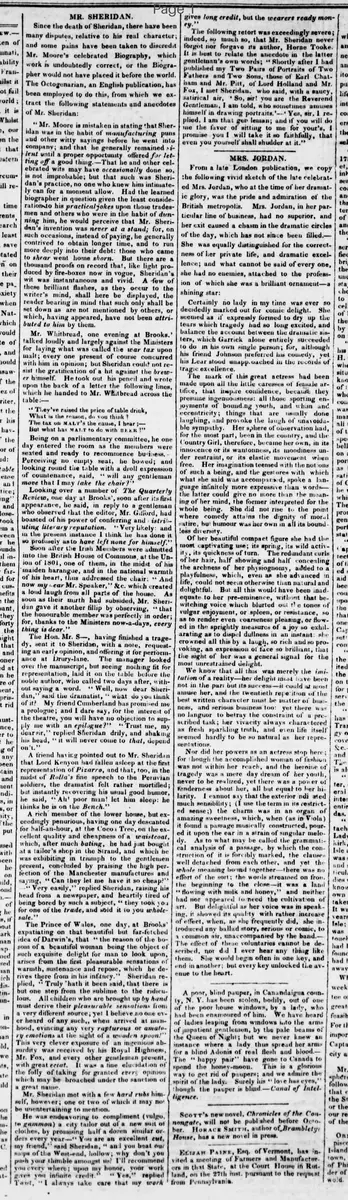
"Mr. Moore is mistaken in stating that Sheridan was in the habit of manufacturing puns and other witty sayings before he went into company; and that he generally remained silent until a proper opportunity offered for letting off a good thing.—That he and other celebrated wits may have occasionally done so, is not improbable; but that such was Sheridan's practice, no one who knew him intimately can for a moment allow. Had the learned biographer in question given the least consideration to his practical jokes upon those tradesmen and others who were in the habit of dunning him, he would perceive that Mr. Sheridan's invention was never at a stand; for, on such occasions, instead of paying, he generally contrived to obtain longer time, and to run more deeply into their debt: those who came to shear went home shorn. But there are a thousand proofs on record that, like light produced by fire-boxes now in vogue, Sheridan's wit was instantaneous and vivid. A few of these brilliant flashes, as they occur to the writer's mind, shall here be displayed, the reader bearing in mind that such only shall be set down as are not mentioned by others, or which, having appeared, have not been attributed to him by them.
Mr. Whitbread, one evening at Brooks', talked loudly and largely against the Ministers for laying what was called the war tax upon malt; every one present of course concurred with him in opinion; but Sheridan could not resist the gratification of a hit against the brewer himself. He took out his pencil and wrote upon the back of a letter the following lines, which he handed to Mr. Whitbread across the table:—
"They've raised the price of table drink,
What is the reason, do you think?
The tax on MALT's the cause, I hear ;—
But what has MALT to do with BEER?
Being on a parliamentary committee, he one day entered the room as the members were seated and ready to recommence business.—Perceiving no empty seat, he bowed; and looking round the table with a droll expression of countenance, said, "will any gentleman move that I may take the chair?"
Looking over a number of The Quarterly Review, one day at Brooks', soon after its first appearance, he said, in reply to a gentleman who observed that the editor, Mr. Gifford, had boasted of his power of conferring and distributing literary reputation. "Very likely: and in the present instance I think he has done it so profusely as to have left none for himself."
Soon after the Irish Members were admitted into the British House of Commons, at the Union of 1801, one of them, in the midst of his maiden harangue, and in the national warmth of his heart, thus addressed the chair: "And now my dear Mr. Speaker," &c. which created a loud laugh from all parts of the house. As soon as their mirth had subsided, Mr. Sheridan gave it another fillip by observing, "that the honourable member was perfectly in order; for, thanks to the Ministers now-a-days, every thing is dear."
The Hon. Mr. S—, having finished a tragedy, sent it to Sheridan, with a note, requesting an early opinion, and offering it for performance at Drury-lane. The manager looked over the manuscript, but seeing nothing fit for representation, laid it on the table before the noble author, who called two days after, without saying a word. "Well, now dear Sheridan," said the dramatist, "what do you think of it? My friend Cumberland has promised me a prologue; and I dare say, for the interest of the theatre, you will have no objection to supply me with an epilogue?" "Trust me, my dear sir," replied Sheridan drily, and shaking his head, "it will never come to that, depend on't."
A friend having pointed out to Mr. Sheridan that Lord Kenyon had fallen asleep at the first representation of Pizarro, and that, too, in the midst of Rolla's fine speech to the Peruvian soldiers, the dramatist felt rather mortified; but instantly recovering his usual good humor, he said, "Ah! poor man! let him sleep: he thinks he is on the Bench."
A rich member of the lower house, but exceedingly penurious, having one day descanted for half-an-hour, at the Cocoa Tree, on the excellent quality and cheapness of a waistcoat, which, after much bating, he had just bought at a tailor's shop in the Strand, and which he was exhibiting in triumph to the gentlemen present, concluded by praising the high perfection of the Manchester manufactures and saying, "Can they let me have it so cheap?" "Very easily," replied Sheridan, raising his head from a newspaper, and heartily tired of being bored by such a subject, "they took you for one of the trade, and sold it to you wholesale."
The Prince of Wales, one day, at Brooks' expatiating on that beautiful but far-fetched idea of Darwin's, that "the reason of the bosom of a beautiful woman being the object of such exquisite delight for man to look upon, arises from the first pleasurable sensations of warmth, sustenance and repose, which he derives there from in his infancy."
Sheridan replied, "Truly 'hath it been said, that there is but one step from the sublime to the ridiculous. All children who are brought up by hand must derive their pleasurable sensations from a very different source; yet I believe no one ever heard of any such., when arrived at manhood, evincing any very rapturous or amatory emotions at the sight of a wooden spoon!"
This very clever exposure of an ingenious absurdity was received by his Royal Highness, Mr. Fox, and every other gentleman present, with great eclat. It was a fine elucidation of the folly of taking for granted every opinion which may be broached under the sanction of a great name.
Mr. Sheridan met with a few hard rubs himself, however; one or two of which it may not be unentertaining to mention.
He was endeavoring to compliment (vulgo, to gammon) a city tailor out of a new suit of clothes, by promising half a dozen similar orders every year—“You are an excellent cut, my friend,” said Sheridan, “and you beat our snips of the West-end, hollow; why don't you push your thimble amongst us? I'll recommend you every where; upon my honor, your "work gives you infinite credit."
“Yes,” replied Twist, “I always take care that my work gives long credit, but the wearers ready money."
The following retort was exceedingly severe; indeed, so much so, that Mr. Sheridan never forgot nor forgave its author, Horne Tooke. It is best to relate the anecdote in the latter gentleman's own words; "Shortly after I had published my Two Pairs of Portraits of Two Fathers and Two Sons, those of Earl Chatham and Mr. Pitt, of Lord Holland and Mr. Fox, I met Sheridan, who said, with a saucy, satirical air, So, sir! you are the Reverend Gentleman, I am told, who sometimes amuses himself in drawing portraits.'—'Yes, sir. I replied, I am that gentleman; and if you will do me the favor of sitting to me for your's, I promise you I will take it so faithfully, that even you yourself shall shudder at it."
What sub-type of article is it?
What themes does it cover?
What keywords are associated?
What entities or persons were involved?
Where did it happen?
Story Details
Key Persons
Location
Brooks', House Of Commons, Drury Lane, Cocoa Tree
Event Date
After 1816
Story Details
Anecdotes from 'The Octogenarian' defend Thomas Moore's biography by illustrating Richard Brinsley Sheridan's spontaneous wit through puns and retorts in social clubs, parliament, and personal interactions, countering claims of premeditated jokes.