Thank you for visiting SNEWPapers!
Sign up free
Southern Standard
Columbus, Lowndes County, Mississippi
What is this article about?
1852 U.S. presidential election commentary on abolitionist strategies via the National Era to split Democratic votes from Pierce by nominating Hale and Julian, indirectly aiding Scott, including speeches in Ohio and elsewhere, slanders against Pierce, and a Tennessee Whig's letter refusing Scott support over compromise issues.
Clipping
OCR Quality
Full Text
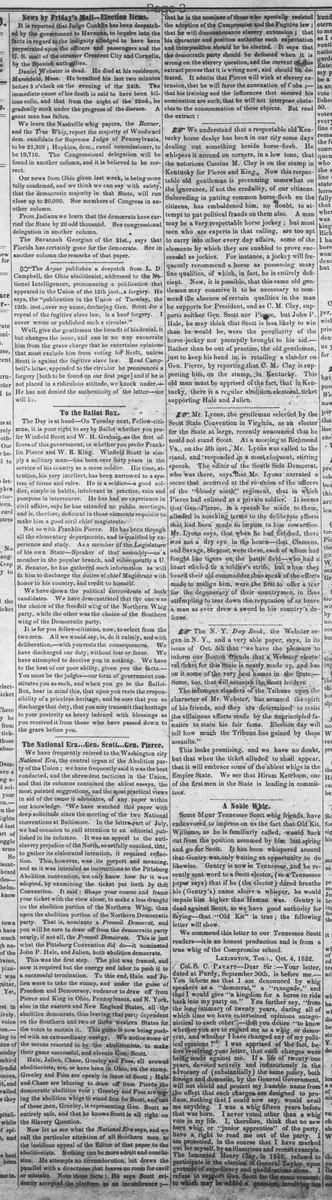
We have frequently referred to the Washington city National Era, the central organ of the Abolition party of the Union; we have frequently said it was the best conducted, and the shrewdest tactician in the Union, and that its columns contained the ablest essays, the most pointed suggestions, and the most practical views in aid of the cause it advocates, of any paper within our knowledge. We have watched this paper with deep solicitude since the meeting of the two National conventions at Baltimore.
In the latter part of July, we had occasion to call attention to an editorial published in its columns. It was an appeal to the anti-slavery prejudice of the North, so artfully couched, that, to gather its elaborated intention, it required reflection. This, however, was its purport and meaning, and as it was intended as instructions to the Pittsburg Abolition convention, we only know how far it was adopted, by examining the ticket put forth by that Convention. It said: Shape your course and frame your ticket with the view alone, to make a less draught on the abolition portion of the Northern Whig, than upon the abolition portion of the Northern Democratic party. That is, nominate a Freesoil Democrat, and you will be sure to draw off from the democratic party nearly, if not all, the Freesoil Democrats. This is just what the Pittsburg Convention did—it nominated John P. Hale, and Julien, both abolition democrats.
This was the first step. The plot was framed, and now it required but the energy and labor, to push it to a successful termination. To this end, Hale and Julien were to take the stump, and under the guise of Freedom and Democracy, endeavor to draw off from Pierce and King in Ohio, Pennsylvania, and N. York, also in the eastern and New England States, all the abolition democrats, thus leaving that party dependent on the Southern and two or three western States for the votes to sustain it. This game is now being pushed with an extraordinary energy. We notice some of the means resorted to by the abolitionists, to make their game successful, and elevate Gen. Scott.
Hale, Julien, Chase, Greeley and Foss, all avowed abolitionists, are, or have been in Ohio, on the stump. Greeley and Foss are openly in favor of Scott; Hale and Chase are laboring to draw off from Pierce the democratic abolition vote; Greeley and Foss are urging the abolition whigs to stand firm for Scott, and one of these men, Greeley, is representing Gen. Scott as entirely safe, and that he knows Scott is all right on the Slavery Question.
Now let us see what the National Era says, and we call the particular attention of all Southern men to the insidious appeal of the Editor of that paper to the abolitionists. Nothing can be more adroit and conclusive. He attempts no circumlocution, but draws the parallel with a directness that leaves no room for cavil or mistake. Note these facts: He says Scott evidently accepted the platform as an incumbrance; that he is the nominee of those who specially resisted the adoption of the Compromise and the Fugitive law: that he will discountenance slavery extension; that his character and position authorize such expectation and interposition should he be elected. It says that the democratic party should be defeated when it is wrong on the slavery question, and the current of this extract proves that it is wrong now, and should be defeated. It admits that Pierce will wink at slavery extension, that he will favor the annexation of Cuba: that his training and the influences that secured his nomination are such, that he will not interpose obstacles to the consummation of these objects. But read the extract:
We understand that a respectable old Kentucky horse dealer has been in our city some days dealing out something beside horse-flesh. He whispers it around on corners, in a low tone, that the notorious Cassius M. Clay is on the stump in Kentucky for Pierce and King. Now this respectable old gentleman is presuming somewhat on the ignorance, if not the credulity, of our citizens. Succeeding in putting common horse-flesh on the citizens, has emboldened him, no doubt, to attempt to put political frauds on them also. A man may be a very respectable horse jockey; but most men who are experts in that calling, are too apt to carry into other every day affairs, some of the elements by which they are enabled to prove successful as jockies. For instance, a jockey will frequently recommend a horse as possessing many fine qualities, of which, in fact, he is entirely deficient. Now, it is possible, that this same old gentleman may conceive it to be necessary to commend the absence of certain qualities in the man he supports for President, and as C. M. Clay, supports neither Gen. Scott nor Pierce, but John P. Hale, he may think that Scott is less likely to win than he would be, were the peculiarity of the horse-jockey not promptly brought to his aid. Rather than be out of practice, the old gentleman, just to keep his hand in, is retailing a slander on Gen. Pierce, by reporting that C. M. Clay is supporting him, on the stump, in Kentucky. This old man must be apprised of the fact, that in Kentucky, there is a regular abolition electoral ticket supporting Hale and Julien.
Mr. Lyons, the gentleman selected by the Scott State Convention in Virginia, as an elector for the State at large, recently announced that he could not stand Scott. At a meeting at Richmond Va., on the 5th inst., Mr. Lyons was called to the stand, and responded in a most eloquent, stirring speech. The editor of the South Side Democrat, who was there, says that Mr. Lyons narrated a scene that occurred at the re-union of the officers of the bloody ninth regiment, that in which Pierce had enlisted as a private soldier. It seems that Gen. Pierce, in a speech he made to them, alluded in touching terms to the deliberate efforts that had been made to impute to him cowardice. Mr. Lyons says, that when he had finished, there was not a dry eye in the house—that Clemens, and Savage, Steptoe, were there, each of whom had fought like tigers on the battle field—who had a heart steeled to a soldier's strife, but when they heard their old commander thus speak of the efforts made to malign him, were the first to offer a tear for the degeneracy of their countrymen, in thus attempting to tear down the reputation of as brave a man as ever drew a sword in his country's defence.
The N. Y. Day Book, the Webster organ in N. Y., and a very able paper, says, in its issue of Oct. 5th that "we have the pleasure to inform our Boston friends that a Webster electoral ticket for this State is nearly made up, and has on it some of the very best names in the State. Some, too, that will astonish the Scott leaders."
The infamous slanders of the Tribune upon the character of Mr. Webster, has aroused the spirit of his friends, and they are determined to resist the villainous efforts made by the unprincipled fanatics to stain his fair fame. Election day will tell how much the Tribune has gained by these assaults.
This looks promising, and we have no doubt, but that when the ticket alluded to shall appear, that it will embrace some of the ablest whigs in the Empire State. We see that Hiram Ketchum, one of the first men in the State is leading in committees.
A Noble Whig.
Some of our Tennessee Scott whig friends, have endeavored to impress on us the fact that "Old Kit." Williams, as he is familiarly called, would back out from the position assumed by him last spring and go for Scott. It has been whispered around that Gentry was only waiting an opportunity to do likewise. Gentry is now in Tennessee, and he recently sent word to a Scott-elector, (so a Tennessee paper says) that if he (the elector) dared breathe his (Gentry's) name above a whisper, he would impale him higher than Haman was. Gentry is dead against Scott, as we have good authority for saying that "Old Kit" is true; the following letter will show.
We commend this letter to our Tennessee Scott readers—it is an honest production and is from a true whig of the Compromise school.
LEXINGTON, Ten., Oct. 4, 1852.
Col. S. C. Pavatt—Dear Sir: Your letter, dated at Purdy, September 30th, is before me. You inform me that I am denounced by whig speakers as a "democrat," a "renegade," and that I would give "a kingdom for a horse to ride back into my party on." You further say, "from the long intimacy of twenty years, during all of which time we have entertained opinions antagonistic to each other"—that you desire "to know whether you are to regard me as a whig or democrat, and whether I have changed any of my political opinions?" I was apprised of the fact, before receiving your letter, that such charges were being made against me. If a life of twenty-one years, devoted actively and industriously in the advocacy of (substantially) the same policy, both foreign and domestic, by the General Government, will not shield and protect my humble name from the effect that such charges are designed to produce, nothing that I could now say, would avail me anything. I was a whig fifteen years before that was born. I never voted other than a whig vote in my life. I, therefore, think that no new born whig, or "junior apprentice" of the party, have a right to read me out of the party. I am protected, in the course that I have marked out for myself, by an illustrious and recent example. The lamented Henry Clay, in 1848, refused to participate in the election of General Taylor upon grounds of expediency and qualifications alone. I refuse to support Gen. Scott for the same reasons; to which may be added a question involving ten hundred millions of property and a principle as eternal as the constitution. It is not my purpose to make an argument. I will only say, believing as I do, that the whig party at the Baltimore Convention, by nominating General Scott, failed to nationalize the whig party by their action, disregarded the constitutional rights of the slave States. Entertaining such opinions, if I were to unite with my party in the election of General Scott, I would be a Benedict Arnold. I am a whig, unchanged in any of my political opinions. In refusing to vote for Gen. Scott, I am complying with a published pledge, made by myself and others, in 1850. In the canvass of 1851, when I solicited the votes of my constituents, I declared in each and every speech, that I would pursue the course and line of conduct that I am now doing, if Gen. Scott remained silent upon the compromise measures and the fugitive slave law. My fears as to Gen. Scott's course in that particular, became a reality—consequently, no man in my Congressional district, who heard me speak or privately converse upon the subject, can charge me with deception, in the line of conduct I choose to pursue. As to the statement that "I would give a kingdom for a horse to ride back to my party on," I can truthfully say, that my condition is not as desperate as that of hump-back Richard of England, who, when fighting bravely for his life and his kingdom, was unhorsed; in his extremity cried out, my kingdom for a horse;" unfortunately for poor Richard no horse could be had even at that price. I have but to say the word and a thousand Scott horses would be at my command, and as soon as would mount I would be hailed by those who are denouncing me, as a gallant old whig veteran but I cannot accept of a horse at such a price.
Yours respectfully,
C. H. WILLIAMS.
What sub-type of article is it?
What themes does it cover?
What keywords are associated?
What entities or persons were involved?
Where did it happen?
Story Details
Key Persons
Location
Washington, Baltimore, Ohio, Pennsylvania, New York, New England States, Kentucky, Richmond Va., Tennessee
Event Date
1852
Story Details
Abolitionists, guided by the National Era, nominate Freesoil Democrats Hale and Julien to draw votes from Pierce's Democratic ticket in Northern states, indirectly supporting Scott. Includes reports of stumping in Ohio, slanders like false claims of Clay supporting Pierce, Lyons' speech defending Pierce's bravery, Webster ticket formation in New York, and C.H. Williams' letter refusing Scott over compromise and slavery issues.