Thank you for visiting SNEWPapers!
Sign up free
Editorial
April 3, 1841
Salt River Journal
Bowling Green, Pike County, Missouri
What is this article about?
Editorial quotes Kentucky Rep. B. Hardin's speech defending tailor Kedding's profession against sneers by Judge Wilkinson in a murder trial, critiquing class distinctions and praising laborers' vital societal role.
Clipping
OCR Quality
75%
Good
Full Text
CORRECT SENTIMENTS.
In looking over some extracts a day or two ago, we found the following. It is a part of a speech delivered by the Hon. B. Hardin, of Kentucky, on the trial of Judge Wilkinson and others for murder. Judge W. had sneeringly alluded to the profession of Kedding which was that of tailor, which was the immediate cause of the affray; Mr. Hardin replies to that allusion as follows:
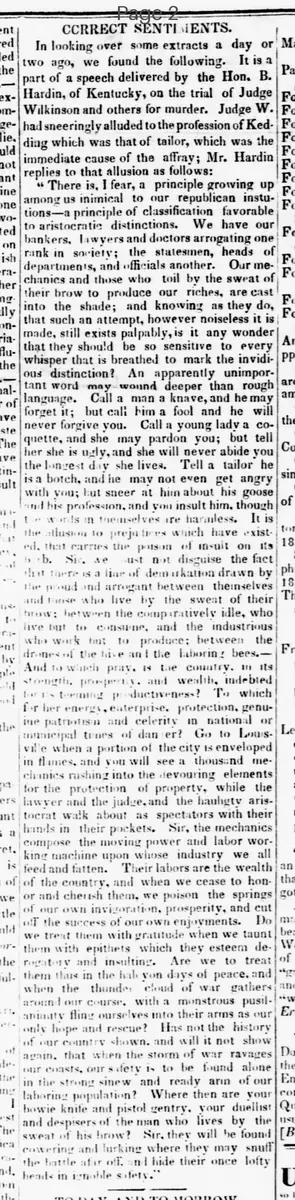
"There is, I fear, a principle growing up among us inimical to our republican institutions--a principle of classification favorable to aristocratic distinctions. We have our bankers, lawyers and doctors arrogating one rank in society; the statesmen, heads of departments, and officials another. Our mechanics and those who toil by the sweat of their brow to produce our riches, are cast into the shade; and knowing as they do, that such an attempt, however noiseless it is made, still exists palpably, is it any wonder that they should be so sensitive to every whisper that is breathed to mark the invidious distinction? An apparently unimportant word may wound deeper than rough language. Call a man a knave, and he may forget it; but call him a fool and he will never forgive you. Call a young lady a coquette, and she may pardon you; but tell her she is ugly, and she will never abide you the longest day she lives. Tell a tailor he is a botch, and he may not even get angry with you; but sneer at him about his goose and his profession, and you insult him, though the words in themselves are harmless. It is the allusion to prejudices which have existed, that carries the poison of insult on its wings. We must not disguise the fact but there is a line of demarcation drawn by the proud and arrogant between themselves and those who live by the sweat of their brow: between the comparatively idle, who live but to consume, and the industrious who work out to produce: between the drones of the hive and the laboring bees.-- And to which pray, is the Country, in its strength, progress, and wealth, indebted but to their productiveness? To which for her energy, enterprise, protection, genuine patriotism and celerity in national or municipal times of danger? Go to Louisville when a portion of the city is enveloped in flames, and you will see a thousand mechanics rushing into the devouring elements for the protection of property, while the lawyer and the judge, and the haughty aristocrat walk about as spectators with their hands in their pockets. Sir, the mechanics compose the moving power and labor working machine upon whose industry we all feed and fatten. Their labors are the wealth of the country, and when we cease to honor and cherish them, we poison the springs of our own invigoration, prosperity, and cut off the success of our own enjoyments. Do we treat them with gratitude when we taunt them with epithets which they esteem derogatory and insulting. Are we to treat them thus in the halcyon days of peace, and when the thunder cloud of war gathers around our course, with a monstrous pusillanimity fling ourselves into their arms as our only hope and rescue? Has not the history of our country shown, and will it not show again, that when the storm of war ravages our coasts, our safety is to be found alone in the strong sinew and ready arm of our laboring population? Where then are your bowie knife and pistol gentry, your duellist and despisers of the man who lives by the sweat of his brow? Sir, they will be found cowering and lurking where they may snuff the battle afar off, and hide their once lofty heads in ignoble safety."
In looking over some extracts a day or two ago, we found the following. It is a part of a speech delivered by the Hon. B. Hardin, of Kentucky, on the trial of Judge Wilkinson and others for murder. Judge W. had sneeringly alluded to the profession of Kedding which was that of tailor, which was the immediate cause of the affray; Mr. Hardin replies to that allusion as follows:
"There is, I fear, a principle growing up among us inimical to our republican institutions--a principle of classification favorable to aristocratic distinctions. We have our bankers, lawyers and doctors arrogating one rank in society; the statesmen, heads of departments, and officials another. Our mechanics and those who toil by the sweat of their brow to produce our riches, are cast into the shade; and knowing as they do, that such an attempt, however noiseless it is made, still exists palpably, is it any wonder that they should be so sensitive to every whisper that is breathed to mark the invidious distinction? An apparently unimportant word may wound deeper than rough language. Call a man a knave, and he may forget it; but call him a fool and he will never forgive you. Call a young lady a coquette, and she may pardon you; but tell her she is ugly, and she will never abide you the longest day she lives. Tell a tailor he is a botch, and he may not even get angry with you; but sneer at him about his goose and his profession, and you insult him, though the words in themselves are harmless. It is the allusion to prejudices which have existed, that carries the poison of insult on its wings. We must not disguise the fact but there is a line of demarcation drawn by the proud and arrogant between themselves and those who live by the sweat of their brow: between the comparatively idle, who live but to consume, and the industrious who work out to produce: between the drones of the hive and the laboring bees.-- And to which pray, is the Country, in its strength, progress, and wealth, indebted but to their productiveness? To which for her energy, enterprise, protection, genuine patriotism and celerity in national or municipal times of danger? Go to Louisville when a portion of the city is enveloped in flames, and you will see a thousand mechanics rushing into the devouring elements for the protection of property, while the lawyer and the judge, and the haughty aristocrat walk about as spectators with their hands in their pockets. Sir, the mechanics compose the moving power and labor working machine upon whose industry we all feed and fatten. Their labors are the wealth of the country, and when we cease to honor and cherish them, we poison the springs of our own invigoration, prosperity, and cut off the success of our own enjoyments. Do we treat them with gratitude when we taunt them with epithets which they esteem derogatory and insulting. Are we to treat them thus in the halcyon days of peace, and when the thunder cloud of war gathers around our course, with a monstrous pusillanimity fling ourselves into their arms as our only hope and rescue? Has not the history of our country shown, and will it not show again, that when the storm of war ravages our coasts, our safety is to be found alone in the strong sinew and ready arm of our laboring population? Where then are your bowie knife and pistol gentry, your duellist and despisers of the man who lives by the sweat of his brow? Sir, they will be found cowering and lurking where they may snuff the battle afar off, and hide their once lofty heads in ignoble safety."
What sub-type of article is it?
Labor
Social Reform
What keywords are associated?
Aristocratic Distinctions
Labor Value
Mechanics Role
Republican Institutions
Social Equality
Professional Insult
What entities or persons were involved?
Hon. B. Hardin
Judge Wilkinson
Kedding
Editorial Details
Primary Topic
Defense Of Mechanics And Laborers Against Aristocratic Distinctions
Stance / Tone
Critical Of Aristocracy, Supportive Of Labor Equality
Key Figures
Hon. B. Hardin
Judge Wilkinson
Kedding
Key Arguments
Principle Of Class Classification Threatens Republican Institutions
Mechanics Sensitive To Professional Insults Due To Existing Prejudices
Society's Wealth And Progress Depend On Laborers' Productivity
Mechanics Provide Protection In Crises Like Fires And Wars
Aristocrats Are Idle Spectators Or Cowards In Danger
Honoring Labor Is Essential For National Prosperity