Thank you for visiting SNEWPapers!
Sign up free
Editorial
June 29, 1937
The Key West Citizen
Key West, Monroe County, Florida
What is this article about?
Editorial critiques Governor Frank Murphy's statement prioritizing workers' rights over property in sit-down strikes, arguing that property rights are also human rights essential to social order and employment.
Clipping
OCR Quality
98%
Excellent
Full Text
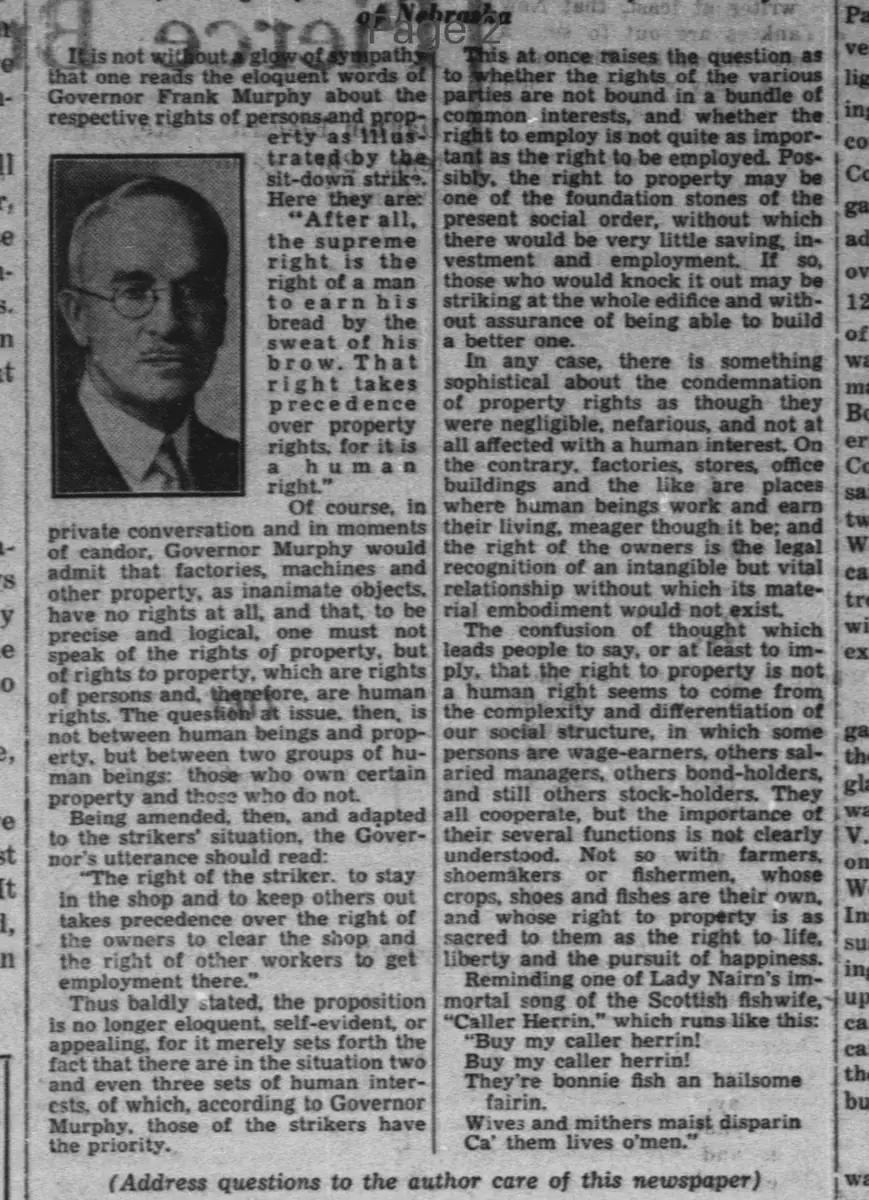
It is not without a glow of sympathy that one reads the eloquent words of Governor Frank Murphy about the respective rights of persons and property as illustrated by the sit-down strike.
Here they are:
"After all, the supreme right is the right of a man to earn his bread by the sweat of his brow. That right takes precedence over property rights, for it is a human right."
Of course, in private conversation and in moments of candor, Governor Murphy would admit that factories, machines and other property, as inanimate objects, have no rights at all, and that, to be precise and logical, one must not speak of the rights of property, but of rights to property, which are rights of persons and, therefore, are human rights. The question at issue, then, is not between human beings and property, but between two groups of human beings: those who own certain property and those who do not.
Being amended, then, and adapted to the strikers' situation, the Governor's utterance should read:
The right of the striker, to stay in the shop and to keep others out takes precedence over the right of the owners to clear the shop and the right of other workers to get employment there.
Thus baldly stated, the proposition is no longer eloquent, self-evident, or appealing, for it merely sets forth the fact that there are in the situation two and even three sets of human interests, of which, according to Governor Murphy, those of the strikers have the priority.
This at once raises the question as to whether the rights of the various parties are not bound in a bundle of common interests, and whether the right to employ is not quite as important as the right to be employed. Possibly, the right to property may be one of the foundation stones of the present social order, without which there would be very little saving, investment and employment. If so, those who would knock it out may be striking at the whole edifice and without assurance of being able to build a better one.
In any case, there is something sophistical about the condemnation of property rights as though they were negligible, nefarious, and not at all affected with a human interest. On the contrary, factories, stores, office buildings and the like are places where human beings work and earn their living, meager though it be: and the right of the owners is the legal recognition of an intangible but vital relationship without which its material embodiment would not exist.
The confusion of thought which leads people to say, or at least to imply, that the right to property is not a human right seems to come from the complexity and differentiation of our social structure, in which some persons are wage-earners, others salaried managers, others bond-holders, and still others stock-holders. They all cooperate, but the importance of their several functions is not clearly understood. Not so with farmers, shoemakers or fishermen, whose crops, shoes and fishes are their own, and whose right to property is as sacred to them as the right to life, liberty and the pursuit of happiness.
Reminding one of Lady Nairn's immortal song of the Scottish fishwife, "Caller Herrin," which runs like this:
"Buy my caller herrin!
Buy my caller herrin!
They're bonnie fish an hailsome fairin.
Wives and mithers maist disparin
Ca' them lives o' men."
Here they are:
"After all, the supreme right is the right of a man to earn his bread by the sweat of his brow. That right takes precedence over property rights, for it is a human right."
Of course, in private conversation and in moments of candor, Governor Murphy would admit that factories, machines and other property, as inanimate objects, have no rights at all, and that, to be precise and logical, one must not speak of the rights of property, but of rights to property, which are rights of persons and, therefore, are human rights. The question at issue, then, is not between human beings and property, but between two groups of human beings: those who own certain property and those who do not.
Being amended, then, and adapted to the strikers' situation, the Governor's utterance should read:
The right of the striker, to stay in the shop and to keep others out takes precedence over the right of the owners to clear the shop and the right of other workers to get employment there.
Thus baldly stated, the proposition is no longer eloquent, self-evident, or appealing, for it merely sets forth the fact that there are in the situation two and even three sets of human interests, of which, according to Governor Murphy, those of the strikers have the priority.
This at once raises the question as to whether the rights of the various parties are not bound in a bundle of common interests, and whether the right to employ is not quite as important as the right to be employed. Possibly, the right to property may be one of the foundation stones of the present social order, without which there would be very little saving, investment and employment. If so, those who would knock it out may be striking at the whole edifice and without assurance of being able to build a better one.
In any case, there is something sophistical about the condemnation of property rights as though they were negligible, nefarious, and not at all affected with a human interest. On the contrary, factories, stores, office buildings and the like are places where human beings work and earn their living, meager though it be: and the right of the owners is the legal recognition of an intangible but vital relationship without which its material embodiment would not exist.
The confusion of thought which leads people to say, or at least to imply, that the right to property is not a human right seems to come from the complexity and differentiation of our social structure, in which some persons are wage-earners, others salaried managers, others bond-holders, and still others stock-holders. They all cooperate, but the importance of their several functions is not clearly understood. Not so with farmers, shoemakers or fishermen, whose crops, shoes and fishes are their own, and whose right to property is as sacred to them as the right to life, liberty and the pursuit of happiness.
Reminding one of Lady Nairn's immortal song of the Scottish fishwife, "Caller Herrin," which runs like this:
"Buy my caller herrin!
Buy my caller herrin!
They're bonnie fish an hailsome fairin.
Wives and mithers maist disparin
Ca' them lives o' men."
What sub-type of article is it?
Labor
Economic Policy
Social Reform
What keywords are associated?
Sit Down Strike
Property Rights
Human Rights
Labor Rights
Governor Murphy
Employment
Social Order
What entities or persons were involved?
Governor Frank Murphy
Strikers
Owners
Workers
Editorial Details
Primary Topic
Critique Of Governor Murphy's Views On Sit Down Strikes And Property Rights
Stance / Tone
Defensive Of Property Rights As Human Rights, Critical Of Prioritizing Strikers
Key Figures
Governor Frank Murphy
Strikers
Owners
Workers
Key Arguments
Property Rights Are Human Rights Of Owners, Not Inanimate Objects
Sit Down Strike Pits Human Interests Against Each Other, Not Persons Vs. Property
Right To Employ Is As Important As Right To Be Employed
Property Rights Foundational To Social Order, Saving, Investment, And Employment
Condemnation Of Property Rights Is Sophistical; They Enable Human Work And Living