Thank you for visiting SNEWPapers!
Sign up free
Editorial
September 19, 1884
Daily Yellowstone Journal
Miles City, Custer County, Montana
What is this article about?
Editorial critiques persistent false theories about Americans, including shorter lifespans, excessive love of money, language corruption, and inability to enjoy leisure, noting Americans themselves believe the overwork myth.
Clipping
OCR Quality
95%
Excellent
Full Text
Some False Theories.
(Edward Eggleston's "The Glory," etc.)
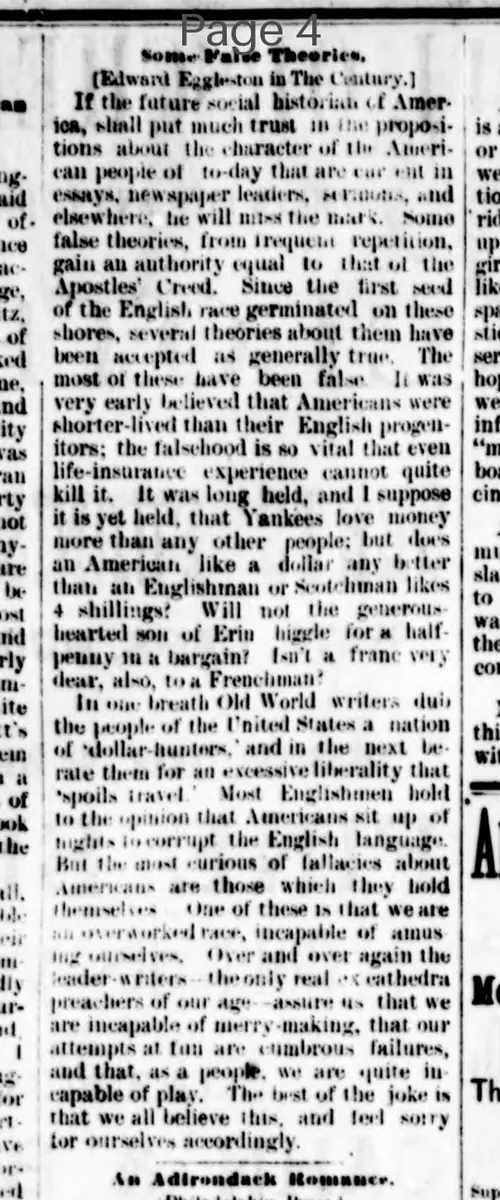
If the future social historian of America shall put much trust in the propositions about the character of the American people of to-day that are carried out in essays, newspaper leaders, sermons, and elsewhere, he will miss the mark. Some false theories, from frequent repetition, gain an authority equal to that of the Apostles' Creed. Since the first seed of the English race germinated on these shores, several theories about them have been accepted as generally true. The most of these have been false. It was very early believed that Americans were shorter-lived than their English progenitors; the falsehood is so vital that even life-insurance experience cannot quite kill it. It was long held, and I suppose it is yet held, that Yankees love money more than any other people; but does an American like a dollar any better than an Englishman or Scotchman likes 4 shillings? Will not the generous-hearted son of Erin haggle for a half-penny in a bargain? Isn't a franc very dear, also, to a Frenchman? In one breath Old World writers dub the people of the United States a nation of dollar-hunters,' and in the next berate them for an excessive liberality that "spoils travel." Most Englishmen hold to the opinion that Americans sit up o' nights to corrupt the English language. But the most curious of fallacies about Americans are those which they hold themselves. One of these is that we are an overworked race, incapable of amusing ourselves. Over and over again the leader-writers—the only real ease-the-drama preachers of our age—assure us that we are incapable of merry-making, that our attempts at fun are cumbrous failures, and that, as a people, we are quite incapable of play. The best of the joke is that we all believe this, and lead our lives accordingly.
(Edward Eggleston's "The Glory," etc.)
If the future social historian of America shall put much trust in the propositions about the character of the American people of to-day that are carried out in essays, newspaper leaders, sermons, and elsewhere, he will miss the mark. Some false theories, from frequent repetition, gain an authority equal to that of the Apostles' Creed. Since the first seed of the English race germinated on these shores, several theories about them have been accepted as generally true. The most of these have been false. It was very early believed that Americans were shorter-lived than their English progenitors; the falsehood is so vital that even life-insurance experience cannot quite kill it. It was long held, and I suppose it is yet held, that Yankees love money more than any other people; but does an American like a dollar any better than an Englishman or Scotchman likes 4 shillings? Will not the generous-hearted son of Erin haggle for a half-penny in a bargain? Isn't a franc very dear, also, to a Frenchman? In one breath Old World writers dub the people of the United States a nation of dollar-hunters,' and in the next berate them for an excessive liberality that "spoils travel." Most Englishmen hold to the opinion that Americans sit up o' nights to corrupt the English language. But the most curious of fallacies about Americans are those which they hold themselves. One of these is that we are an overworked race, incapable of amusing ourselves. Over and over again the leader-writers—the only real ease-the-drama preachers of our age—assure us that we are incapable of merry-making, that our attempts at fun are cumbrous failures, and that, as a people, we are quite incapable of play. The best of the joke is that we all believe this, and lead our lives accordingly.
What sub-type of article is it?
Satire
Social Reform
What keywords are associated?
False Theories
American Character
Stereotypes
Overwork Myth
Money Obsession
Language Corruption
What entities or persons were involved?
Edward Eggleston
Editorial Details
Primary Topic
False Theories About The American People
Stance / Tone
Critical And Ironic Debunking Of Misconceptions
Key Figures
Edward Eggleston
Key Arguments
Americans Are Not Shorter Lived Than English Progenitors
Yankees Do Not Love Money More Than Other Nationalities
Americans Are Accused Of Both Dollar Hunting And Excessive Liberality
English Believe Americans Corrupt The Language
Americans Wrongly Believe They Are An Overworked Race Incapable Of Amusement