Thank you for visiting SNEWPapers!
Sign up free
The Rhode Island American, And General Advertiser
Providence, Providence County, Rhode Island
What is this article about?
Reports on U.S. Senate and House proceedings from late 1813 to early 1814, covering bills on militia, navigation, navy, imports, patents, and military appointments, plus petitions and resolutions related to the War of 1812.
Merged-components note: These components form a single coherent report on congressional proceedings, with continuous text flow from Senate and House sessions.
Clippings
1 of 2
OCR Quality
Full Text
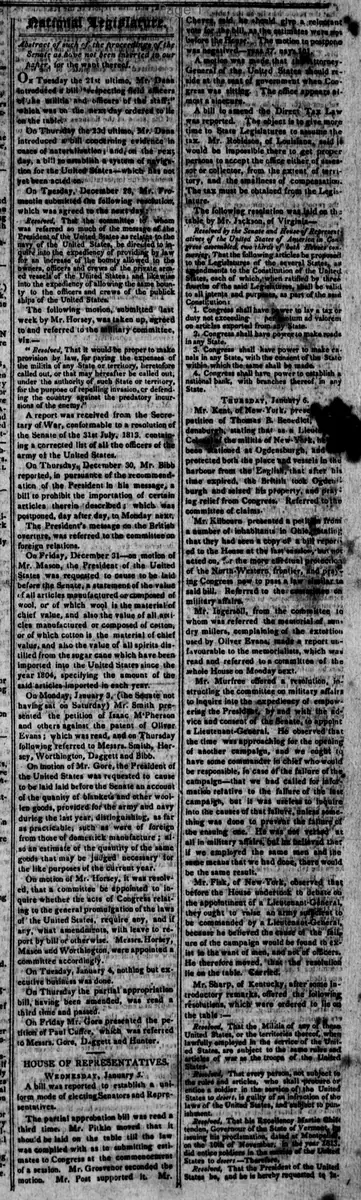
On Tuesday the 21st ultimo, Mr. Dana introduced a bill respecting field officers of the Militia and officers of the staff which was on the next day ordered to lie on the table.
On Thursday the 23d ultimo, Mr. Dana introduced a bill concerning evidence in cases of naturalization; and on the next day, a bill to establish a system of navigation for the United States - which has not yet been acted on.
On Tuesday, December 28, Mr. Frost submitted the following resolution which was agreed to the next day.
Resolved, That the committee to whom was referred so much of the message of the President of the United States as relates to the navy of the United States, be directed to inquire into the expediency of providing by law for an increase of the bounty allowed to the owners, officers and crews of the private armed vessels of the United States; and likewise into the expediency of allowing the same bounty to the officers and crews of the public ships of the United States.
The following motion, submitted last week by Mr. Horsey, was taken up, agreed to and referred to the military committee, Viz.
Resolved, That it would be proper to make provision by law, for paying the expenses of the militia of any State or territory, heretofore called out, or that may hereafter be called out, under the authority of such State or territory, for the purpose of repelling invasion, or defending the country against the predatory incursions of the enemy.
A report was received from the Secretary of War, conformable to a resolution of the Senate of the 31st July 1813, containing a corrected list of all the officers of the army of the United States.
On Thursday, December 30, Mr. Bibb reported, in pursuance of the recommendation of the President in his message, a bill to prohibit the importation of certain articles therein described which was postponed, day after day, to Monday next.
The President's message on the British overture, was referred to the committee on foreign relations.
On Friday, December 31, on motion of Mr. Mason, the President of the United States was requested to cause to be laid before the Senate, a statement of the value of all articles manufactured or composed of wool, or of which wool is the material of chief value, and also the value of all articles manufactured or composed of cotton, or of which cotton is the material of chief value, and also the value of all spirits distilled from the sugar cane which have been imported into the United States since the year 1804, specifying the amount of the said articles imported in each year.
On Monday, January 3 (the Senate not having sat on Saturday) Mr. Smith presented the petition of Isaac M Pherson and others against the patent of Oliver Evans; which was read, and on Thursday following referred to Messrs. Smith, Horsey, Worthington, Daggett and Bibb.
On motion of Mr. Gore, the President of the United States was requested to cause to be laid before the Senate an account of the quantity of blankets and other woollen goods, provided for the army and navy during the last year, distinguishing, as far as practicable, such as were of foreign from those of domestick manufacture; also an estimate of the quantity of the same goods that may be judged necessary for the like purposes of the current year.
On motion of Mr. Horsey, it was resolved, that a committee be appointed to inquire whether the acts of Congress relating to the general promulgation of the laws of the United States require any, and if any, what amendments, with leave to report by bill or otherwise. Messrs. Horsey, Mason and Worthington, were appointed a committee accordingly.
On Tuesday, January 4 nothing but executive business was done.
On Thursday the partial appropriation bill, having been amended, was read a third time and passed.
On Friday Mr. Gore presented the petition of Paul Cuffee, which was referred to Messrs. Gore, Daggett and Hunter.
HOUSE OF REPRESENTATIVES.
Wednesday, January 5.
A bill was reported to establish uniform mode of electing Senators and Representatives.
The partial appropriation bill was read a third time. Mr. Pitkin moved that it should be laid on the table till the law was complied with as to submitting estimates to Congress at the commencement of a session. Mr. Grosvenor seconded the motion. Mr. Post supported it. Mr. Cheves said he should give a reluctant vote for the bill as the estimates were not before the House. The motion to postpone was negatived 85 to 101.
A motion was made that the Attorney-General of the United States should reside at the seat of government when Congress was sitting. The office appears almost a sinecure.
A bill to amend the Direct Tax Law was reported. The object is to give more time to State Legislatures to assume the tax. Mr. Robertson, of Louisiana said it would be impossible there to get proper persons to accept the office either of assessor or collector, from the extent of territory, and the smallness of compensation. The tax must be obtained from the Legislature.
The following resolution was laid on the table by Mr. Jackson, of Virginia-
Resolved by the Senate and House of Representatives of the United States of America in Congress assembled, two thirds of both Houses concurring: That the following articles be proposed to the Legislatures of the several States, as amendments to the Constitution of the United States, each of which, when ratified by three fourths of the said Legislatures, shall be valid to all intents and purposes, as part of the said Constitution:
1. Congress shall have power to lay a tax or duty not exceeding per centum ad valorem on articles exported from any State.
2. Congress shall have power to make roads in any State.
3. Congress shall have power to make canals in any State, with the consent of the State within which the same shall be made.
4. Congress shall have power to establish a national bank, with branches thereof in any State.
Thursday, January 6.
Mr. Kent, of New York, presented petition of Thomas B. Benedict of Ogdensburgh stating that as Lieut. Colonel of the militia of New York, he had been stationed at Ogdensburgh, and protected both the place and vessels in the harbour from the English; that after his time expired the British took Ogdensburgh and seized his property, and praying relief from Congress. Referred to the committee of claims.
Mr. Kilbourn presented a petition from a number of inhabitants in Ohio State stating that they had seen a copy of a bill reported to the House at the last session, but not acted on, for the more effectual protection of the North-Western frontier, and praying Congress to pass a similar bill. Referred to the committee on military affairs.
Mr. Ingersoll, from the committee to whom was referred the memorial of sundry millers, complaining of the extortion used by Oliver Evans, made a report unfavourable to the memorialists, which was read and referred to a committee of the whole House on Monday next.
Mr. Murfree offered resolution instructing the committee on military affairs to inquire into the expediency of empowering the President, by and with the advice and consent of the Senate, to appoint a Lieutenant-General. He observed that the time was approaching for the opening of another Campaign, and we ought to have some commander in chief who would be responsible, in case of the failure of the campaign-that we had called for information relative to the failure of the last campaign, but it was useless to inquire into the causes of that failure, unless something was done to prevent the failure of the ensuing one. He was not versed at all in military affairs but he believed that if we employed the same men and the same means that we had done, there would be the same result.
Mr. Fisk, of New York, observed that before the House undertook to debate of the appointment of a Lieutenant-General, they ought to raise an army sufficient to be commanded by a Lieutenant-General, because he believed the cause of the failure of the campaign would be found to exist in the want of men, and not of officers. He therefore moved that the resolution lie on the table. Carried.
Mr. Sharp, of Kentucky after some introductory remarks, offered the following resolutions, which were ordered to lie on the table.
Resolved, That the Militia of any of the United States lawfully employed in the service of the United States, are subject to the same rules and articles of war as the troops of the United States.
Resolved, That every person, not subject to the rules and articles, who shall procure or entice a soldier, in the service of the United States to desert, is guilty of an infraction of the laws of the United States, and subject to punishment.
Resolved, That his Excellency Martin Chittenden, Governour of the State of Vermont by issuing his proclamation, dated at Montpelier on the 10th of November, in the year 1813, did entice soldiers in the service of the United States to desert. Therefore,
Resolved, That the President of the United States be, and he is hereby requested to issue a proclamation, denouncing the said Martin Chittenden as an enemy to his country.
SENATE.
Monday, December 10.
Mr. Gore, from the committee appointed on the memorial of Paul Cuffee, made a report favorable to the prayer of the memorialist, and also reported a bill authorizing the President of the United States under such regulations as he may prescribe, to allow the petitioner to depart from the United States, with vessel for Sierra Leone, and to return to this country.
Mr. Campbell, from the committee on military affairs, reported a bill authorizing the President of the United States to cause certain regiments to be enlisted for the term of five years or during the war, which was twice read.
On motion of Mr. Dana, the bill concerning evidences in cases of naturalization, was referred to a select committee; on which Messrs. Dana, Taylor and Mason were appointed.
On motion of Mr. Daggett, a select committee composed of Messrs. Daggett, Brown and Gore were appointed to inquire into the propriety of making provisions by law concerning fees or costs in the courts of the United States. Adjourned.
What sub-type of article is it?
What keywords are associated?
What entities or persons were involved?
Where did it happen?
Domestic News Details
Primary Location
Washington
Event Date
November 1813 January 1814
Key Persons
Event Details
Abstract of Senate proceedings including bills on field officers of militia, evidence in naturalization cases, system of navigation, resolution on navy bounties, provision for militia expenses, report on army officers, bill to prohibit importation of certain articles, request for statements on wool, cotton, and spirits imports, petition against Oliver Evans patent, request for account of woolen goods, resolution on promulgation of laws, and report on Paul Cuffee memorial. House proceedings include bill on electing Senators and Representatives, partial appropriation bill, motion on Attorney-General residence, bill to amend Direct Tax Law, resolution proposing constitutional amendments on export tax, roads, canals, national bank, petition from Thomas B. Benedict, petition from Ohio inhabitants on frontier protection, report on millers' memorial against Oliver Evans, resolution on appointing Lieutenant-General, and resolutions on militia rules and Martin Chittenden's proclamation.