Thank you for visiting SNEWPapers!
Sign up free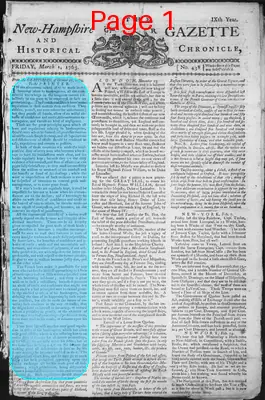
Letter to Editor
March 1, 1765
The New Hampshire Gazette And Historical Chronicle
Portsmouth, Greenland, Rockingham County, New Hampshire
What is this article about?
A letter from the Craftsman advocating for reforms to British bankruptcy laws, inspired by superior French and Dutch regulations that simplify processes, punish fraud and negligence, protect honest merchants, and promote integrity in trade.
Clipping
OCR Quality
98%
Excellent
Full Text
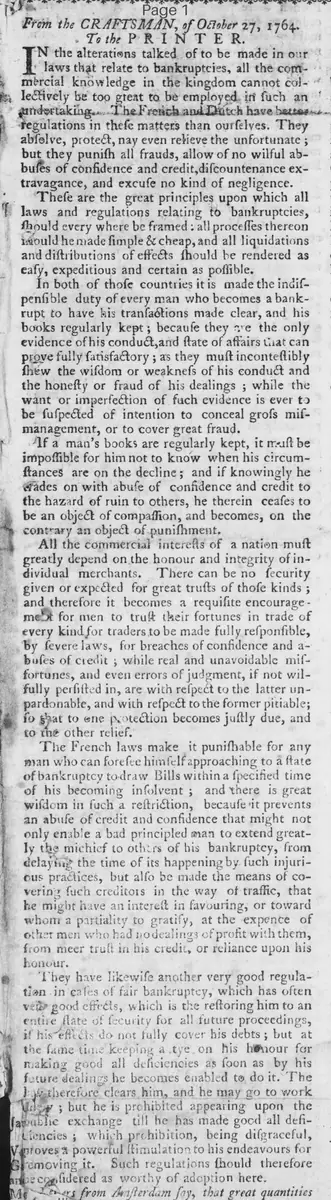
From the CRAFTSMAN, of October 27, 1764.
To the PRINTER.
In the alterations talked of to be made in our laws that relate to bankruptcies, all the commercial knowledge in the kingdom cannot collectively be too great to be employed in such an undertaking. The French and Dutch have better regulations in these matters than ourselves. They absolve, protect, nay even relieve the unfortunate; but they punish all frauds, allow of no wilful abuses of confidence and credit, discountenance extravagance, and excuse no kind of negligence.
These are the great principles upon which all laws and regulations relating to bankruptcies, should every where be framed: all processes thereon should be made simple & cheap, and all liquidations and distributions of effects should be rendered as easy, expeditious and certain as possible.
In both of those countries it is made the indispensable duty of every man who becomes a bankrupt to have his transactions made clear, and his books regularly kept; because they are the only evidence of his conduct, and state of affairs that can prove fully satisfactory; as they must inconceivably show the wisdom or weakness of his conduct and the honesty or fraud of his dealings; while the want or imperfection of such evidence is ever to be suspected of intention to conceal gross mismanagement, or to cover great fraud.
If a man's books are regularly kept, it must be impossible for him not to know when his circumstances are on the decline; and if knowingly he trades on with abuse of confidence and credit to the hazard of ruin to others, he therein ceases to be an object of compassion, and becomes, on the contrary an object of punishment.
All the commercial interests of a nation must greatly depend on the honour and integrity of individual merchants. There can be no security given or expected for great trusts of those kinds; and therefore it becomes a requisite encouragement for men to trust their fortunes in trade of every kind for traders to be made fully responsible, by severe laws, for breaches of confidence and abuses of credit: while real and unavoidable misfortunes, and even errors of judgment, if not wilfully persisted in, are with respect to the latter unpardonable, and with respect to the former pitiable; so that to one protection becomes justly due, and to the other relief.
The French laws make it punishable for any man who can foresee himself approaching to a state of bankruptcy to draw Bills within a specified time of his becoming insolvent; and there is great wisdom in such a restriction, because it prevents an abuse of credit and confidence that might not only enable a bad principled man to extend greatly the mischief to others of his bankruptcy, from delaying the time of its happening by such injurious practices, but also be made the means of covering such creditors in the way of traffic, that he might have an interest in favouring, or toward whom a partiality to gratify, at the expense of other men who had no dealings of profit with them, from meer trust in his credit, or reliance upon his honour.
They have likewise another very good regulation in cases of fair bankruptcy, which has often very good effects, which is the restoring him to an entire state of security for all future proceedings, if his effects do not fully cover his debts; but at the same time keeping a tie on his honour for making good all deficiencies as soon as by his future dealings he becomes enabled to do it. The law therefore clears him, and he may go to work freely; but he is prohibited appearing upon the public exchange till he has made good all deficiencies; which prohibition, being disgraceful, proves a powerful stimulation to his endeavours for removing it. Such regulations should therefore be considered as worthy of adoption here.
To the PRINTER.
In the alterations talked of to be made in our laws that relate to bankruptcies, all the commercial knowledge in the kingdom cannot collectively be too great to be employed in such an undertaking. The French and Dutch have better regulations in these matters than ourselves. They absolve, protect, nay even relieve the unfortunate; but they punish all frauds, allow of no wilful abuses of confidence and credit, discountenance extravagance, and excuse no kind of negligence.
These are the great principles upon which all laws and regulations relating to bankruptcies, should every where be framed: all processes thereon should be made simple & cheap, and all liquidations and distributions of effects should be rendered as easy, expeditious and certain as possible.
In both of those countries it is made the indispensable duty of every man who becomes a bankrupt to have his transactions made clear, and his books regularly kept; because they are the only evidence of his conduct, and state of affairs that can prove fully satisfactory; as they must inconceivably show the wisdom or weakness of his conduct and the honesty or fraud of his dealings; while the want or imperfection of such evidence is ever to be suspected of intention to conceal gross mismanagement, or to cover great fraud.
If a man's books are regularly kept, it must be impossible for him not to know when his circumstances are on the decline; and if knowingly he trades on with abuse of confidence and credit to the hazard of ruin to others, he therein ceases to be an object of compassion, and becomes, on the contrary an object of punishment.
All the commercial interests of a nation must greatly depend on the honour and integrity of individual merchants. There can be no security given or expected for great trusts of those kinds; and therefore it becomes a requisite encouragement for men to trust their fortunes in trade of every kind for traders to be made fully responsible, by severe laws, for breaches of confidence and abuses of credit: while real and unavoidable misfortunes, and even errors of judgment, if not wilfully persisted in, are with respect to the latter unpardonable, and with respect to the former pitiable; so that to one protection becomes justly due, and to the other relief.
The French laws make it punishable for any man who can foresee himself approaching to a state of bankruptcy to draw Bills within a specified time of his becoming insolvent; and there is great wisdom in such a restriction, because it prevents an abuse of credit and confidence that might not only enable a bad principled man to extend greatly the mischief to others of his bankruptcy, from delaying the time of its happening by such injurious practices, but also be made the means of covering such creditors in the way of traffic, that he might have an interest in favouring, or toward whom a partiality to gratify, at the expense of other men who had no dealings of profit with them, from meer trust in his credit, or reliance upon his honour.
They have likewise another very good regulation in cases of fair bankruptcy, which has often very good effects, which is the restoring him to an entire state of security for all future proceedings, if his effects do not fully cover his debts; but at the same time keeping a tie on his honour for making good all deficiencies as soon as by his future dealings he becomes enabled to do it. The law therefore clears him, and he may go to work freely; but he is prohibited appearing upon the public exchange till he has made good all deficiencies; which prohibition, being disgraceful, proves a powerful stimulation to his endeavours for removing it. Such regulations should therefore be considered as worthy of adoption here.
What sub-type of article is it?
Informative
Persuasive
Ethical Moral
What themes does it cover?
Commerce Trade
Economic Policy
Morality
What keywords are associated?
Bankruptcy Laws
Commercial Regulations
Fraud Punishment
Merchant Integrity
French Laws
Dutch Regulations
Trade Credit
What entities or persons were involved?
To The Printer
Letter to Editor Details
Recipient
To The Printer
Main Argument
british bankruptcy laws should be reformed based on french and dutch models to simplify processes, punish fraud and negligence, protect honest merchants from undue hardship, and ensure accountability through regular bookkeeping and restrictions on abusive practices.
Notable Details
References French And Dutch Bankruptcy Regulations
Emphasizes Importance Of Regular Bookkeeping As Evidence Of Conduct
Highlights Punishment For Drawing Bills Near Insolvency
Describes Restoration To Security With Honor Based Repayment Obligation