Thank you for visiting SNEWPapers!
Sign up free
Lynchburg Virginian
Lynchburg, Virginia
What is this article about?
Letter from J.R. Poinsett to Sen. A.P. Butler (Dec. 12, 1847) critiques U.S. Mexican War policy, opposing territorial acquisitions, creating a peace party, and prolonged campaigns; warns of high casualties and recommends withdrawal, securing borders, and potential peace.
Clipping
OCR Quality
Full Text
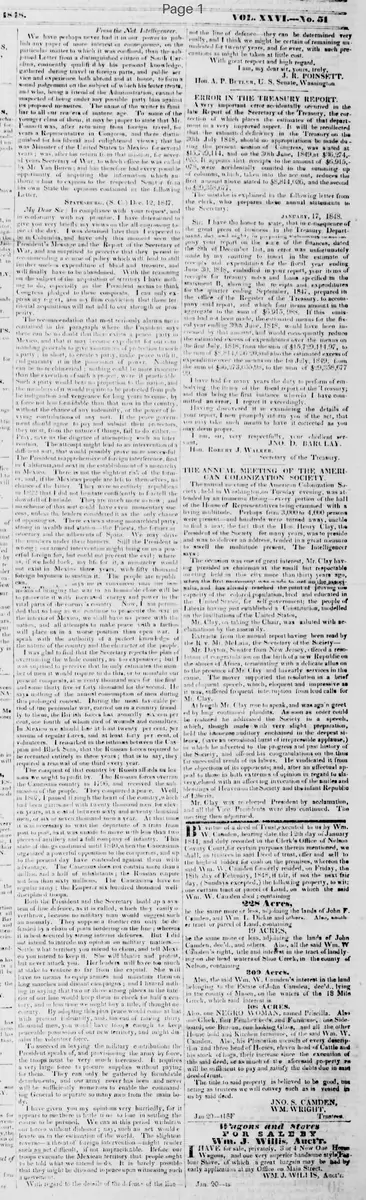
We have perhaps never had it in our power to publish any paper of more interest or consequence, on the particular matter to which it was confined, than the subjoined Letter from a distinguished citizen of South Carolina, eminently qualified by his personal knowledge, gathered during travel in foreign parts, and public service and experience both abroad and at home, to form a sound judgment on the subject of which his letter treats. And who, being a friend of the Administration, cannot be suspected of being under any possible party bias against its proposed measures. The name of the writer is familiar to all our readers of mature age. To some of the younger class of them, it may be proper to state that Mr. Poinsett was, after returning from foreign travel, for years a Representative in Congress, and there distinguished for his liberal and enlightened views; that he was Minister of the United States to Mexico for several years; was, after his return from that mission, for several years Secretary of War, to which office he was called by Mr. Van Buren; and has therefore had every possible opportunity of acquiring the information which authorizes him to express to the respected Senator from his own State the opinions contained in the following Letter.
STATESBURG, (S.C.) Dec. 12, 1847.
My Dear Sir: In compliance with your request, and in conformity with my promise, I have determined to give you very briefly my views on the all engrossing topics of the day. I was detained later than I expected to be in Columbia, and have only this moment seen the President's Message and the Report of the Secretary of War, and am surprised to perceive that they persist in recommending a course of policy which will lead to still further useless expenditure of blood and treasure, and will finally have to be abandoned. With the reasoning on the subject of the acquisition of territory I have nothing to do, especially as the President seems to think Congress pledged to these conquests. I can only express my regret, and my firm conviction that these territorial acquisitions will not add to our strength or prosperity.
The recommendation that most seriously alarms me is contained in the paragraph where the President says there can be no doubt that there exists a peace party in Mexico, and that it may become expedient for our commanding generals to give assurances of protection to such a party; in short, to create a party, make peace with it, and guaranty it in the possession of power. Nothing can be more chimerical; nothing could be more insecure than the execution of such a project, were it practicable. Such a party would bear no proportion to the nation, and the members of it would require to be protected from public indignation and vengeance for long years to come, by a force not less formidable than that now in the country, without the chance of any indemnity, or the power of levying contributions of any sort. If the peace government should agree to pay and subsist their protectors, they must, from the nature of things, fail to do either. Pray, save me the disgrace of attempting such an intervention. The attempt might lead to an intervention of a different sort, that would possibly prove more successful.
The President is apprehensive of foreign interference, first in California, and next in the establishment of a monarchy in Mexico. There is not the slightest risk of the former, and, if the Mexican people are left to themselves, no chance of the latter. They were so entirely republican in 1822 that I did not hesitate confidently to foretell the downfall of Iturbide. They are much more so now, and no scheme of that sort could have even momentary success, unless the leaders considered it as the only chance of opposing us. There exists a strong monarchical party, strong in wealth and station: the Priests, the former aristocracy and the adherents of Spain. We may drive the masses under their banners. Still the President is wrong: our armed intervention might bring on us a powerful foreign foe, but could not prevent the evil; whereas, if we hold back, my life for it, a monarchy would not exist in Mexico three years, with fifty thousand foreign bayonets to sustain it. The people are republican. I am convinced that the means of bringing the war to an honorable close will be to prosecute it with increased energy and power in the vital parts of the enemy's country. Now, I am persuaded that so long as we continue to prosecute the war in the interior of Mexico, we shall have no peace with the nation, and all attempts to make peace with a faction will place us in a worse position than open war. I speak with the authority of a perfect knowledge of the nature of the country and the character of the people.
I was glad to find that the Secretary rejects the plan of overrunning the whole country, as too expensive; but I was surprised to perceive that he only estimates the number of men it would require to do this, or to maintain our present conquests, at seventy thousand men for the first and some thirty five or forty thousand for the second. He says nothing of the annual consumption of men during this prolonged contest. During the most favorable period of the peninsular war, carried on in a country friendly to them, the British forces lost annually sixteen per cent, one fourth of whom died of wounds and casualties. In Mexico we should lose at least twenty per cent. per annum of regular forces, and at least forty per cent. of volunteers. I remarked in the isthmus between the Caspian and Black Seas, that the Russian forces required to be recruited entirely in three years; that is to say, they required a renewal of one third every year.
The conquest of that country by Russia affords us a lesson we ought to profit by. The Russian forces overran the Caucasian country in 1785, and received the submission of the people. They conquered a peace. Well, in 1828, I passed through the heart of the country, which had been garrisoned with twenty thousand men for thirty years, at a cost of between sixty and seventy thousand men, or six or seven thousand men a year. At that time it was necessary to wait the departure of a train from post to post, as it was unsafe to move with less than two pieces of artillery and a full company of infantry. This state of things continued until 1840, when the Caucasians organized a powerful opposition to the conquerors, and up to the present day have contended against them with advantage. The Caucasus does not contain more than a million and a half of inhabitants; the Russian empire not less than sixty millions. The Caucasians have no regular army; the Emperor six hundred thousand well disciplined troops.
Both the President and the Secretary build up a system of line of defence, as it is called, which they easily overthrow, because no military man would suggest such an anomaly. They suppose a frontier can only be defended by a chain of posts bordering on the line; whereas it is best secured by strong interior defences. But I did not intend to intrude my opinion on military matters. Settle what territory you intend to claim, and tell Mexico you intend to keep it. She will bluster and protest, but never attack you. Her leaders will have too much at stake to venture so far from the capital. She will have no means to equip armies and maintain them on long marches and distant campaigns; and I hazard nothing in saying that two or three strong places in the interior of our line would keep them in check for half a century, and in less time we might buy a title, if thought necessary. By adopting this plan peace would come at last with present indemnity, and, instead of raising thirty thousand men, you would have troops enough to keep peaceable possession of our new territory, and might dismiss the volunteer force.
To succeed in levying the military contributions the President speaks of, and provisioning the army by force, the troops must be very much increased. It requires a very large force to procure supplies without paying for them. They can only be gathered by formidable detachments, and our army never has been and never will be sufficiently numerous to enable the commanding General to separate so many men from the main body.
I have given you my opinions very hurriedly, for it appears to me there is little time to lose in settling the course to be pursued. We can at this period withdraw our forces without dishonor; nay, such an act would elevate us in the estimation of the world. The slightest reverse--a threat of foreign intervention--might render such an act difficult, if not impracticable. Before our troops evacuate the Mexican territory that people ought to be told what we intend to do. It is barely possible that they might be disposed to peace upon witnessing such a movement.
With regard to the details of the defence of the line--not the line of defence--they can be determined very easily, and I think we might be certain of remaining unmolested for twenty years, and for ever, with such precautions as might be taken at little cost.
With great respect and high regard,
I am, my dear sir, yours, truly,
J. R. POINSETT.
Hon. A. P. BUTLER, U. S. Senate, Washington
What sub-type of article is it?
What keywords are associated?
What entities or persons were involved?
Where did it happen?
Foreign News Details
Primary Location
Mexico
Event Date
Dec. 12, 1847
Key Persons
Outcome
high projected casualties (20-40% annually); recommends withdrawal without dishonor, securing territory with minimal forces, potential peace and indemnity.
Event Details
J.R. Poinsett's letter criticizes U.S. policy in the Mexican War, opposing territorial acquisitions, creating a peace party, and interior campaigns; warns of unsustainable losses based on historical examples; suggests declaring and holding claimed territory with strong interior defenses to achieve peace.