Thank you for visiting SNEWPapers!
Sign up free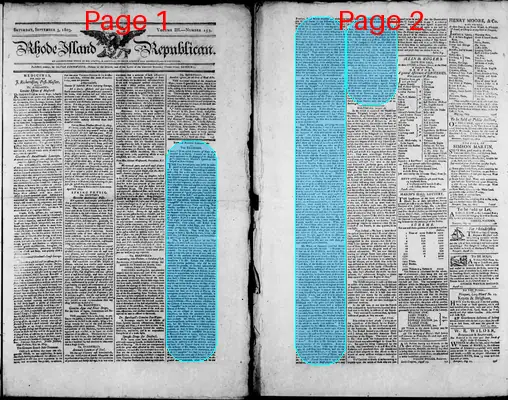
Rhode Island Republican
Newport, Newport County, Rhode Island
What is this article about?
This editorial from the Boston Chronicle criticizes Federalist 'War Hawks' like Jonathan Mason, James Ross, and others for inconsistent stances on the Louisiana Purchase, quoting their past speeches emphasizing the vital commercial and strategic importance of the Mississippi River and New Orleans, while now depreciating the territory as worthless wilderness.
Merged-components note: This is a continuation of the editorial piece across pages 1 and 2, based on sequential reading order and direct textual continuation.
Clippings
1 of 2
OCR Quality
Full Text
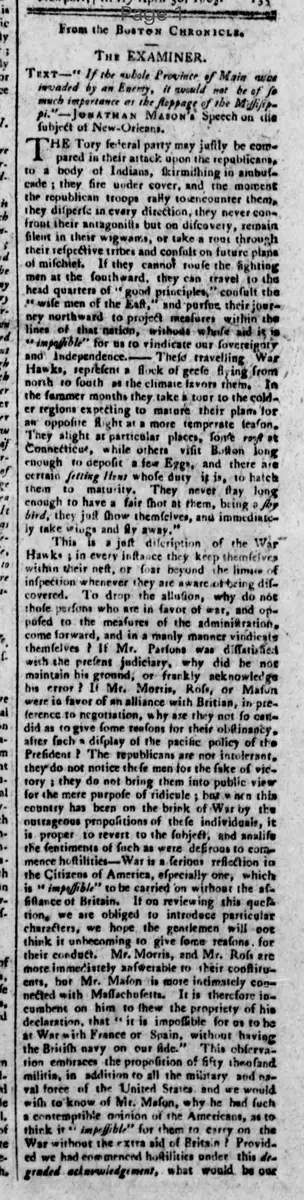
The EXAMINER.
Text—"If the whole Province of Maine were
invaded by an Enemy, it would not be of so
much importance as the Stoppage of the Mississippi."
—JONATHAN MASON Speech on the
Subject of New-Orleans.
THE Tory federal party may justly be compared to a body of Indians, skirmishing in ambuscade; they strike under cover, and the moment the republican troops rally to encounter them, they disperse in every direction, they never confront their antagonists but on discovery, retreat silent in their wigwams, or take a tour through their respective tribes and consult on future plans of mischief. If they cannot rouse the fighting men at the southward, they can travel to the head quarters of "good principles," consult the "wise men of the East," and pursue their journey northward to project measures within the lines of that nation, without whose aid it is "impossible" for us to vindicate our sovereignty and Independence. These travelling, War Hawks, represent a flock of geese flying from north to south as the climate favors them. In the summer months they take a tour to the colder regions expecting to mature their plans, for an opposite flight at a more temperate season. They alight at particular places, one roost at Connecticut, while others visit Boston long enough to deposit a few Eggs, and there are certain sitting hens whose duty it is, to hatch them to maturity. They never stay long enough to have a fair shot at them, being a shy bird, they just show themselves, and immediately take wings and fly away."
This is a just description of the War Hawks: in every instance they keep themselves within their nest, or soar beyond the limits of inspection whenever they are aware of being discovered. To drop the allusion, why do not those persons who are in favor of war, and opposed to the measures of the administration, come forward, and in a manly manner vindicate themselves? If Mr. Parsons was dissatisfied with the present judiciary, why did he not maintain his ground; or frankly acknowledge his error? If Mr. Morris, Ross, or Mason were in favor of an alliance with Britain, in preference to negotiation, why are they not so candid as to give some reasons for their obstinacy, after such a display of the pacific policy of the President? The republicans are not intolerant, they do not notice these men for the sake of victory; they do not bring them into public view for the mere purpose of ridicule; but when this country has been on the brink of War by the outrageous propositions of these individuals, it is proper to revert to the subject, and analyze the sentiments of such as were desirous to commence hostilities—War is a serious reflection to the Citizens of America, especially one, which is "impossible" to be carried on without the assistance of Britain. If on reviewing this question we are obliged to introduce particular character, we hope the gentlemen will not think it unbecoming to give some reasons, for their conduct. Mr. Morris, and Mr. Ross are more immediately answerable to their constituents, but Mr. Mason is more intimately connected with Massachusetts. It is therefore incumbent on him to show the propriety of his declaration, that "it is impossible for us to be at War with France or Spain, without having the British navy on our side." This observation embraces the proposition of fifty thousand militia, in addition to all the military and naval force of the United States, and we would wish to know of Mr. Mason, why he had such a contemptible opinion of the Americans, as to think it "impossible" for them to carry on the War without the extra aid of Britain? Provided we had commenced hostilities under this degraded acknowledgement, what would be our Situation, if the British ministry had replied to the United States in the following language,
"That it was impossible for them to help us; that the war in which they were engaged called forth all their energies to protect themselves, and that Bonaparte was so closely besieging even the island of Great Britain, that every man, woman & child were nearly under requisition to defend their own territory; that while we were contending for New Orleans in expectation of their succour, the island of Great Britain itself was in jeopardy by their folly in commencing war so long after they were exhausted by their former exertions." They might even at this juncture suggest the imprudence of our reliance on them, when we had so many instances of their failing in defending other nations who had within ten years trusted to their omnipotence. On reflection, Mr. Mason must be ashamed of his declaration, and if he is possessed of the smallest ingredient of candor, he must humbly acknowledge his ignorance, and give his hearty approbation of the measures of the administration.
At the War Hawks now attempt to depreciate the acquisition of Louisiana, and represent the territory "as a wilderness, inhabited only by savages" of little importance, a "mere whistle," and not worth the purchase or acceptance of the United States; that we ought not to close with the proposition of the French at the price proposed by the Treaty; after thus depreciating the ultimatum of the negotiation, we will now exhibit to the public the value the War Hawks themselves set on the island of New-Orleans, when war, horrid war! was the object contemplated. If this island for a place of deposit was so highly esteemed, what must be the value of the whole territory? Let "Fabricius," the speaking trumpet of the faction answer this question; but this here is reserved for a more delicate repast.
Read, Fellow-Citizens, and judge for yourselves. Mr. Ross admits, "that if France holds the Mississippi, they will have the command of the fortunes of those who inhabit the Western waters." He declares, that Bonaparte might tell the United States, "my French West-India Colonies, and those of my allies can be supplied from my Colony of Louisiana with flour, pork, beef, lumber and any other necessary."
"That these articles can be carried by French ships, and navigated by French sailors"—That if the United States "on the Atlantic coast with to trade with the French Colonies in those articles, they might be exposed to pay 15 or 20 per cent. import"—"That France would want no further supplies from us, and that a recurrence to them must be the condition of all our future intercourse"—"That the Mississippi was the great and only highway of commerce from the Western country to the Ocean." These are the sentiments of Mr. Ross on the commercial importance of Louisiana: he then goes on to the idea of our purchasing by negotiation—"If (says he) we give no offence to the new and probable masters of the Mississippi (meaning the French) may be they will sell!" "To me it is utterly incredible, that such an effect should arise from such conduct"—"They might possibly sell if they found us in arms; in possession, and resolved to maintain it: but when we have no army, no military preparation, no semblance of resistance, what would induce them to sell?"
These are the sayings of Mr. Ross, the primum mobile of the War party. He first describes the value of the territory, and then the improbability of our purchasing it; but after failing in this flat prophecy, his partisans declare this most valuable territory to be a mere wilderness, and scarcely worthy our acceptance. When men are so inconsistent what can be said in their vindication? Will not such preposterous assertions open the eyes of the people, and will they not contemn those, who have such palpable evidence brought against them by their own testimony? Thank God, some of them are returned to private life, and we trust their private cabals will prove abortive.
Mr. White, of Delaware, (another friend to war) sung expresses himself. "Without the free use of the Mississippi, and the necessary advantages of deposit, the fertile soil of the Western people is not worth possessing; their produce must be wasted in the fields, or rot in granaries. Let Bonaparte once take quiet possession of the Mississippi, and we shall have a war indeed; nothing but the length of our swords, and the best blood of our citizens will ever make it ours. He knows well the value of the position, he knows that it must become one of the first in the world, and that it now offers higher temptations to a powerful, ambitious, intriguing people than any place on earth. The only key to the immense region watered by the Mississippi, and its tributary streams, to a country larger in extent than all Europe, surpassed by no portion of the world in fertility of soil, and most of it in climate a Paradise."—Thus much for Mr. White.
Mr. Dayton, (another friend to war) says, the Mississippi was "the great and only outlet for the productions of nearly half a million of people, and that three articles only of American produce, entered at New Orleans in 1801, (as taken from their custom-house books) amounted to one million, six hundred thousand dollars: and that the other nine or ten articles of export in that year would have swelled the whole to nearly four millions." It further appeared by his official statement, "that from the 1st of February, to the 30th of June, 1802, 150 vessels from 100 to 300 tons, cleared at the custom-house of New Orleans, & that 50 vessels more of from 200 to 300 tons, were necessary to take off the produce then in store." Here then in Mr. Dayton's idea of the importance of the acquisition. Even our friend Jonathan Mason holds out the advantages of possessing New-Orleans, and the free navigation of the Mississippi. "of more importance than the whole Province of Maine, and as involving directly and indirectly the trade of all the States." Friend Jonathan is apt to make mistakes, and seeing in Massachusetts proper; may readily forgive him: but what think we, Citizens of Maine! in estimating you below the Mississippi?
What sub-type of article is it?
What keywords are associated?
What entities or persons were involved?
Editorial Details
Primary Topic
Critique Of War Hawks' Inconsistent Views On Louisiana And Mississippi Importance
Stance / Tone
Strongly Pro Administration, Anti Federalist War Hawks, Supportive Of Peaceful Acquisition
Key Figures
Key Arguments