Thank you for visiting SNEWPapers!
Sign up free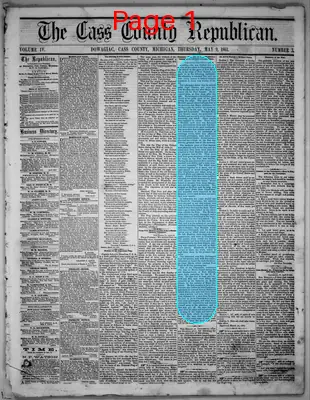
The Cass County Republican
Dowagiac, Cass County, Michigan
What is this article about?
A soldier's account from the New York Tribune details heavy rebel casualties during the Fort Sumter siege at Fort Moultrie, with 300-400 killed and many wounded. Additional reports note 150 casualties on Morris Island and 39 on Sullivan's Island. Dead were secretly buried to conceal losses.
Clipping

OCR Quality
Full Text
Statement by a Soldier who was There.
From the New York Tribune, April 30.
A soldier who was drafted into the service of the rebels in Charleston, and who served at the guns of Fort Moultrie, at the siege of Fort Sumter, has made to us the following statement. His reliability is vouched for, and we have every reason to believe that his statement is every way worthy of belief.
Our informant states that he served under Capt. Havens, and went into Fort Moultrie the day after Major Anderson left for Fort Sumter. He remained three or four days after the fight. He belonged to the artillery, and served at the guns most of the time during the siege. The guns of Fort Moultrie opened about half-past four in the morning, but Major Anderson did not fire a gun for nearly two hours after. When he did open, his fire was rapid and destructive. The balls from Fort Sumter struck the port-holes of Moultrie, and at nearly every discharge somebody was killed. Their places were supplied by others. There were in Moultrie more than one thousand men, and between three and four hundred were kept at the guns constantly. Not more than that number could protect themselves in the casements of sandbags, which, while they afforded excellent protection, were much torn up and knocked down. It was between nine and ten o'clock on the first day that the greatest loss of life occurred. The barbette guns of Fort Sumter were silenced early in the day, and the round shot from these were most destructive to Fort Moultrie and caused the greatest loss of life. They were fired with great accuracy, and at times the scene in the Fort was terrible.
During the siege between three and four hundred were killed, and a large number were wounded. The killed were collected together in a mass, and at night placed in boxes brought down from Charleston and taken away to Potter's Field and interred during the night. Some of the men were horribly mangled, and others were scarcely dead when thrown into the boxes. Blood flowed in streams from these receptacles, and the sight was horrible. The surgeon at the Fort sent for help, and others came down from Charleston. The wounded were removed to the Hospital, where such as have not since died, now remain.
In order that the truth should not be known in Charleston, the soldiers were charged to say that nobody was hurt, and were threatened with certain death if they disclosed the facts. There were a good many killed in the dwellings outside the Fort. The Moultrie house was very much damaged, and a large number of buildings in the neighborhood of the Fort demolished. The officers' quarters in the fort were riddled, and it is the opinion of our informant that had there been three hundred men in Sumter, Fort Moultrie would have been destroyed, and the Rebels driven out or killed almost to a man.
He left Moultrie three days after the engagement, and went to Charleston. The people there would not believe that nobody had been killed, and made constant inquiry for their friends, who, they were assured, were still on Sullivan's Island. Hundreds of families are yet to learn the truth, which is kept from them by the greatest vigilance.
Our informant was duly discharged from the service, and, with five others, embarked on board the bark Smithsonian, Capt. Davis, which reached New York on Friday morning last.
One of the Charleston volunteers who was on Morris Island during the late bombardment of Fort Sumter, came here yesterday by the D. B. Pitts. He says that at least one hundred and fifty men were killed and wounded at the batteries on Morris Island, by the canister of Major Anderson. He had occasion to be at Fort Johnson also before he left Charleston, and there he learned that on Sullivan's Island thirty-nine men had been killed —that a mortar had been blown from Fort Johnson by a shot from Sumter. He had to go to Charleston in a boat with some passengers, and when there embraced the opportunity and stowed himself away in the schooner, and in that way got off. He says that the dead were all taken and boxed and carried away in the night and buried in Potter's field, where the negroes are buried. He says that thousands of negroes only want some of their leaders to give them the word, and great will be the slaughter.
What sub-type of article is it?
What keywords are associated?
What entities or persons were involved?
Where did it happen?
Domestic News Details
Primary Location
Fort Moultrie, Charleston
Event Date
During The Siege Of Fort Sumter
Key Persons
Outcome
between three and four hundred killed and a large number wounded at fort moultrie; at least one hundred and fifty killed and wounded at morris island batteries; thirty-nine killed on sullivan's island; a mortar blown from fort johnson; dead secretly buried in potter's field at night.
Event Details
A drafted soldier served at Fort Moultrie's guns during the siege, where Union fire from Fort Sumter caused heavy casualties among over one thousand rebels. Guns opened at half-past four a.m., with Sumter responding after two hours. Greatest losses between nine and ten a.m. from accurate round shot. Wounded treated in hospital; truth concealed from Charleston public. Additional volunteer reports casualties on Morris and Sullivan's Islands. Buildings damaged near Fort Moultrie.