Thank you for visiting SNEWPapers!
Sign up free
The Richmond Virginian
Richmond, Virginia
What is this article about?
Story of Mary Goloubyova, a young Russian woman who joined the women's 'Death Battalion' in WWI, trained in Petrograd, fought on the Eastern Front, was wounded by a grenade and bayonet, killed two Germans, and is recovering in hospital with plans to return.
Clipping
OCR Quality
Full Text
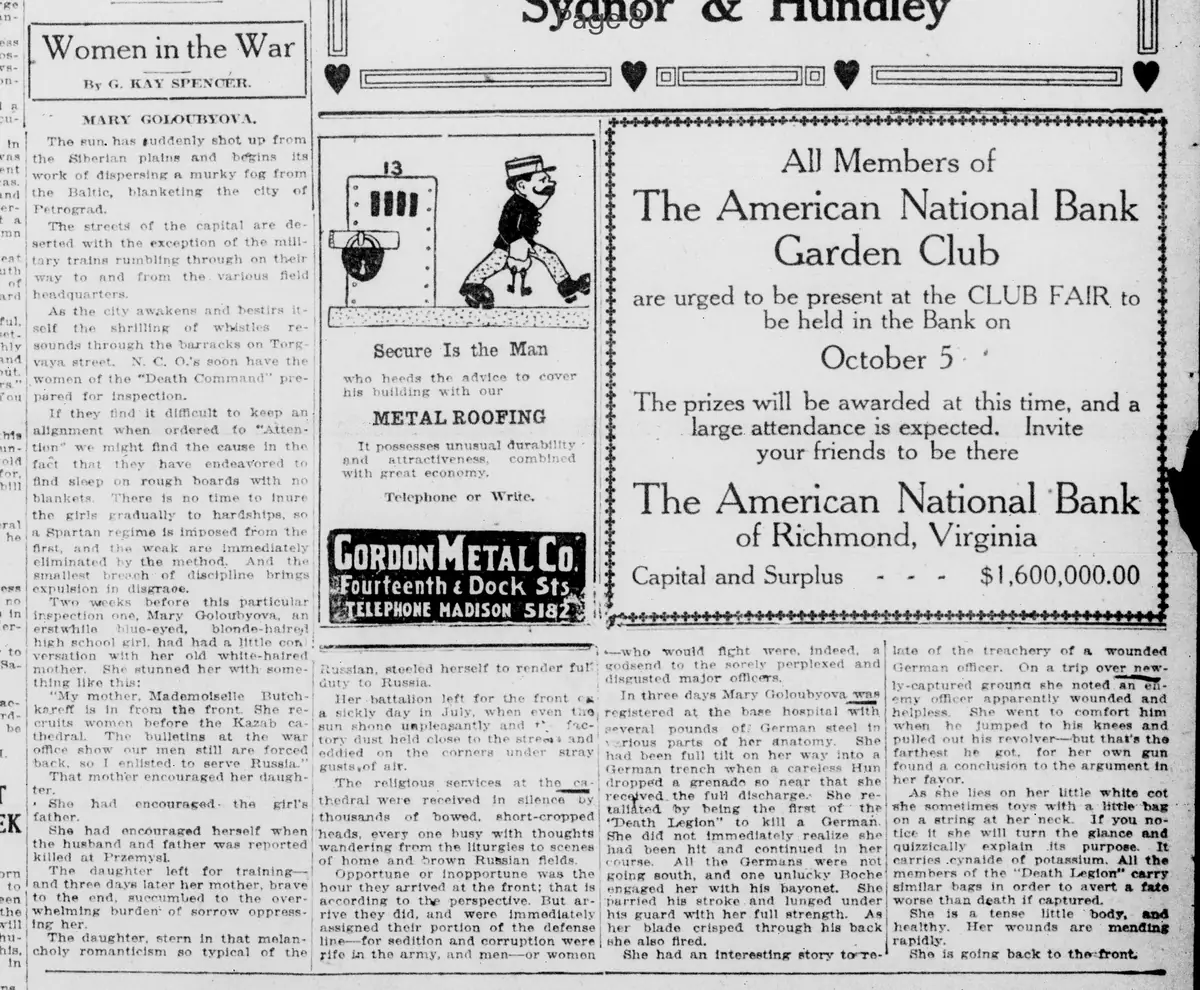
By G. KAY SPENCER.
MARY GOLOUNYOVA,
The sun has suddenly shot up from the Siberian plains and begins its work of dispersing a murky fog from the Baltic, blanketing the city of Petrograd.
The streets of the capital are deserted with the exception of the military trains rumbling through on their way to and from the various field headquarters.
As the city awakens and bestirs itself the shrilling of whistles resounds through the barracks on Torgvaya street. N. C. O.'s soon have the women of the "Death Command" prepared for inspection.
If they find it difficult to keep an alignment when ordered to "Attention" we might find the cause in the fact that they have endeavored to find sleep on rough boards with no blankets. There is no time to inure the girls gradually to hardships, so a Spartan regime is imposed from the first, and the weak are immediately eliminated by the method. And the smallest breach of discipline brings expulsion in disgrace.
Two weeks before this particular inspection one, Mary Goloubyova, an erstwhile blue-eyed, blonde-haired high school girl, had had a little conversation with her old white-haired mother. She stunned her with something like this:
"My mother, Mademoiselle Butchkareff is in from the front. She recruits women before the Kazan cathedral. The bulletins at the war office show our men still are forced back, so I enlisted, to serve Russia."
That mother encouraged her daughter.
She had encouraged the girl's father.
She had encouraged herself when the husband and father was reported killed at Przemysl.
The daughter left for training—and three days later her mother, brave to the end, succumbed to the overwhelming burden of sorrow oppressing her.
The daughter, stern in that melancholy romanticism so typical of the Russian, steeled herself to render full duty to Russia.
Her battalion left for the front on a sultry day in July, when even the sun shone unpleasantly and the factory dust held close to the streets and eddied on the corners under stray gusts of air.
The religious services at the cathedral were received in silence by thousands of bowed, short-cropped heads, every one busy with thoughts wandering from the liturgies to scenes of home and brown Russian fields.
Opportune or inopportune was the hour they arrived at the front: that is according to the perspective. But arrive they did, and were immediately assigned their portion of the defense line—for sedition and corruption were rife in the army, and men—or women—who would fight were, indeed, a godsend to the sorely perplexed and disgusted major officers.
In three days Mary Goloubyova was registered at the base hospital with several pounds of German steel in various parts of her anatomy. She had been full tilt on her way into a German trench when a careless Hun dropped a grenade so near that she received the full discharge. She retaliated by being the first of the "Death Legion" to kill a German.
She did not immediately realize she had been hit and continued in her course. All the Germans were not going south, and one unlucky Boche engaged her with his bayonet. She parried his stroke and lunged under his guard with her full strength. As her blade crisped through his back she also fired.
She had an interesting story to relate of the treachery of a wounded German officer. On a trip over newly-captured ground she noted an enemy officer apparently wounded and helpless. She went to comfort him when he jumped to his knees and pulled out his revolver—but that's the farthest he got, for her own gun found a conclusion to the argument in her favor.
As she lies on her little white cot she sometimes toys with a little bag on a string at her neck. If you notice it she will turn the glance and quizzically explain its purpose. It carries cyanide of potassium. All the members of the "Death Legion" carry similar bags in order to avert a fate worse than death if captured.
She is a tense little body, and healthy. Her wounds are mending rapidly.
She is going back to the front.
What sub-type of article is it?
What keywords are associated?
What entities or persons were involved?
Where did it happen?
Foreign News Details
Primary Location
Petrograd
Event Date
Sultry Day In July
Key Persons
Outcome
mary goloubyova wounded by grenade and in bayonet fight but survived; killed two german soldiers; recovering in hospital and plans to return to front.
Event Details
Mary Goloubyova, a high school girl, enlists in the women's 'Death Battalion' led by Mademoiselle Butchkareff amid Russian retreats in WWI. After harsh training in Petrograd, her unit deploys to the front in July, participates in assault on German trenches. Mary is wounded but kills a German in melee and later shoots a treacherous wounded officer. Battalion members carry cyanide to avoid capture.