Thank you for visiting SNEWPapers!
Sign up free
Batesville Guard
Batesville, Independence County, Arkansas
What is this article about?
Prentice Mulford's vivid impressions of Washington, D.C., critiquing the Capitol's botched design and orientation away from the city, describing bustling street life dominated by office-seekers, boarding houses, and African Americans, improvements by Boss Shepherd, a church service with President Hayes, chaotic Capitol interiors, and the Treasury's money-printing operations.
Clipping
OCR Quality
Full Text
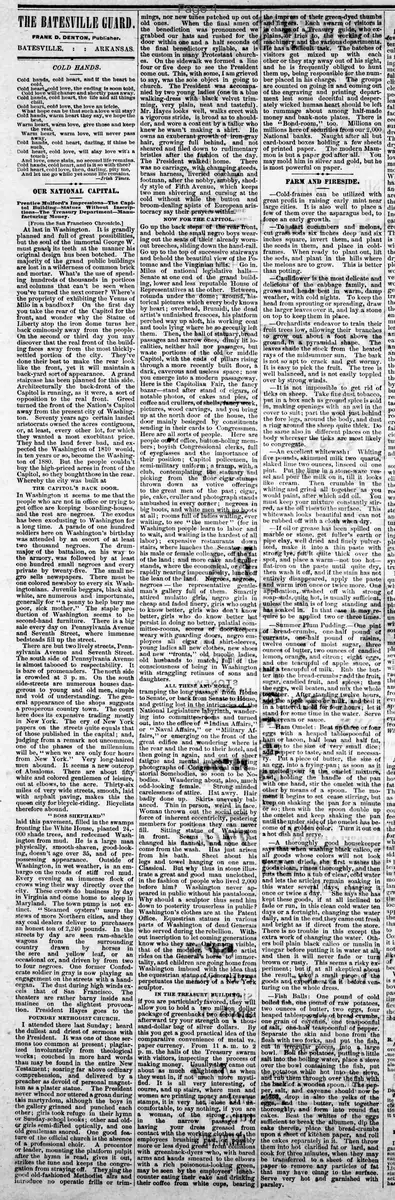
Prentice Mulford's Impressions-The Capitol Building-Statues Without Inscriptions-The Treasury Department-Manufacturing Money.
[From the San Francisco Chronicle.]
At last in Washington. It is grandly planned and full of great possibilities, but the soul of the immortal George W. must gnash its teeth at the manner his original design has been botched. The majority of the grand public buildings are lost in a wilderness of common brick and mortar. What's the use of spending hundreds of thousands in porticos and columns that can't be seen when you've turned the next corner? Where's the propriety of exhibiting the Venus of Milo in a bandbox? On the first day you take the rear of the Capitol for the front, and wonder why the Statue of Liberty atop the iron dome turns her back ominously away from the people. On the second or third day you may discover that the real front of the building faces away from the most thickly-settled portion of the city. They've done their best to make the rear look like the front, yet it will maintain a back-yard sort of appearance. A grand staircase has been planned for this side. Architecturally the back-front of the Capitol is running, as it were, a sort of opposition to the real front. Greed turned the front of the Nation's Capitol away from the present city of Washington. Seventy years ago certain landed aristocrats owned the acres contiguous, or, at least, every other lot, for which they wanted a most exorbitant price. They had the land fever bad, and expected the Washington of 1810 would, in ten years or so, become the Washington of 1880. But the people couldn't buy the high-priced acres in front of the Capitol, so they bought those in the rear. Whereby the city was built at
THE CAPITOL'S BACK DOOR.
In Washington it seems to me that the people who are not in office or trying to get office are keeping boarding-houses, and the rest are negroes. The exodus has been exodusting to Washington for a long time. A parade of one hundred soldiers here on Washington's birthday was attended by an escort of at least two thousand negroes. The drum-major of the battalion, on his way to the armory, was followed by at least one hundred small negroes and every private by twenty-five. The small negro sells newspapers. There must be one colored newsboy to every six Washingtonians. Juvenile beggars, black and white, are numerous and importunate, generally for "a penny to help bury me poor, sick mother." The staple production of Washington seems to be second-hand furniture. There is a big sale every day on Pennsylvania Avenue and Seventh Street, where immense bedsteads fill up the street. There are but two lively streets, Pennsylvania Avenue and Seventh Street. The south side of Pennsylvania Avenue is almost tabooed to respectability. It is bare of promenaders. The north side is crowded at 3 p. m. On the south side-streets are numerous houses dangerous to young and old men, simple and void of understanding. The general appearance of the shops suggests a prosperous country town. The court here does its expensive trading mostly in New York. The cry of New York papers on the streets quite equals that of those published in the capital; and, judging from a remark not uncommon, one of the phases of the millennium will be, "when we are only four hours from New York." Very long-haired men abound. It seems a new outcrop of Absaloms. There are about fifty white and colored gentlemen of leisure, out at elbows, to the acre. Thirty-six miles of very wide streets, smooth, laid with asphalt paving, makes this the queen city for bicycle-riding. Bicyclists therefore abound.
"BOSS SHEPHERD"
laid this pavement, filled in the swamps fronting the White House, planted 24,000 shade trees, and redeemed Washington from mud. He is a large man physically, smooth-shaven, good-looking, doesn't age over 35, and of prepossessing appearance. Outside of Washington, in wet weather, is an embargo on the roads of stiff red mud. Every evening an immense flock of crows wing their way directly over the city. These crows do business by day in Virginia and come home to sleep in Maryland. The town pump is not extinct. "Steamed oysters" usurp the stews of more Northern cities, and they say coal dealers deliver to purchasers an honest ton of 2,240 pounds. In the streets by day are seen ram-shackle wagons from the surrounding country drawn by horses in the sere and yellow leaf, or an occasional ox, and driven by from two to four negroes. One former Confederate soldier in gray is now playing an engagement on the streets with a hand-organ. The dust during high winds excels that of San Francisco. The theaters are rather barny inside and matinee on the slightest provocation. President Hayes goes to the
FOUNDRY METHODIST CHURCH.
I attended there last Sunday; heard the dullest and driest of sermons with the President. It was one of those sermons too common at present; plagiarized involuntarily from theological works; couched in more hard words than may be found in the entire New Testament; soaring far above ordinary comprehension, and delivered by a preacher as devoid of personal magnetism as a plaster statue. The President never winced nor uttered a groan during this martyrdom, although the boys in the gallery grinned and punched each other; girls took refuge in their hymn or Sunday-school books; other and older girls semi-flirted optically, and one old gentleman snored. One good feature of the official church is the absence of a professional choir. A precentor or leader, mounting the platform pulpit after the hymn is read, gives it out, strikes the tune and keeps the congregation from straying off. They sing the good old-fashioned Methodist airs and
introduce no operatic frills or trimmings, nor new tunes patched up out of old ones. When the final amen of the benediction was pronounced we grabbed our hats and rushed for the door within one and a half seconds of the final benedictory syllable, as is the custom in many Protestant churches. On the sidewalk we formed a line four or five deep to see the President come out. This, with some, I am grieved to say, was the sole object in going to church. The President was accompanied by two young ladies (one in a blue walking-dress with black velvet trimming, very plain, neat and tasteful). Mr. Hayes looks well, walks erect with a vigorous stride, is broad as to shoulder, and wore a coat cut by a tailor who knew he wasn't making a shirt. He owns an exuberant growth of iron-gray hair, growing full behind, and not sheared and filed down to rudimentary bristles after the fashion of the day. The President walked home. There was no carriage, with champing steeds, brass harness, liveried coachman and footman, after the nobby, snobby, showy style of Fifth Avenue, which keeps two men shivering and cursing at the cold without while the button and broom-dealing apists of European aristocracy say their prayers within.
NOW FOR THE CAPITOL.
Go up the back steps of the rear front, and behold the small negro boys wearing out the seats of their already worn-out breeches, sliding down the hand-rail. Go up to the top of successive stairways and behold the beautiful view of the Potomac and the Virginian hills. Go in. Miles of national legislative halls- Senate at one end of the grand building, lower and less reputable House of Representatives at the other. Between, rotunda under the dome; around, historical pictures which everybody knows by heart; overhead, Brumidi, the dead artist's unfinished frescoes, his platform perched way up aloft, his working coat and tools lying where he so recently left them. Then, the hall of statuary, broad passages and narrow ones, dimly lit localities, neither hall nor passages, but waste portions of the old or middle Capitol, with the ends of pillars rising through a more recently built floor, a dark, cavernous and useless space; now you emerge into a modern passageway. Here is the Capitolian Fair, the fancy bazar-stand after stand of cigars, of notable photos, of cakes and pies, of coffee and crullers, of shells, fancy work, pictures, wood carvings, and you bring up at the north door of the house, the door mainly besieged by constituents sending in their cards to Congressmen. Here are all sorts of people. Here are people out of office, button-holing members; boyish Congressional clerks, full of eyeglasses and the importance of their position; Capitol policemen, in semi-military uniform; a tramp, with a club, contemplating the statuary and picking from the floor cigar-stumps thrown down as votive offerings to the great men of the past; cigar, pie, cake, cruller and photograph stands ambushed in every corner; negroes in big boots, and white men with no boots at all; rooms full of ladies waiting, ever waiting, to see "the member" (for in Washington people learn to labor and to wait, and waiting is the hardest of all labor); expensive restaurants downstairs, where lunches the Senator with his male or female colleague, off the fat of the land; and more cake and cruller stands, where the economical, or others rapidly nearing impecuniosity, lunch off the lean of the land. Negroes, negroes, negroes-the representative gentleman's gallery full of them. Smartly attired mulatto girls, negro girls in cheap and faded finery, girls who ought to know better, girls who don't know better, girls who do know better but persist in doing no better, palatial committee-rooms, scores of door-keepers weary with guarding doors, negro employees all cigar and shirt-sleeves, young ladies all new clothes, new shoes and new "fronts," old bucolic ladies, old husbands to match, full of the consciousness of being in Washington with straggling retinues of sons and daughters.
ALL THESE AND MORE,
tramping the long passage from House to Senate, or back from Senate to House, and getting lost in the intricacies of the National Legislature labyrinth, wandering into committee rooms and turned out, into the office of "Indian Affairs," or "Naval Affairs," or "Military Affairs," or emerging on the front of the great edifice and wondering where is the rear and the road to their hotel, and then going in again, and out of sheer fatigue and mental imbecility boring photographs of Congressional and Senatorial Somebodies, so soon to be Nobodies. Wandering about, also, much odd-looking female. Strong minded carelessness of attire. Hat awry. Hair badly done up. Skirts unevenly balanced. Thin in person, weird in face. Woman thrown out the social orbit by force of inherent eccentricity, pestering members for positions they can never fill. Sitting statue of Washington in front. Seems to have just changed his flannels, and none other come from the wash. Has just arisen from his bath. Sheet about his legs and towel hanging on one arm. Classical. But why thus in stone illustrate a great and good man unclothed, in the fashion of people who lived 2,000 years before him? Washington never appeared in public without his pantaloons. Why should a sculptor thus send him down to posterity trouserless in public? Washington's clothes are at the Patent Office. Equestrian statues in various parts of Washington of dead Generals who served during the rebellion. Without inscription to let coming generations know who they are. Only name visible, that of the modeler. The artist rides on the General's horse to immortality, and children are going home from Washington imbued with the idea that the equestrian statue of General Thomas perpetuates the memory of a New York sculptor.
IN THE TREASURY BUILDING,
if you are particularly favored, they will allow you to hold a two million dollar package of greenbacks two seconds and afterward try your strength on a thousand-dollar bag of silver dollars. By this you get a good practical idea of the comparative convenience of metal vs. paper currency. From 11 a. m. to 2 p. m. the halls of the Treasury swarm with visitors, inspecting the process of making money. Usually they came out about as much enlightened as when they went in, if not much more mystified. It is all very interesting, of course, and up stairs, where men and women are printing money and revenue stamps, it is very hot, close and uncomfortable, to say nothing, if you are woman, of the strong chance in the narrow passages of having your dress greased from contact with the working clothes of the employees brushing past, or possibly more or less dyed green from collisions with greenback-dyers who, with bared arms and hands smeared to the elbows with a rich poisonous-looking green, may be seen by the employees lunch-counter eating their cake and drinking their coffee from white cups, bearing the impress of their green-dyed thumbs and fingers. Each swarm of visitors is in charge of a Treasury guide, who explains, or tries to, the working of the machinery and the various departments. He has a difficult task. The batches of visitors get mixed up with each other or they stay away out of his sight, and he is frequently obliged to hunt them up, being responsible for the number placed in his charge. The groups are counted on going in and coming out of the engraving and printing department lest some deceitful and desperately wicked human heart should be left to rummage about among half-made money and bank-note plates. There is the "Bond-room," too. Millions on millions here of securities from our 2,000 National banks. Naught after all but card-board boxes holding a few sheets of printed paper. The modern Mammon is but a paper god after all. You may mold him in silver and gold, but he is most powerful on paper.
What sub-type of article is it?
What themes does it cover?
What keywords are associated?
What entities or persons were involved?
Where did it happen?
Story Details
Key Persons
Location
Washington, D.C.
Event Date
Circa 1880
Story Details
Prentice Mulford describes his visit to Washington, D.C., criticizing the Capitol's design turned away from the city due to land greed, observing the prevalence of office-seekers, African Americans, street life, and improvements by Boss Shepherd; attends church with President Hayes; tours the chaotic Capitol with its unfinished frescoes and vendors; visits the Treasury to witness money printing and handle currency.