Thank you for visiting SNEWPapers!
Sign up free
The New Hampshire Gazette And General Advertiser
Portsmouth, Rockingham County, New Hampshire
What is this article about?
U.S. House of Representatives proceedings from January 20-22, 1790: discussion of a foreigner's petition to buy western land (rejected); confidential report on southwestern frontiers and Indian affairs; President Washington transmits Secretary Knox's plan for national militia arrangement, emphasizing republican defense principles.
Clipping
OCR Quality
Full Text
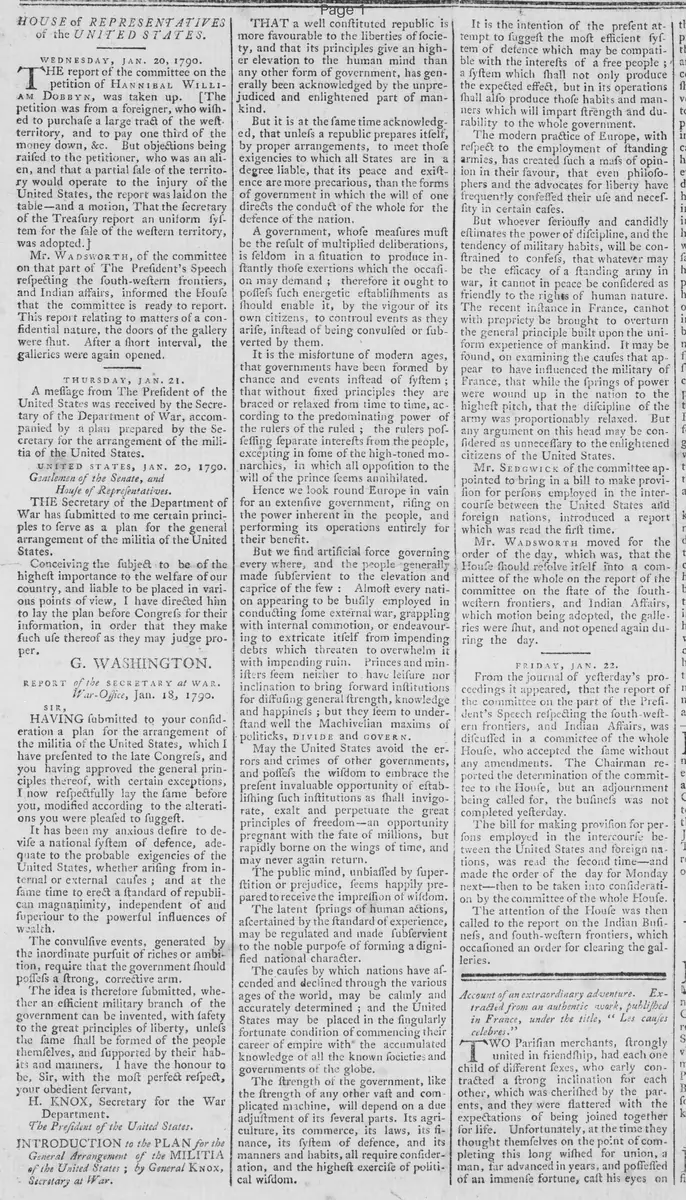
of the UNITED STATES.
WEDNESDAY, JAN. 20, 1790.
The report of the committee on the
petition of Hannibal William
Dobbin, was taken up. [The
petition was from a foreigner, who wished
to purchase a large tract of the west
territory, and to pay one third of the
money down, &c. But objections being
raised to the petitioner, who was an alien,
and that a partial sale of the territory
would operate to the injury of the
United States, the report was laid on the
table—and a motion, That the secretary
of the Treasury report an uniform system
for the sale of the western territory,
was adopted.]
Mr. Wadsworth, of the committee
on that part of the President's Speech
respecting the south-western frontiers,
and Indian affairs, informed the House
that the committee is ready to report.
This report relating to matters of a confidential nature, the doors of the gallery
were shut. After a short interval, the
galleries were again opened.
THURSDAY, JAN. 21.
A message from the President of the
United States was received by the Secretary
of the Department of War, accompanied by a plan prepared by the Secretary for the arrangement of the militia
of the United States.
UNITED STATES, JAN. 20, 1790.
Gentlemen of the Senate, and
House of Representatives.
THE Secretary of the Department of
War has submitted to me certain principles to serve as a plan for the general
arrangement of the militia of the United
States.
Conceiving the subject to be of the
highest importance to the welfare of our
country, and liable to be placed in various points of view, I have directed him
to lay the plan before Congress for their
information, in order that they make
such use thereof as they may judge proper.
G. WASHINGTON.
REPORT of the SECRETARY AT WAR.
War-Office, Jan. 18, 1790.
SIR,
HAVING submitted to your consideration a plan for the arrangement of
the militia of the United States, which I
have presented to the late Congress, and
you having approved the general principles thereof, with certain exceptions,
I now respectfully lay the same before
you, modified according to the alterations you were pleased to suggest.
It has been my anxious desire to devise a national system of defence, adequate to the probable exigencies of the
United States, whether arising from internal or external causes; and at the
same time to erect a standard of republican magnanimity, independent of and
superior to the powerful influences of
wealth.
The convulsive events, generated by
the inordinate pursuit of riches or ambition, require that the government should
possess a strong, corrective arm.
The idea is therefore submitted, whether an efficient military branch of the
government can be invented, with safety
to the great principles of liberty, unless
the same shall be formed of the people
themselves, and supported by their habits
and manners. I have the honour to
be, Sir, with the most perfect respect,
your obedient servant,
H. KNOX, Secretary for the War
Department.
The President of the United States.
INTRODUCTION to the PLAN for the
General Arrangement of the MILITIA
of the United States; by General Knox,
Secretary at War.
THAT a well constituted republic is
more favourable to the liberties of society,
and that its principles give a higher
elevation to the human mind than
any other form of government, has generally been acknowledged by the unprejudiced and enlightened part of mankind.
But it is at the same time acknowledged,
that unless a republic prepares itself,
by proper arrangements, to meet those
exigencies to which all States are in a
degree liable, that its peace and existence are more precarious, than the forms
of government in which the will of one
directs the conduct of the whole for the
defence of the nation.
A government, whose measures must
be the result of multiplied deliberations,
is seldom in a situation to produce instantly those exertions which the occasion may demand; therefore it ought to
possess such energetic establishments as
should enable it, by the vigour of its
own citizens, to control events as they
arise, instead of being convulsed or subverted by them.
It is the misfortune of modern ages,
that governments have been formed by
chance and events instead of system;
that without fixed principles they are
braced or relaxed from time to time, according to the predominating power of
the rulers or the ruled; the rulers possessing separate interests from the people,
excepting in some of the high-toned monarchies, in which all opposition to the
will of the prince seems annihilated.
Hence we look round Europe in vain
for an extensive government, rising on
the power inherent in the people, and
performing its operations entirely for
their benefit.
But we find artificial force governing
every where, and the people generally
made subservient to the elevation and
caprice of the few: Almost every nation appearing to be busily employed in
conducting some external war, grappling
with internal commotion, or endeavouring to extricate itself from impending
debts which threaten to overwhelm it
with impending ruin. Princes and ministers seem neither to have leisure nor
inclination to bring forward institutions
for diffusing general strength, knowledge
and happiness; but they seem to understand well the Machiavellian maxims of
politics, DIVIDE and GOVERN.
May the United States avoid the errors and crimes of other governments,
and possess the wisdom to embrace the
present invaluable opportunity of establishing such institutions as shall invigorate, exalt and perpetuate the great
principles of freedom—an opportunity
pregnant with the fate of millions, but
rapidly borne on the wings of time, and
may never again return.
The public mind, unbiased by superstition or prejudice, seems happily prepared to receive the impression of wisdom.
The latent springs of human actions,
ascertained by the standard of experience,
may be regulated and made subservient
to the noble purpose of forming a dignified national character.
The causes by which nations have ascended and declined through the various
ages of the world, may be calmly and
accurately determined; and the United
States may be placed in the singularly
fortunate condition of commencing their
career of empire with the accumulated
knowledge of all the known societies and
governments of the globe.
The strength of the government, like
the strength of any other vast and complicated machine, will depend on a due
adjustment of its several parts. Its agriculture, its commerce, its laws, its finance, its system of defence, and its
manners and habits, all require consideration, and the highest exercise of political wisdom.
It is the intention of the present attempt to suggest the most efficient system of defence which may be compatible with the interests of a free people;
a system which shall not only produce
the expected effect, but in its operations
shall also produce those habits and manners which will impart strength and durability to the whole government.
The modern practice of Europe, with
respect to the employment of standing
armies, has created such a mass of opinion in their favour, that even philosophers and the advocates for liberty have
frequently confessed their use and necessity in certain cases.
But whoever seriously and candidly
estimates the power of discipline, and the
tendency of military habits, will be constrained to confess, that whatever may
be the efficacy of a standing army in
war, it cannot in peace be considered as
friendly to the rights of human nature.
The recent instance in France, cannot
with propriety be brought to overturn
the general principle built upon the uniform experience of mankind. It may be
found, on examining the causes that appear to have influenced the military of
France, that while the springs of power
were wound up in the nation to the
highest pitch, that the discipline of the
army was proportionably relaxed. But
any argument on this head may be considered as unnecessary to the enlightened
citizens of the United States.
Mr. Sedgwick of the committee appointed to bring in a bill to make provision for persons employed in the intercourse between the United States and
foreign nations, introduced a report
which was read the first time.
Mr. Wadsworth moved for the
order of the day, which was, that the
House should resolve itself into a committee of the whole on the report of the
committee on the state of the south.
western frontiers, and Indian Affairs.
which motion being adopted, the galleries were shut, and not opened again during the day.
FRIDAY, JAN. 22.
From the journal of yesterday's proceedings it appeared, that the report of
the committee on the part of the President's Speech respecting the south-west. hern frontiers, and Indian Affairs, was
discussed in a committee of the whole
House, who accepted the same without
any amendments. The Chairman reported the determination of the committee to the House, but an adjournment
being called for, the business was not
completed yesterday.
The bill for making provision for persons employed in the intercourse between the United States and foreign nations, was read the second time—and
made the order of the day for Monday
next—then to be taken into consideration by the committee of the whole House.
The attention of the House was then
called to the report on the Indian Business, and south-western frontiers, which
occasioned an order for clearing the galleries.
What sub-type of article is it?
What keywords are associated?
What entities or persons were involved?
Where did it happen?
Domestic News Details
Primary Location
United States House Of Representatives
Event Date
January 20 22, 1790
Key Persons
Outcome
petition on western land sale laid on table; motion for treasury report on uniform sales adopted; confidential indian affairs report accepted without amendments; militia plan submitted to congress for consideration; bill on foreign intercourse read second time and ordered for monday.
Event Details
Proceedings include debate on alien's petition to buy western territory (objections raised, report tabled); committee ready to report on southwestern frontiers and Indian affairs (confidential, galleries shut); President transmits Secretary of War's modified plan for militia arrangement with introductory principles on republican defense; bill introduced for provisions in foreign intercourse; House resolves into committee on Indian affairs (galleries shut).