Thank you for visiting SNEWPapers!
Sign up free
The Enquirer
Richmond, Henrico County, Virginia
What is this article about?
A letter defending the Virginia House of Delegates' resolution supporting the U.S. administration against accusations from a Senate member of it being an electioneering cabal influenced by executive power. The writer criticizes the opposition's hypocrisy in charging the executive while claiming confidence in the President, urging political unity amid divisions.
Clipping
OCR Quality
Full Text
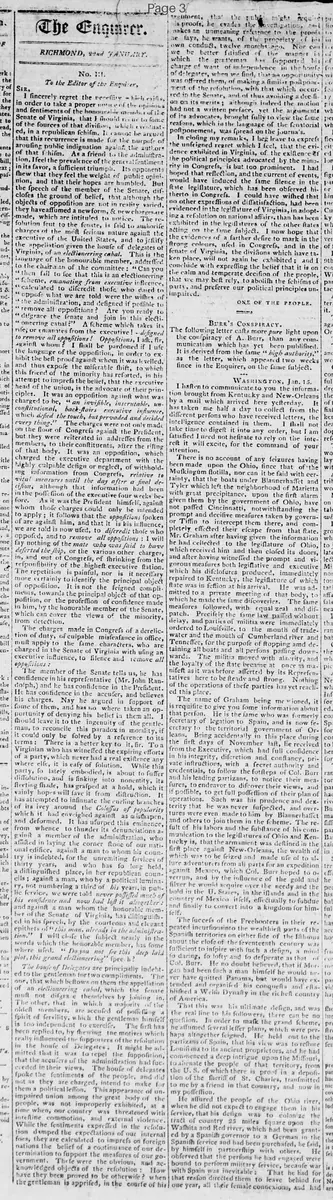
SIR,
I sincerely regret the necessity which exists, in order to take a proper notice of the opinions and sentiments of the honourable members of the Senate of Virginia, that I should recur to some of the sources of that division, which eventuated, in a republican schism. It cannot be argued that this recurrence is made for the purpose of arousing public indignation against the authors of that schism. As a friend to the administration, I feel the prevalence of the general sentiment in its favor, a sufficient triumph. Its opponents show that they feel the weight of public opinion, and that their hopes are humbled. But the speech of the member of the Senate, discloses the ground of belief, that although the objects of opposition are not in reality varied, they have assumed a new form, & new charges are made, which are entitled to notice. The resolution sent to the senate, is said to authorize charges of the most serious nature against the executive of the United States, and to justify the appellation given the house of delegates of Virginia, of an electioneering cabal. This is the language of the honourable member, addressed to the chairman of the committee: "Can you then fail to see that this is an electioneering scheme, emanating from executive influence, calculated to discredit those who dared to oppose what we are told were the wishes of the administration, and designed if possible to remove all oppositions? Are you ready to disgrace the senate and join in this electioneering cabal?" A scheme which takes its rise; or emanates from the executive! --designed to remove all oppositions! Oppositions, I ask, sir, against whom? I shall be pardoned if I use the language of the opposition, in order to exhibit the best proof against whom it was last levelled, and thus expose the miserable shift, to which this friend of the minority has resorted, in his attempt to impress the belief, that the executive head of the union, is the advocate of their principles. It was an opposition against what was charged to be, "an invisible, inscrutable, unconstitutional, back-stairs executive influence, which defied the touch, but pervaded and decided every thing." The charges were not only made on the floor of Congress against the President, but they were reiterated in addresses from the members, to their constituents, after the rising of that body. It was an opposition, which charged the executive department with the highly culpable design or neglect, of withholding information from Congress, relative to vital measures until the day after a final decision; although that information had been in the possession of the executive four weeks before. As it was the President himself, against whom those charges could only be intended to apply; it follows that the oppositions spoken of are against him, and that it is his influence, we are told is now used, to discredit those who opposed, and to remove all oppositions: I will say nothing of the mate who was said to have deserted the ship, or the various other charges, in, and out of Congress, of shrinking from the responsibility of the highest executive station.
The repetition is painful, nor is it necessary more certainly to identify the principal object of opposition. It is not the feigned compliments, towards the principal object of that opposition, or the profession of confidence made in him, by the honorable member of the Senate, which can cover the views of the minority, from detection.
The charges made in Congress of a dereliction of duty, of culpable misfeasance in office, must apply to the same characters, who are charged in the Senate of Virginia with using an executive influence, to silence and remove all oppositions:
The member of the Senate tells us, he has confidence in his representative (Mr. John Randolph,) and he has confidence in the President. He has confidence in the accuser, and believes his charges. Nay he argued in support of some of them, and has no where taken an opportunity of denying his belief in them all. I should leave it to the ingenuity of the gentleman, to reconcile this paradox in morality, if it could only be solved by a reference to its terms: There is a better key to it, sir. To a Virginian who has witnessed the expiring efforts of a party, which never had a real existence any where else, it is easy of solution. While this party, so lately embodied, is about to suffer dissolution, and is sinking into nonentity, its fleeting shade, has grasped at a hold, which it vainly hopes will save it from destruction. It has attempted to insinuate the curling branches of its ivy around the Colossus of popularity which it had inveighed against as misshapen, and deformed. It has usurped this eminence, from whence to thunder its denunciations against a member of the administration, who assisted in laying the corner stone of our national edifice, against a man to whom his country is indebted, for the unremitting services of thirty years, and who has so long held, a distinguished place, in her republican councils; against a man, who by a political luminary, not numbering a third of his years, in public service, we were told never possessed much of his confidence and now has lost it "altogether: and against a man whom the honorable member of the Senate of Virginia, has distinguished in his speech, by the courteous and elegant epithets of "this man, already in the administration." I will close the subject nearly in the words which the honorable member, has somewhere used. "Do you not see this deep laid plot, this grand electioneering scheme?"
The house of Delegates are principally indebted to the gentleman for two compliments. The one, that which bestows on them the appellation of an electioneering cabal, which the senate must not disgrace themselves by joining in. The other, that in which a majority of the oldest members, are accused of possessing spirit of servility, which the gentleman himself is too independent to exercise. The first has been replied to, by showing the motives which really influenced the supporters of the resolution in the house of Delegates: It might be admitted that it was to repel the supposition, that the accusers of the administration had succeeded in their views. The house of delegates spoke the sentiments of the people, and did not as they are charged, intend to make for them a political lesson. This appearance of unimpaired union among the great body of the people, was not improperly exhibited, at a time when, our country was threatened with intestine commotion, and external violence. While the sentiments expressed in the resolution damped the expectations of our internal foes, they are calculated to impress on foreign nations the belief of a continuance of our determination to support the measures of our government. These were the obvious, and acknowledged objects of the resolution: How have they been proved to be otherwise? when the gentleman is apprised, in the course of his argument, that the rubric might be guide as proofs, he evades the obligation. not makes an unmeaning reference to the proof he says, he wants, of the propriety if his own conduct, twelve months ago. Nor can we be better satisfied of the manner in which the gentleman has supported his charge of want of independence in the house of delegates, when re find, that an opportunity was offered then, of making a similar postponement of the resolution, with that which occurred in the Senate, and of thus avoiding a decision on its merits; although indeed the motion had not a written preface, yet the arguments of its advocates, brought fully to view the same reasons, which in the language of the senatorial postponement, was spread on the journals.
In closing my remarks, I beg leave to express the unfeigned regret which I feel, that the evidence exhibited in Virginia, of the existence of the political principles advocated by the minority in Congress, is but too prominent. I had hoped that reflection, and the current of events, would have induced the same silence in the state legislature, which has been observed hitherto in Congress. I could have wished that no other expressions of dissatisfaction, had been evidenced in the legislature of Virginia, in adopting a resolution on national affairs, than has been exhibited in the legislatures of the other states acting on the same subject. I now hope that the evidences of a farther desire to mark in the strong colours used in Congress, and in the senate of Virginia, the divisions which have taken place, will not again be exhibited: and I conclude with expressing the belief that it is on the calm and temperate decision of the people, that we may best rely, to abolish the schisms of party, and preserve our political principles unimpaired.
ONE OF THE PEOPLE.
What sub-type of article is it?
What themes does it cover?
What keywords are associated?
What entities or persons were involved?
Letter to Editor Details
Author
One Of The People.
Recipient
The Editor Of The Enquirer
Main Argument
the letter refutes accusations that the virginia house of delegates' resolution was an electioneering cabal driven by executive influence, exposing the opposition's hypocrisy in criticizing the president while professing confidence in him, and calls for political unity to preserve republican principles.
Notable Details