Thank you for visiting SNEWPapers!
Sign up free
Editorial
January 30, 1801
The National Intelligencer And Washington Advertiser
Washington, District Of Columbia
What is this article about?
An editorial critiques the proposed government plan for the Territory of Columbia, arguing that the restrictive suffrage based on property ownership will disadvantage urban areas like Washington, undermine representation, and violate principles of equal taxation and representation central to American republicanism.
Clipping
OCR Quality
95%
Excellent
Full Text
FOR THE NATIONAL INTELLIGENCER
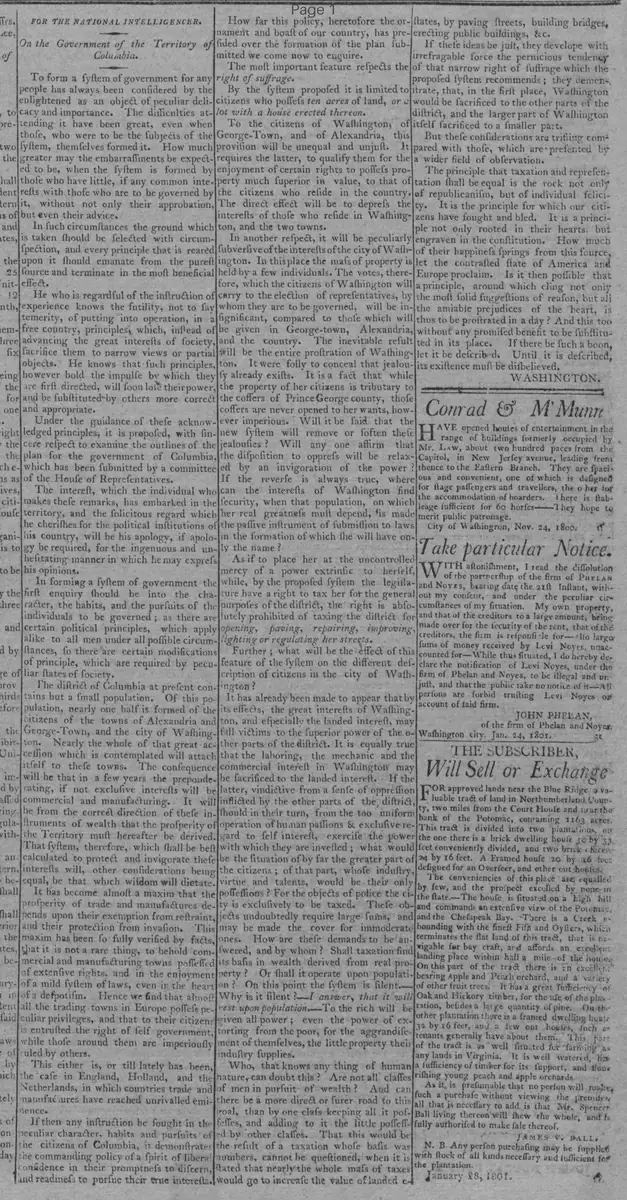
On the Government of the Territory of Columbia.
To form a system of government for any people has always been considered by the enlightened as an object of peculiar delicacy and importance. The difficulties attending it have been great, even when those, who were to be the subjects of the system, themselves formed it. How much greater may the embarrassments be expected to be, when the system is formed by those who have little, if any common interests with those who are to be governed by it, without not only their approbation, but even their advice.
In such circumstances the ground which is taken should be selected with circumspection, and every principle that is reared upon it should emanate from the purest source and terminate in the most beneficial effect.
He who is regardful of the instruction of experience knows the futility, not to say temerity, of putting into operation, in a free country, principles which, instead of advancing the great interests of society, sacrifice them to narrow views or partial objects. He knows that such principles, however bold the impulse by which they are first directed, will soon lose their power, and be substituted by others more correct and appropriate.
Under the guidance of these acknowledged principles, it is proposed, with sincere respect to examine the outlines of the plan for the government of Columbia, which has been submitted by a committee of the House of Representatives.
The interest, which the individual who makes these remarks, has embarked in the territory, and the solicitous regard which he cherishes for the political institutions of his country, will be his apology, if apology be required, for the ingenuous and unhesitating manner in which he may express his opinions.
In forming a system of government the first enquiry should be into the character, the habits, and the pursuits of the individuals to be governed; as there are certain political principles, which apply alike to all men under all possible circumstances, so there are certain modifications of principle, which are required by peculiar states of society.
The district of Columbia at present contains but a small population. Of this population, nearly one half is formed of the citizens of the towns of Alexandria and George-Town, and the city of Washington. Nearly the whole of that great accession which is contemplated will attach itself to these towns. The consequence will be that in a few years the preponderating, if not exclusive interests will be commercial and manufacturing. It will be from the correct direction of these instruments of wealth that the prosperity of the Territory must hereafter be derived.
That system, therefore, which shall be best calculated to protect and invigorate these interests will, other considerations being equal, be that which wisdom will dictate.
It has become almost a maxim that the prosperity of trade and manufactures depends upon their exemption from restraint, and their protection from invasion. This maxim has been so fully verified by facts, that it is not a rare thing, to behold commercial and manufacturing towns possessed of extensive rights, and in the enjoyment of a mild system of laws, even in the heart of a despotism. Hence we find that almost all the trading towns in Europe possess peculiar privileges, and that to their citizens is entrusted the right of self government, while those around them are imperiously ruled by others.
This either is, or till lately has been, the case in England, Holland, and the Netherlands, in which countries trade and manufactures have reached unrivalled eminence.
If then any instruction be sought in the peculiar character, habits and pursuits of the citizens of Columbia, it demonstrates the commanding policy of a spirit of liberal confidence in their promptness to discern, and readiness to pursue their true interests.
How far this policy, heretofore the ornament and boast of our country, has presided over the formation of the plan submitted we come now to enquire.
The most important feature respects the right of suffrage.
By the system proposed it is limited to citizens who possess ten acres of land, or a lot with a house erected thereon.
To the citizens of Washington; of George-Town, and of Alexandria, this provision will be unequal and unjust. It requires the latter, to qualify them for the enjoyment of certain rights to possess property much superior in value, to that of the citizens who reside in the country.
The direct effect will be to depress the interests of those who reside in Washington, and the two towns.
In another respect, it will be peculiarly subversive of the interests of the city of Washington. In this place the mass of property is held by a few individuals. The votes, therefore, which the citizens of Washington will carry to the election of representatives, by whom they are to be governed, will be insignificant, compared to those which will be given in George-town, Alexandria, and the country. The inevitable result will be the entire prostration of Washington. It were folly to conceal that jealousy already exists. It is a fact that while the property of her citizens is tributary to the coffers of Prince George county, those coffers are never opened to her wants, however imperious. Will it be said that the new system will remove or soften these jealousies? Will any one affirm that the disposition to oppress will be relaxed by an invigoration of the power?
If the reverse is always true, where can the interests of Washington find security, when that population, on which her real greatness must depend, is made the passive instrument of submission to laws in the formation of which they will have only the name?
As if to place her at the uncontrolled mercy of a power extrinsic to herself, while, by the proposed system the legislature have a right to tax her for the general purposes of the district, the right is absolutely prohibited of taxing the district for opening, paving, repairing, improving, lighting or regulating her streets.
Further: what will be the effect of this feature of the system on the different description of citizens in the city of Washington?
It has already been made to appear that by its effects, the great interests of Washington, and especially the landed interest, may fall victims to the superior power of the other parts of the district. It is equally true that the laboring, the mechanic and the commercial interest in Washington may be sacrificed to the landed interest. If the latter, vindictive from a sense of oppression inflicted by the other parts of the district, should in their turn, from the too uniform operation of human passions & exclusive regard to self interest, exercise the power with which they are invested; what would be the situation of by far the greater part of the citizens; of that part, whose industry, virtue and talents, would be their only possessions? For the objects of police the city is exclusively to be taxed. These objects undoubtedly require large sums, and may be made the cover for immoderate ones. How are these demands to be answered, and by whom? Shall taxation find its basis in wealth derived from real property? Or shall it operate upon population? On this point the system is silent. Why is it silent? I answer that it will rest upon population. To the rich will be given all power; even the power of extorting from the poor, for the aggrandizement of themselves, the little property their industry supplies.
Who, that knows any thing of human nature, can doubt this? Are not all classes of men in pursuit of wealth? And can there be a more direct or surer road to this goal, than by one class keeping all its possessions, and adding to it the little possessed by other classes. That this would be the result of a taxation whose basis was numbers, cannot be questioned, when it is stated that nearly the whole mass of taxes would go to increase the value of landed estates, by paving streets, building bridges, erecting public buildings, &c.
If these ideas be just, they develope with irrefragable force the pernicious tendency of that narrow right of suffrage which the proposed system recommends; they demonstrate, that, in the first place, Washington would be sacrificed to the other parts of the district, and the larger part of Washington itself sacrificed to a smaller part.
But these considerations are trifling compared with those, which are presented by a wider field of observation.
The principle that taxation and representation shall be equal is the rock not only of republicanism, but of individual felicity. It is the principle for which our citizens have fought and bled. It is a principle not only rooted in their hearts, but engraven in the constitution. How much of their happiness springs from this source, let the contrasted state of America and Europe proclaim. Is it then possible that a principle, around which cling not only the most solid suggestions of reason, but all the amiable prejudices of the heart, is thus to be prostrated in a day? And this too without any promised benefit to be substituted in its place. If there be such a boon, let it be described. Until it is described, its existence must be disbelieved.
WASHINGTON.
On the Government of the Territory of Columbia.
To form a system of government for any people has always been considered by the enlightened as an object of peculiar delicacy and importance. The difficulties attending it have been great, even when those, who were to be the subjects of the system, themselves formed it. How much greater may the embarrassments be expected to be, when the system is formed by those who have little, if any common interests with those who are to be governed by it, without not only their approbation, but even their advice.
In such circumstances the ground which is taken should be selected with circumspection, and every principle that is reared upon it should emanate from the purest source and terminate in the most beneficial effect.
He who is regardful of the instruction of experience knows the futility, not to say temerity, of putting into operation, in a free country, principles which, instead of advancing the great interests of society, sacrifice them to narrow views or partial objects. He knows that such principles, however bold the impulse by which they are first directed, will soon lose their power, and be substituted by others more correct and appropriate.
Under the guidance of these acknowledged principles, it is proposed, with sincere respect to examine the outlines of the plan for the government of Columbia, which has been submitted by a committee of the House of Representatives.
The interest, which the individual who makes these remarks, has embarked in the territory, and the solicitous regard which he cherishes for the political institutions of his country, will be his apology, if apology be required, for the ingenuous and unhesitating manner in which he may express his opinions.
In forming a system of government the first enquiry should be into the character, the habits, and the pursuits of the individuals to be governed; as there are certain political principles, which apply alike to all men under all possible circumstances, so there are certain modifications of principle, which are required by peculiar states of society.
The district of Columbia at present contains but a small population. Of this population, nearly one half is formed of the citizens of the towns of Alexandria and George-Town, and the city of Washington. Nearly the whole of that great accession which is contemplated will attach itself to these towns. The consequence will be that in a few years the preponderating, if not exclusive interests will be commercial and manufacturing. It will be from the correct direction of these instruments of wealth that the prosperity of the Territory must hereafter be derived.
That system, therefore, which shall be best calculated to protect and invigorate these interests will, other considerations being equal, be that which wisdom will dictate.
It has become almost a maxim that the prosperity of trade and manufactures depends upon their exemption from restraint, and their protection from invasion. This maxim has been so fully verified by facts, that it is not a rare thing, to behold commercial and manufacturing towns possessed of extensive rights, and in the enjoyment of a mild system of laws, even in the heart of a despotism. Hence we find that almost all the trading towns in Europe possess peculiar privileges, and that to their citizens is entrusted the right of self government, while those around them are imperiously ruled by others.
This either is, or till lately has been, the case in England, Holland, and the Netherlands, in which countries trade and manufactures have reached unrivalled eminence.
If then any instruction be sought in the peculiar character, habits and pursuits of the citizens of Columbia, it demonstrates the commanding policy of a spirit of liberal confidence in their promptness to discern, and readiness to pursue their true interests.
How far this policy, heretofore the ornament and boast of our country, has presided over the formation of the plan submitted we come now to enquire.
The most important feature respects the right of suffrage.
By the system proposed it is limited to citizens who possess ten acres of land, or a lot with a house erected thereon.
To the citizens of Washington; of George-Town, and of Alexandria, this provision will be unequal and unjust. It requires the latter, to qualify them for the enjoyment of certain rights to possess property much superior in value, to that of the citizens who reside in the country.
The direct effect will be to depress the interests of those who reside in Washington, and the two towns.
In another respect, it will be peculiarly subversive of the interests of the city of Washington. In this place the mass of property is held by a few individuals. The votes, therefore, which the citizens of Washington will carry to the election of representatives, by whom they are to be governed, will be insignificant, compared to those which will be given in George-town, Alexandria, and the country. The inevitable result will be the entire prostration of Washington. It were folly to conceal that jealousy already exists. It is a fact that while the property of her citizens is tributary to the coffers of Prince George county, those coffers are never opened to her wants, however imperious. Will it be said that the new system will remove or soften these jealousies? Will any one affirm that the disposition to oppress will be relaxed by an invigoration of the power?
If the reverse is always true, where can the interests of Washington find security, when that population, on which her real greatness must depend, is made the passive instrument of submission to laws in the formation of which they will have only the name?
As if to place her at the uncontrolled mercy of a power extrinsic to herself, while, by the proposed system the legislature have a right to tax her for the general purposes of the district, the right is absolutely prohibited of taxing the district for opening, paving, repairing, improving, lighting or regulating her streets.
Further: what will be the effect of this feature of the system on the different description of citizens in the city of Washington?
It has already been made to appear that by its effects, the great interests of Washington, and especially the landed interest, may fall victims to the superior power of the other parts of the district. It is equally true that the laboring, the mechanic and the commercial interest in Washington may be sacrificed to the landed interest. If the latter, vindictive from a sense of oppression inflicted by the other parts of the district, should in their turn, from the too uniform operation of human passions & exclusive regard to self interest, exercise the power with which they are invested; what would be the situation of by far the greater part of the citizens; of that part, whose industry, virtue and talents, would be their only possessions? For the objects of police the city is exclusively to be taxed. These objects undoubtedly require large sums, and may be made the cover for immoderate ones. How are these demands to be answered, and by whom? Shall taxation find its basis in wealth derived from real property? Or shall it operate upon population? On this point the system is silent. Why is it silent? I answer that it will rest upon population. To the rich will be given all power; even the power of extorting from the poor, for the aggrandizement of themselves, the little property their industry supplies.
Who, that knows any thing of human nature, can doubt this? Are not all classes of men in pursuit of wealth? And can there be a more direct or surer road to this goal, than by one class keeping all its possessions, and adding to it the little possessed by other classes. That this would be the result of a taxation whose basis was numbers, cannot be questioned, when it is stated that nearly the whole mass of taxes would go to increase the value of landed estates, by paving streets, building bridges, erecting public buildings, &c.
If these ideas be just, they develope with irrefragable force the pernicious tendency of that narrow right of suffrage which the proposed system recommends; they demonstrate, that, in the first place, Washington would be sacrificed to the other parts of the district, and the larger part of Washington itself sacrificed to a smaller part.
But these considerations are trifling compared with those, which are presented by a wider field of observation.
The principle that taxation and representation shall be equal is the rock not only of republicanism, but of individual felicity. It is the principle for which our citizens have fought and bled. It is a principle not only rooted in their hearts, but engraven in the constitution. How much of their happiness springs from this source, let the contrasted state of America and Europe proclaim. Is it then possible that a principle, around which cling not only the most solid suggestions of reason, but all the amiable prejudices of the heart, is thus to be prostrated in a day? And this too without any promised benefit to be substituted in its place. If there be such a boon, let it be described. Until it is described, its existence must be disbelieved.
WASHINGTON.
What sub-type of article is it?
Constitutional
Suffrage
Taxation
What keywords are associated?
Columbia Territory Government
Suffrage Restrictions
Property Qualifications
Washington City Interests
Taxation Representation
Urban Vs Rural
Commercial Prosperity
What entities or persons were involved?
House Of Representatives Committee
Citizens Of Washington
Citizens Of George Town
Citizens Of Alexandria
Prince George County
Editorial Details
Primary Topic
Critique Of Proposed Government And Suffrage For Columbia Territory
Stance / Tone
Opposition To Property Based Suffrage And Unequal Representation
Key Figures
House Of Representatives Committee
Citizens Of Washington
Citizens Of George Town
Citizens Of Alexandria
Prince George County
Key Arguments
Forming Government Requires Understanding Local Character And Interests, Especially Commercial In Urban Areas.
Proposed Suffrage Limited To Landowners Disadvantages Urban Citizens With Higher Property Values.
Restrictive Voting Will Lead To Rural Dominance, Prostrating Washington City's Interests.
Unequal Taxation Powers Allow District To Tax City Without Reciprocal Benefits For Urban Improvements.
Laboring And Commercial Classes In Washington Vulnerable To Landed Interests' Taxation Based On Population.
Violates Core Principle Of No Taxation Without Representation, Foundational To American Republicanism.