Thank you for visiting SNEWPapers!
Sign up free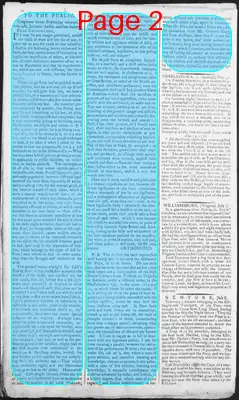
Letter to Editor
July 27, 1776
The Freeman's Journal, Or, New Hampshire Gazette
Portsmouth, Rockingham County, New Hampshire
What is this article about?
A letter to the public arguing against British legislative impositions on American colonies without representation, contrasting liberty through mutual treaties with slavery under arbitrary power, using Cain and Abel analogy, and defending the author's original ideas amid war.
Clipping
OCR Quality
95%
Excellent
Full Text
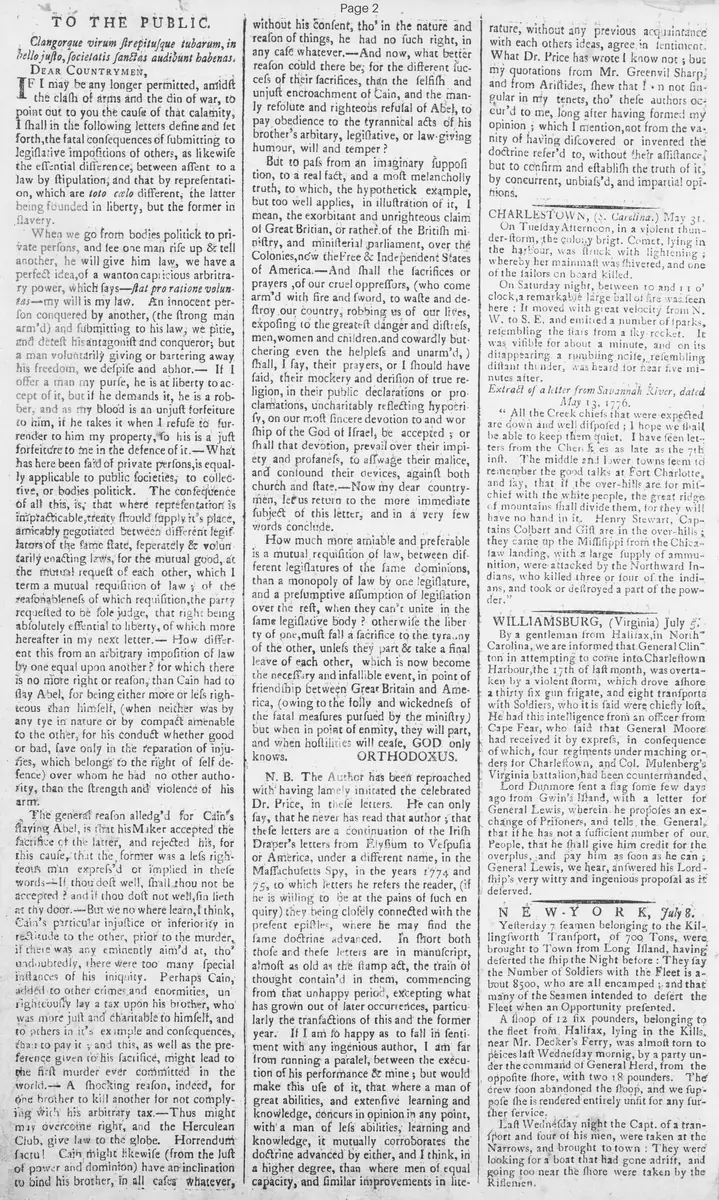
TO THE PUBLIC
Clangor auge virum trepidusque tubarum,
bello justo. Societatis sanitas audibunt habenas.
Dear Countrymen,
If I may be any longer permitted, amidst the clash of arms and the din of war, to point out to you the cause of that calamity; I shall in the following letters define and set forth the fatal consequences of submitting to legislative impositions of others, as likewise the essential difference between assent to a law by stipulation; and that by representation, which are toto coelo different: the latter being founded in liberty, but the former in slavery.
When we go from bodies politic to private persons, and see one man rise up & tell another, he will give him law, we have a perfect idea of a wanton capricious arbitrary power, which says--tat pro ratione voluntas--my will is my law. An innocent person conquered by another, (the strong man armed) and submitting to his law; we pity, and detest his antagonist and conqueror; but a man voluntarily giving or bartering away his freedom, we despise and abhor.-- If I offer a man my purse, he is at liberty to accept of it, but if he demands it, he is a robber. and as my blood is an unjust forfeiture to him, if he takes it when I refuse to surrender to him my property, so his is a just forfeiture to me in the defence of it.- What has here been said of private persons, is equally applicable to public societies; to collective, or bodies politic. The consequence of all this, is, that where representation is impracticable, treaty should supply its place. amicably negotiated between different legislatures of the same state. separately & voluntarily enacting laws. for the mutual good, at the mutual request of each other, which I term a mutual requisition of law : of the reasonableness of which requisition, the party requested to be sole judge, that right being absolutely essential to liberty, of which more hereafter in my next letter.-- How different this from an arbitrary imposition of law by one equal upon another ? for which there is no more right or reason, than Cain had to slay Abel, for being either more or less righteous than himself, (when neither was by any tie in nature or by compact amenable to the other, for his conduct whether good or bad. save only in the reparation of injuries, which belongs to the right of self defence) over whom he had no other authority, than the strength and violence of his arm.
The general reason alleged for Cain's slaying Abel, is that his Maker accepted the sacrifice of the latter. and rejected his, for this cause, that the former was a less righteous man expressed or implied in these words--If thou doest well, shalt thou not be accepted ? and if thou dost not well, sin lieth at thy door.--But we no where learn, I think, Cain's particular injustice or inferiority in rectitude to the other, prior to the murder. if there was any eminently aimed at, though undoubtedly, there were too many special instances of his iniquity. Perhaps Cain, added to other crimes and enormities, unrighteously lay a tax upon his brother, who was more just and charitable to himself, and to others in its example and consequences, than to pay it ; and this, as well as the preference given to his sacrifice, might lead to the first murder ever committed in the world.- A shocking reason, indeed. for one brother to kill another for not complying with his arbitrary tax.--Thus might force overcome right. and the Herculean Club, give law to the globe. Horrendum factu! Cain might likewise (from the lust of power and dominion) have an inclination to bind his brother, in all cases whatever,
without his Consent. tho' in the nature and reason of things. he had no such right, in any case whatever.--And now, what better reason could there be: for the different success of their sacrifices. than the selfish and unjust encroachment of Cain, and the manly resolute and righteous refusal of Abel, to pay obedience to the tyrannical acts of his brother's arbitrary, legislative, or law-giving humour, will and temper?
But to pass from an imaginary supposition, to a real fact, and a most melancholy truth, to which, the hypothetick example, but too well applies, in illustration of it, I mean, the exorbitant and unrighteous claim of Great Britain. Or rather.of the British ministry, and ministerial parliament, over the Colonies, now the Free & Independent States of America.--And shall the sacrifices or prayers ,of our cruel oppressors, (who come armed with fire and sword, to waste and destroy our country, robbing us of our lives, exposing to the greatest danger and distress, men,women and children.and cowardly butchering even the helpless and unarmed, ) shall, I say, their prayers, or I should have said, their mockery and derision of true religion, in their public declarations or proclamations, uncharitably reflecting hypocrisy, on our most sincere devotion to and worship of the God of Israel, be accepted ; or shall that devotion, prevail over their impiety and profaneness, to asswage their malice, and confound their devices, against both church and state.--Now my dear countrymen, let us return to the more immediate subject of this letter, and in a very few words conclude.
How much more amiable and preferable is a mutual requisition of law, between different legislatures of the same dominions, than a monopoly of law by one legislature, and a presumptive assumption of legislation over the rest. when they can't unite in the same legislative body ? otherwise the liberty of one,must fall a sacrifice to the tyranny of the other, unless they part & take a final leave of each other, which is now become the necessary and infallible event, in point of friendship between Great Britain and America, (owing to the folly and wickedness of the fatal measures pursued by the ministry) but when in point of enmity, they will part, and when hostilities will cease, GOD only knows.
ORTHODOXUS.
N. B. The Author has been reproached with having lamely imitated the celebrated Dr. Price, in these letters. He can only say, that he never has read that author ; that these letters are a continuation of the Irish Draper's letters from Elysium to Vespusia or America, under a different name, in the Massachusetts Spy, in the years 1774 and 75, to which letters he refers the reader, (if he is willing to be at the pains of such enquiry) they being closely connected with the present epistles, where he may find the same doctrine advanced. In short both those and these letters are in manuscript, almost as old as the stamp act, the train of thought contain'd in them, commencing from that unhappy period, excepting what has grown out of later occurrences, particularly the transactions of this and the former year. If I am so happy as to fall in sentiment with any ingenious author. I am far from running a parallel, between the execution of his performance & mine ; but would make this use of it. that. where a man of great abilities,; and extensive learning and knowledge, concurs in opinion in any point, with' a man of less abilities,; learning and knowledge, it mutually corroborates the doctrine advanced by either, and I think. in a higher degree, than where men of equal capacity, and similar improvements in literature, without any previous acquaintance with each others ideas. agree in sentiment. What Dr. Price has wrote I know not ; but my quotations from Mr. Grenville Sharp, and from Aristides. shew that I am not singular in my tenets, tho' these authors occur'd to me, long after having formed my opinion ; which I mention,not from the vanity of having discovered or invented the doctrine refer'd to, without their assistance but to confirm and establish the truth of it, by concurrent, unbiased, and impartial opinions.
Clangor auge virum trepidusque tubarum,
bello justo. Societatis sanitas audibunt habenas.
Dear Countrymen,
If I may be any longer permitted, amidst the clash of arms and the din of war, to point out to you the cause of that calamity; I shall in the following letters define and set forth the fatal consequences of submitting to legislative impositions of others, as likewise the essential difference between assent to a law by stipulation; and that by representation, which are toto coelo different: the latter being founded in liberty, but the former in slavery.
When we go from bodies politic to private persons, and see one man rise up & tell another, he will give him law, we have a perfect idea of a wanton capricious arbitrary power, which says--tat pro ratione voluntas--my will is my law. An innocent person conquered by another, (the strong man armed) and submitting to his law; we pity, and detest his antagonist and conqueror; but a man voluntarily giving or bartering away his freedom, we despise and abhor.-- If I offer a man my purse, he is at liberty to accept of it, but if he demands it, he is a robber. and as my blood is an unjust forfeiture to him, if he takes it when I refuse to surrender to him my property, so his is a just forfeiture to me in the defence of it.- What has here been said of private persons, is equally applicable to public societies; to collective, or bodies politic. The consequence of all this, is, that where representation is impracticable, treaty should supply its place. amicably negotiated between different legislatures of the same state. separately & voluntarily enacting laws. for the mutual good, at the mutual request of each other, which I term a mutual requisition of law : of the reasonableness of which requisition, the party requested to be sole judge, that right being absolutely essential to liberty, of which more hereafter in my next letter.-- How different this from an arbitrary imposition of law by one equal upon another ? for which there is no more right or reason, than Cain had to slay Abel, for being either more or less righteous than himself, (when neither was by any tie in nature or by compact amenable to the other, for his conduct whether good or bad. save only in the reparation of injuries, which belongs to the right of self defence) over whom he had no other authority, than the strength and violence of his arm.
The general reason alleged for Cain's slaying Abel, is that his Maker accepted the sacrifice of the latter. and rejected his, for this cause, that the former was a less righteous man expressed or implied in these words--If thou doest well, shalt thou not be accepted ? and if thou dost not well, sin lieth at thy door.--But we no where learn, I think, Cain's particular injustice or inferiority in rectitude to the other, prior to the murder. if there was any eminently aimed at, though undoubtedly, there were too many special instances of his iniquity. Perhaps Cain, added to other crimes and enormities, unrighteously lay a tax upon his brother, who was more just and charitable to himself, and to others in its example and consequences, than to pay it ; and this, as well as the preference given to his sacrifice, might lead to the first murder ever committed in the world.- A shocking reason, indeed. for one brother to kill another for not complying with his arbitrary tax.--Thus might force overcome right. and the Herculean Club, give law to the globe. Horrendum factu! Cain might likewise (from the lust of power and dominion) have an inclination to bind his brother, in all cases whatever,
without his Consent. tho' in the nature and reason of things. he had no such right, in any case whatever.--And now, what better reason could there be: for the different success of their sacrifices. than the selfish and unjust encroachment of Cain, and the manly resolute and righteous refusal of Abel, to pay obedience to the tyrannical acts of his brother's arbitrary, legislative, or law-giving humour, will and temper?
But to pass from an imaginary supposition, to a real fact, and a most melancholy truth, to which, the hypothetick example, but too well applies, in illustration of it, I mean, the exorbitant and unrighteous claim of Great Britain. Or rather.of the British ministry, and ministerial parliament, over the Colonies, now the Free & Independent States of America.--And shall the sacrifices or prayers ,of our cruel oppressors, (who come armed with fire and sword, to waste and destroy our country, robbing us of our lives, exposing to the greatest danger and distress, men,women and children.and cowardly butchering even the helpless and unarmed, ) shall, I say, their prayers, or I should have said, their mockery and derision of true religion, in their public declarations or proclamations, uncharitably reflecting hypocrisy, on our most sincere devotion to and worship of the God of Israel, be accepted ; or shall that devotion, prevail over their impiety and profaneness, to asswage their malice, and confound their devices, against both church and state.--Now my dear countrymen, let us return to the more immediate subject of this letter, and in a very few words conclude.
How much more amiable and preferable is a mutual requisition of law, between different legislatures of the same dominions, than a monopoly of law by one legislature, and a presumptive assumption of legislation over the rest. when they can't unite in the same legislative body ? otherwise the liberty of one,must fall a sacrifice to the tyranny of the other, unless they part & take a final leave of each other, which is now become the necessary and infallible event, in point of friendship between Great Britain and America, (owing to the folly and wickedness of the fatal measures pursued by the ministry) but when in point of enmity, they will part, and when hostilities will cease, GOD only knows.
ORTHODOXUS.
N. B. The Author has been reproached with having lamely imitated the celebrated Dr. Price, in these letters. He can only say, that he never has read that author ; that these letters are a continuation of the Irish Draper's letters from Elysium to Vespusia or America, under a different name, in the Massachusetts Spy, in the years 1774 and 75, to which letters he refers the reader, (if he is willing to be at the pains of such enquiry) they being closely connected with the present epistles, where he may find the same doctrine advanced. In short both those and these letters are in manuscript, almost as old as the stamp act, the train of thought contain'd in them, commencing from that unhappy period, excepting what has grown out of later occurrences, particularly the transactions of this and the former year. If I am so happy as to fall in sentiment with any ingenious author. I am far from running a parallel, between the execution of his performance & mine ; but would make this use of it. that. where a man of great abilities,; and extensive learning and knowledge, concurs in opinion in any point, with' a man of less abilities,; learning and knowledge, it mutually corroborates the doctrine advanced by either, and I think. in a higher degree, than where men of equal capacity, and similar improvements in literature, without any previous acquaintance with each others ideas. agree in sentiment. What Dr. Price has wrote I know not ; but my quotations from Mr. Grenville Sharp, and from Aristides. shew that I am not singular in my tenets, tho' these authors occur'd to me, long after having formed my opinion ; which I mention,not from the vanity of having discovered or invented the doctrine refer'd to, without their assistance but to confirm and establish the truth of it, by concurrent, unbiased, and impartial opinions.
What sub-type of article is it?
Persuasive
Political
Philosophical
What themes does it cover?
Constitutional Rights
Politics
What keywords are associated?
Taxation Without Representation
British Tyranny
American Liberty
Mutual Requisition Of Law
Representation Vs Stipulation
Stamp Act
Colonial Independence
What entities or persons were involved?
Orthodoxus
To The Public
Letter to Editor Details
Author
Orthodoxus
Recipient
To The Public
Main Argument
submitting to legislative impositions without representation leads to slavery; where representation is impracticable, mutual treaties between legislatures should replace it, or separation is necessary, as illustrated by british claims over american colonies.
Notable Details
Analogy To Cain And Abel As Taxation Without Representation Leading To Murder
References To Dr. Price, Irish Draper's Letters In Massachusetts Spy (1774 75)
Citations Of Grenville Sharp And Aristides
Latin Phrases Like 'Toto Coelo Different' And 'Tat Pro Ratione Voluntas'