Thank you for visiting SNEWPapers!
Sign up free
Hickory Daily Record
Hickory, Catawba County, North Carolina
What is this article about?
Public health nurse Alice T. Bassett explains causes of winter epidemics like influenza, emphasizing germ spread through close contact, coughing, and shared items. Advises precautions such as covering mouth, thorough cleaning, hand washing, and oral hygiene to prevent transmission.
Clipping
OCR Quality
Full Text
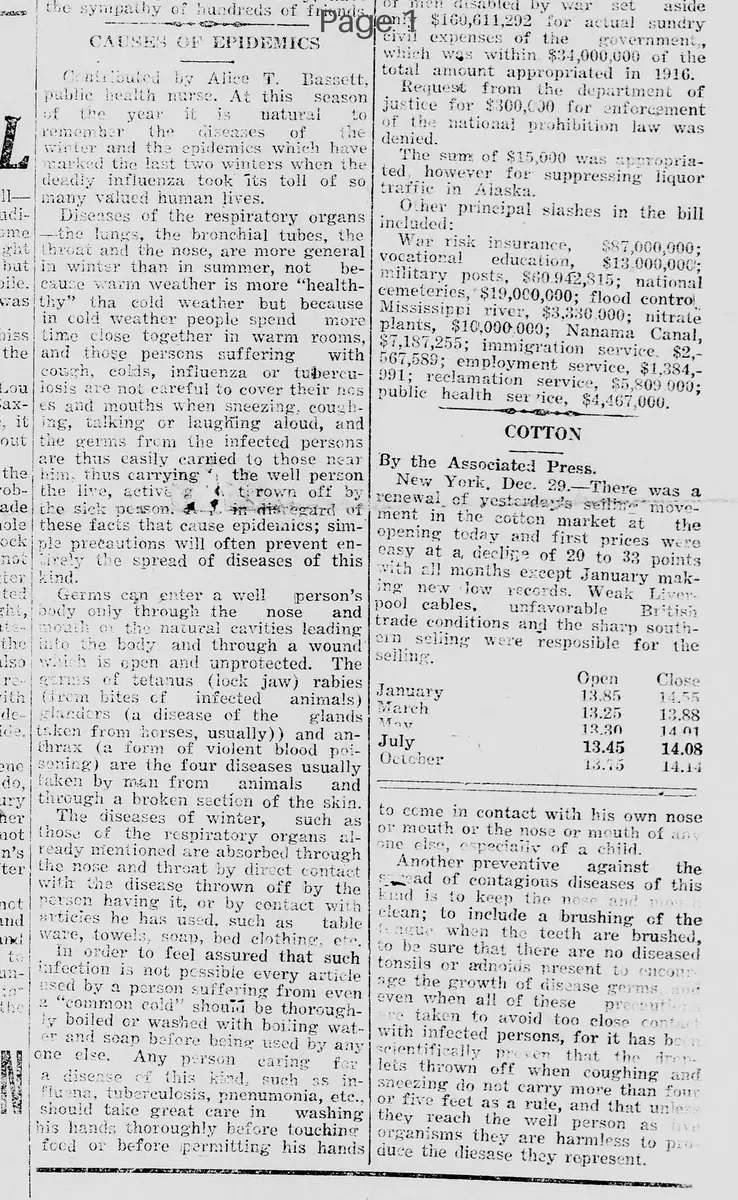
Contributed by Alice T. Bassett, public health nurse.
At this season of the year it is natural to remember the diseases of the winter and the epidemics which have marked the last two winters when the deadly influenza took its toll of so many valued human lives.
Diseases of the respiratory organs—the lungs, the bronchial tubes, the throat and the nose, are more general in winter than in summer, not because warm weather is more "healthy" than cold weather but because in cold weather people spend more time close together in warm rooms, and those persons suffering with cough, colds, influenza or tuberculosis are not careful to cover their noses and mouths when sneezing, coughing, talking or laughing aloud, and the germs from the infected persons are thus easily carried to those near him, thus carrying to the well person the live, active germs thrown off by the sick person. Disregard of these facts cause epidemics; simple precautions will often prevent entirely the spread of diseases of this kind.
Germs can enter a well person's body only through the nose and mouth or the natural cavities leading into the body and through a wound which is open and unprotected. The germs of tetanus (lock jaw) rabies (from bites of infected animals) glanders (a disease of the glands taken from horses, usually) and anthrax (a form of violent blood poisoning) are the four diseases usually taken by man from animals and through a broken section of the skin.
The diseases of winter, such as those of the respiratory organs already mentioned are absorbed through the nose and throat by direct contact with the disease thrown off by the person having it, or by contact with articles he has used, such as table ware, towels, soap, bed clothing, etc.
In order to feel assured that such infection is not possible every article used by a person suffering from even a "common cold" should be thoroughly boiled or washed with boiling water and soap before being used by anyone else. Any person caring for a disease of this kind, such as influenza, tuberculosis, pneumonia, etc., should take great care in washing his hands thoroughly before touching food or before permitting his hands to come in contact with his own nose or mouth or the nose or mouth of anyone else, especially of a child.
Another preventive against the spread of contagious diseases of this kind is to keep the nose and mouth clean; to include a brushing of the tongue when the teeth are brushed, to be sure that there are no diseased tonsils or adenoids present to encourage the growth of disease germs even when all of these precautions are taken to avoid too close contact with infected persons, for it has been scientifically proven that the droplets thrown off when coughing and sneezing do not carry more than four or five feet as a rule, and that unless they reach the well person as organisms they are harmless to produce the disease they represent.
What sub-type of article is it?
What keywords are associated?
What entities or persons were involved?
Domestic News Details
Key Persons
Event Details
Article by public health nurse explaining causes of winter epidemics, particularly respiratory diseases like influenza and tuberculosis, due to close indoor contact and poor hygiene practices. Details germ transmission via coughing, sneezing, shared items, and animal-related diseases. Provides preventive measures including covering mouth, boiling items, hand washing, and oral hygiene.