Thank you for visiting SNEWPapers!
Sign up free
Alexandria Daily Gazette, Commercial & Political
Alexandria, Virginia
What is this article about?
On April 3, 1812, President James Madison vetoed a bill allowing Supreme Court justices to handle district court cases during judges' absence or disability, citing constitutional concerns. The House ordered the message printed and set reconsideration for the next day.
Clipping
OCR Quality
Full Text
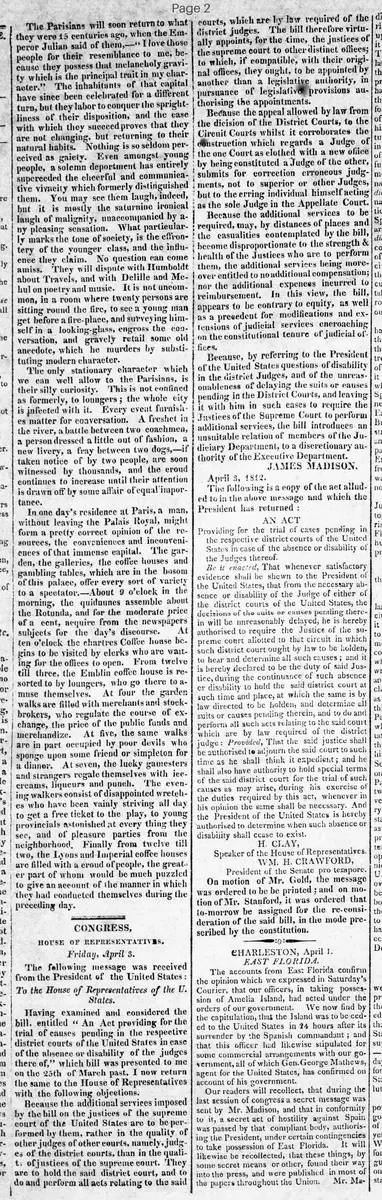
HOUSE OF REPRESENTATIVES.
Friday, April 3.
The following message was received from the President of the United States:
To the House of Representatives of the U. States.
Having examined and considered the bill, entitled "An Act providing for the trial of causes pending in the respective district courts of the United States in case of the absence or disability of the judges thereof," which bill was presented to me on the 25th of March past, I now return the same to the House of Representatives with the following objections.
Because the additional services imposed by the bill on the justices of the supreme court of the United States are to be performed by them, rather in the quality of other judges of other courts, namely, judges of the district courts, than in the quality of justices of the supreme court. They are to hold the said district court, and to do and perform all acts relating to the said courts, which are by law required of the district judges. The bill therefore virtually appoints, for the time, the justices of the supreme court to other distinct offices: to which, if compatible, with their original offices, they ought, to be appointed by another than a legislative authority, in pursuance of legislative provisions authorising the appointments.
Because the appeal allowed by law from the decision of the District Courts, to the Circuit Courts whilst it corroborates the construction which regards a Judge of the one Court as clothed with a new office by being constituted a Judge of the other, submits for correction erroneous judgments, not to superior or other Judges, but to the erring individual himself acting as the sole Judge in the Appellate Court.
Because the additional services to be required, may, by distances of places and the casualties contemplated by the bill, become disproportionate to the strength & health of the Justices who are to perform them, the additional services being moreover entitled to no additional compensation; nor the additional expenses incurred to reimbursement. In this view, the bill appears to be contrary to equity, as well as a precedent for modifications and extensions of judicial services encroaching on the constitutional tenure of judicial offices.
Because, by referring to the President of the United States questions of disability in the district Judges, and of the unreasonableness of delaying the suits or causes pending in the District Courts, and leaving it with him in such cases to require the Justices of the Supreme Court to perform additional services, the bill introduces an unsuitable relation of members of the Judiciary Department, to a discretionary authority of the Executive Department.
JAMES MADISON.
April 3, 1812.
The following is a copy of the act alluded to in the above message and which the President has returned:
AN ACT
Providing for the trial of cases pending in the respective district courts of the United States in case of the absence or disability of the Judges thereof
Be it enacted, That whenever satisfactory evidence shall be shewn to the President of the United States, that from the necessary absence or disability of the Judge of either of the district courts of the United States, the decisions of the suits or causes pending therein will be unreasonably delayed, he is hereby authorised to require the Justice of the supreme court allotted to that circuit in which such district court ought by law to be holden, to hear and determine all such causes; and it is hereby declared to be the duty of said Justice, during the continuance of such absence or disability to hold the said district court at such time and place, at which the same is by law directed to be holden, and determine all suits or causes pending therein, and to do and perform all such acts relating to the said court which are by law required of the district judge: Provided, That the said justice shall be authorised to adjourn the said court to such time as he shall think it expedient; and he shall also have authority to hold special terms of the said district court for the trial of such causes as may arise, during his exercise of the duties required by this act, whenever in his opinion the same shall be necessary. And the President of the United States is hereby authorised to determine when such absence or disability shall cease to exist.
H. CLAY,
Speaker of the House of Representatives.
WM. H. CRAWFORD,
President of the Senate pro tempore.
On motion of Mr. Gold, the message was ordered to be printed; and on motion of Mr. Stanford, it was ordered that to-morrow be assigned for the re-consideration of the said bill, in the mode prescribed by the constitution.
What sub-type of article is it?
What keywords are associated?
What entities or persons were involved?
Domestic News Details
Event Date
April 3, 1812
Key Persons
Outcome
bill vetoed by president madison and returned to house with objections; message ordered printed; reconsideration assigned for tomorrow.
Event Details
President Madison vetoed a bill authorizing Supreme Court justices to perform duties of absent or disabled district judges upon presidential request, objecting on grounds of separation of powers, additional uncompensated duties, and executive involvement in judicial matters. The full text of the veto message and the bill were presented in the House.