Thank you for visiting SNEWPapers!
Sign up free
New Hampshire Statesman
Concord, Merrimack County, New Hampshire
What is this article about?
A trial determines if an elderly man qualifies as a 'gentleman' after winning a horse race meant for gentlemen riders. His counsel satirically contrasts the man's sober, moral conduct with the drunken, rude young MPs disputing the prize, securing a verdict in his favor amid applause.
Clipping
OCR Quality
Full Text
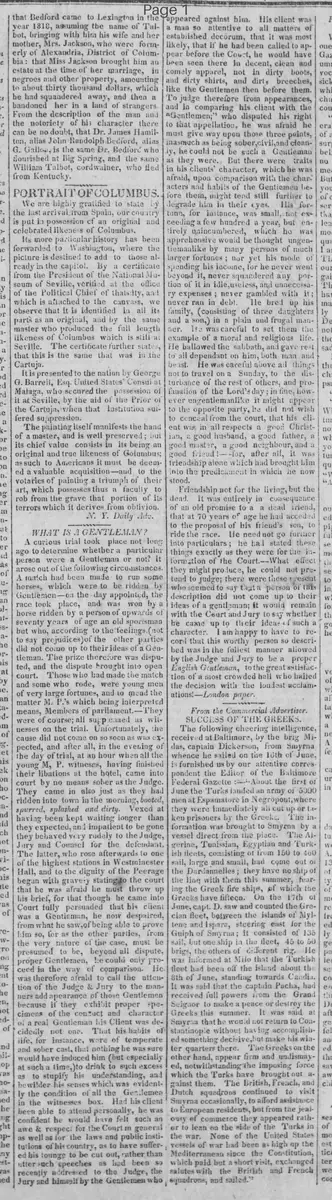
A curious trial took place not long ago to determine whether a particular person were a Gentleman or not? It arose out of the following circumstances. A match had been made to run some horses, which were to be ridden by Gentlemen—on the day appointed, the race took place, and was won by a horse ridden by a person of upwards of seventy years of age an old sportsman but who, according to the feelings,(not to say prejudices) of the other parties did not come up to their ideas of a Gentleman. The prize therefore was disputed, and the dispute brought into open court. Those who had made the match and some who rode, were young men of very large fortunes, and to mend the matter M. P.'s which being interpreted means, Members of parliament.—They were of course; all subpoenaed as witnesses on the trial. Unfortunately, the cause did not come on so soon as was expected, and after all, in the evening of the day of trial, at an hour when all the young M. P. witnesses, having finished their libations at the hotel, came into court by no means sober as the Judge. They came in also just as they had ridden into town in the morning, booted. spurred, splashed and dirty. Vexed at having been kept waiting longer than they expected, and impatient to be gone they behaved very rudely to the Judge, Jury and Counsel for the defendant. The latter, who rose afterwards to one of the highest stations in Westminster Hall, and to the dignity of the Peerage began with gravity stating to the court that he was afraid he must throw up his brief, for that though he came into Court fully persuaded that his client was a Gentleman, he now despaired. from what he saw, of being able to prove him so, for as the other parties, from the very nature of the case, must be presumed to be, beyond all dispute. proper Gentlemen, he could only proceed in the way of comparison. He. was therefore afraid to call the attention of the Judge & Jury to the manners and appearance of those Gentlemen because if they exhibit proper specimens of the conduct and character of a real Gentleman his Client was decidedly not one. That his habits of life, for instance, were of temperate and sober cast, that nothing he was sure would have induced him (but especially at such a time.) to drink to such excess as to stupify his understanding, and bewilder his senses which was evidently the condition of all the Gentlemen in the witnesses box. Had his client been able to attend personally, he was confident he would have felt such an awe & respect for the Court in general as well as for the laws and public institutions of his country, as to have suffered his tongue to be cut out, rather than utter such speeches as had been so recently addressed to the Judge, the Jury and himself by the Gentlemen who appeared against him. His client was a man so attentive to all matters of established decorum, that it was most likely, that if he had been called to appear before the Court, he would have been seen there in decent, clean and comely apparel, not in dirty boots, and dirty shirts, and dirty breeches, like the Gentlemen then before them. To judge therefore from appearances, and in comparing his client with the "Gentlemen;" who disputed his right to that appellation, he was afraid he must give way upon those three points, inasmuch as being sober, civil, and cleanly, he could not be such a Gentleman as they were. But there were traits in his clients' character, which he was afraid, upon comparison with the characters and habits of the Gentlemen before them, might tend still further to legrade him in their eyes. His' former fortune, for instance, was small, not exceeding a few hundred a year. but entirely unincumbered, which he was apprehensive would be thought ungentlemanlike by many persons of much larger fortunes; nor yet his mode of spending his income, for he never went beyond it, never squandered any portion of it in idle, useless, and unnecessary expenses; never gambled with it: never ran in debt. He bred up his family, (consisting of three daughters and a son,) in a plain and frugal manner. He was careful to set them the example of a moral and religious life. He hallowed the sabbath, and gave rest to all dependant on him, both man and beast. He was careful above all things not to travel on a Sunday. to the disturbance of the rest of others. and profanation of the Lord's day; in fine, however ungentlemanlike it might appear to the opposite party, he did not wish to conceal from the court, that his client was in all respects a good Christian, a good husband, a good father, a good master, a good neighbour, and a good friend!—for, after all, it was friendship alone which had brought him into the predicament in which he now stood.
Friendship not for the living, but the dead. It was entirely in consequence of an old promise to a dead friend. that at 70 years of age he had acceded to the proposal of his friend's son, to ride the race. He need not go further into particulars: he had stated these things exactly as they were for the information of the Court.—What effect they might produce, he could not pretend to judge; there were those present who seemed to say that a person of this description did not come up to their ideas of a gentleman; it would remain with the Court and Jury to say whether he came up to their ideas of such a character. I am happy to have to record that this worthy person so described was in the fullest manner allowed by the Judge and Jury to be a proper English Gentleman, to the great satisfaction of a most crowded hall who hailed the decision with the loudest acclamations!—London paper.
What sub-type of article is it?
What themes does it cover?
What keywords are associated?
What entities or persons were involved?
Where did it happen?
Story Details
Key Persons
Location
In Court
Event Date
Not Long Ago
Story Details
An elderly man wins a horse race for gentlemen riders, prompting a trial over his status. His counsel humorously contrasts his sobriety, civility, cleanliness, frugality, and morality with the opposing young MPs' drunken rudeness and extravagance, rooted in fulfilling a promise to a deceased friend. The court declares him a true gentleman amid cheers.