Thank you for visiting SNEWPapers!
Sign up free
Story
March 26, 1942
Mcallen Daily Press
Mcallen, Hidalgo County, Texas
What is this article about?
Amid WWII rubber shortage, a Commerce Department spokesman discusses plans for synthetic rubber production while inventors propose unconventional tire alternatives like wooden blocks, milkweed, dandelions, and other materials to conserve or replace rubber.
Clipping
OCR Quality
85%
Good
Full Text
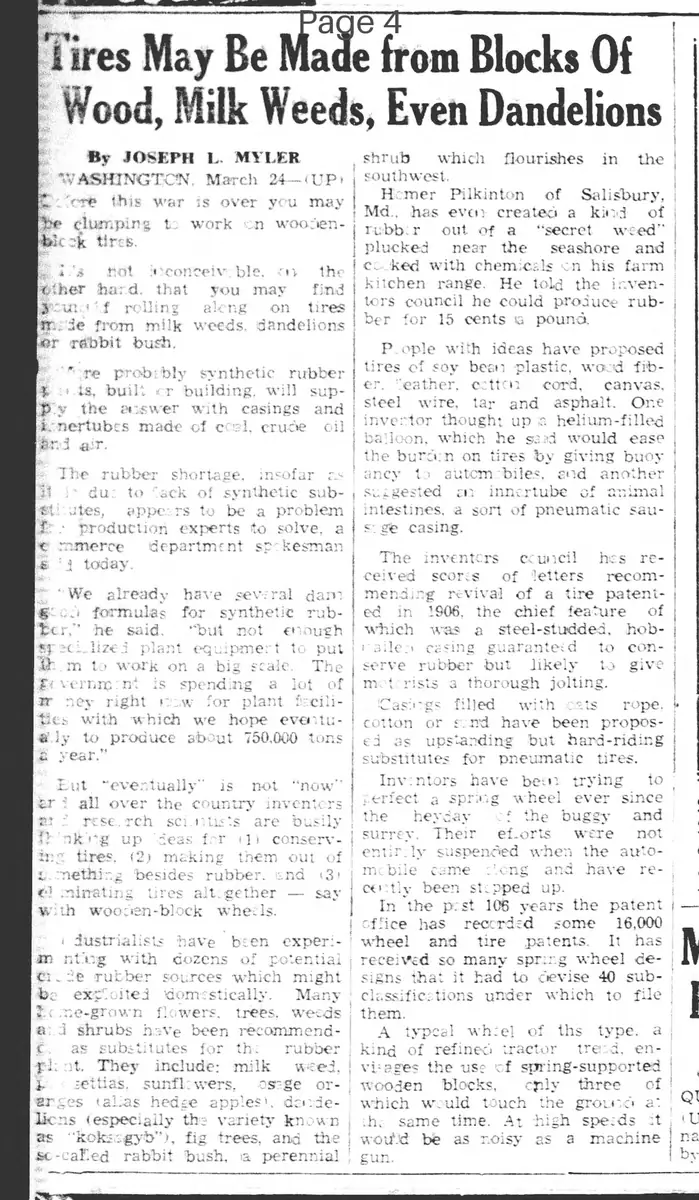
Tires May Be Made from Blocks Of Wood, Milk Weeds, Even Dandelions
By JOSEPH L. MYLER
WASHINGTON, March 24 (UP).
Before this war is over you may be clumping to work on wooden-block tires.
It's not inconceivable, on the other hand, that you may find yourself rolling along on tires made from milk weeds, dandelions or rabbit bush.
These probably [are not from] synthetic rubber plants, but building [plants that] will supply the answer with casings and inner tubes made of coal, crude oil and air.
The rubber shortage, insofar as it [is] due to lack of synthetic substitutes, appears to be a problem for production experts to solve, a commerce department spokesman said today.
"We already have several different formulas for synthetic rubber," he said. "but not enough specialized plant equipment to put them to work on a big scale. The government is spending a lot of money right now for plant facilities with which we hope eventually to produce about 750,000 tons a year."
But "eventually" is not "now" and all over the country inventors and research scientists are busily devising ways for (1) conserving tires, (2) making them out of anything besides rubber, and (3) eliminating tires altogether - say with wooden-block wheels.
Industrialists have been experimenting with dozens of potential rubber sources which might be exploited domestically. Many home-grown flowers, trees, weeds and shrubs have been recommended as substitutes for the rubber plant. They include: milk weed, petunias, sunflowers, orange blossoms, talas hedge apples, dandelions (especially the variety known as 'kok-saghyz'), fig trees, and the so-called rabbit bush, a perennial shrub which flourishes in the southwest.
Homer Pilkinton of Salisbury, Md., has even created a kind of rubber out of a "secret weed" plucked near the seashore and cooked with chemicals on his farm kitchen range. He told the inventors council he could produce rubber for 15 cents a pound.
People with ideas have proposed tires of soy bean plastic, wood fiber, leather, cotton cord, canvas, steel wire, tar and asphalt. One inventor thought up a helium-filled balloon, which he said would ease the burden on tires by giving buoyancy to automobiles, and another suggested a inner tube of animal intestines, a sort of pneumatic sausage casing.
The inventors council has received scores of letters recommending revival of a tire patented in 1890s, the chief feature of which was a steel-studded, hob-nail casing guaranteed to conserve rubber but likely to give motorists a thorough jolting.
Casings filled with oats, rope, cotton or sand have been proposed as unyielding but hard-riding substitutes for pneumatic tires.
Inventors have been trying to perfect a spring wheel ever since the heyday of the buggy and surrey. Their efforts were not entirely suspended when the automobile came along and have recently been stepped up.
In the past 105 years the patent office has recorded some 16,000 wheel and tire patents. It has received so many spring wheel designs that it had to devise 40 sub-classifications under which to file them.
A typical wheel of this type, a kind of refined tractor tread, envisages the use of spring-supported wooden blocks, only three of which would touch the ground at the same time. At high speeds it would be as noisy as a machine gun.
By JOSEPH L. MYLER
WASHINGTON, March 24 (UP).
Before this war is over you may be clumping to work on wooden-block tires.
It's not inconceivable, on the other hand, that you may find yourself rolling along on tires made from milk weeds, dandelions or rabbit bush.
These probably [are not from] synthetic rubber plants, but building [plants that] will supply the answer with casings and inner tubes made of coal, crude oil and air.
The rubber shortage, insofar as it [is] due to lack of synthetic substitutes, appears to be a problem for production experts to solve, a commerce department spokesman said today.
"We already have several different formulas for synthetic rubber," he said. "but not enough specialized plant equipment to put them to work on a big scale. The government is spending a lot of money right now for plant facilities with which we hope eventually to produce about 750,000 tons a year."
But "eventually" is not "now" and all over the country inventors and research scientists are busily devising ways for (1) conserving tires, (2) making them out of anything besides rubber, and (3) eliminating tires altogether - say with wooden-block wheels.
Industrialists have been experimenting with dozens of potential rubber sources which might be exploited domestically. Many home-grown flowers, trees, weeds and shrubs have been recommended as substitutes for the rubber plant. They include: milk weed, petunias, sunflowers, orange blossoms, talas hedge apples, dandelions (especially the variety known as 'kok-saghyz'), fig trees, and the so-called rabbit bush, a perennial shrub which flourishes in the southwest.
Homer Pilkinton of Salisbury, Md., has even created a kind of rubber out of a "secret weed" plucked near the seashore and cooked with chemicals on his farm kitchen range. He told the inventors council he could produce rubber for 15 cents a pound.
People with ideas have proposed tires of soy bean plastic, wood fiber, leather, cotton cord, canvas, steel wire, tar and asphalt. One inventor thought up a helium-filled balloon, which he said would ease the burden on tires by giving buoyancy to automobiles, and another suggested a inner tube of animal intestines, a sort of pneumatic sausage casing.
The inventors council has received scores of letters recommending revival of a tire patented in 1890s, the chief feature of which was a steel-studded, hob-nail casing guaranteed to conserve rubber but likely to give motorists a thorough jolting.
Casings filled with oats, rope, cotton or sand have been proposed as unyielding but hard-riding substitutes for pneumatic tires.
Inventors have been trying to perfect a spring wheel ever since the heyday of the buggy and surrey. Their efforts were not entirely suspended when the automobile came along and have recently been stepped up.
In the past 105 years the patent office has recorded some 16,000 wheel and tire patents. It has received so many spring wheel designs that it had to devise 40 sub-classifications under which to file them.
A typical wheel of this type, a kind of refined tractor tread, envisages the use of spring-supported wooden blocks, only three of which would touch the ground at the same time. At high speeds it would be as noisy as a machine gun.
What sub-type of article is it?
Curiosity
Historical Event
What themes does it cover?
Misfortune
Triumph
Survival
What keywords are associated?
Rubber Shortage
Synthetic Rubber
Tire Alternatives
Wooden Tires
Plant Substitutes
Inventors
Wwii Innovations
What entities or persons were involved?
Joseph L. Myler
Homer Pilkinton
Where did it happen?
Washington
Story Details
Key Persons
Joseph L. Myler
Homer Pilkinton
Location
Washington
Event Date
March 24
Story Details
Due to wartime rubber shortage, government plans synthetic rubber plants while inventors experiment with alternatives like plant-based rubbers from milkweed and dandelions, wooden block tires, and other unconventional materials to conserve or replace rubber.