Thank you for visiting SNEWPapers!
Sign up free
Letter to Editor
October 9, 1828
The Litchfield County Post
Litchfield, Litchfield County, Connecticut
What is this article about?
Response to a query on falling prices of foreign goods after US tariffs, explaining it via cheaper raw materials, machinery improvements, and competition breaking British monopoly. Advocates protective duties like the 1816 Tariff to foster American manufacturing.
Clipping
OCR Quality
98%
Excellent
Full Text
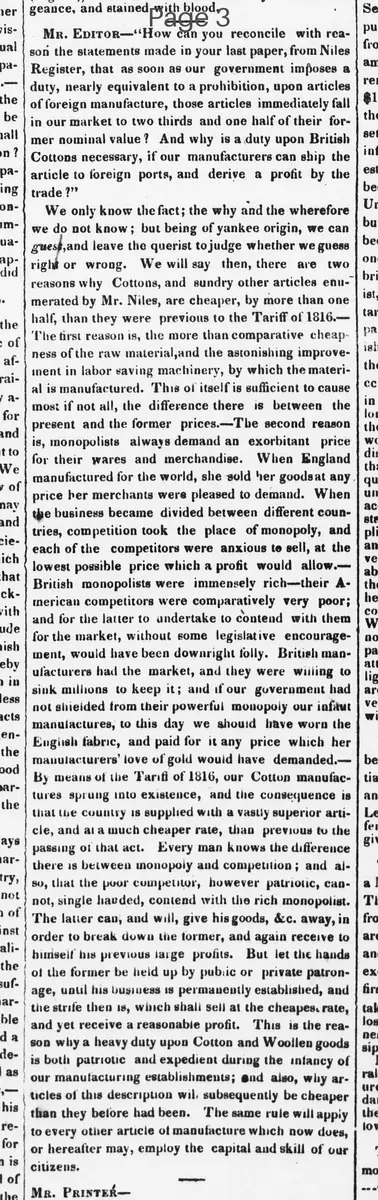
Mr. Editor-"How can you reconcile with reason the statements made in your last paper, from Niles Register, that as soon as our government imposes a duty, nearly equivalent to a prohibition, upon articles of foreign manufacture, those articles immediately fall in our market to two thirds and one half of their former nominal value? And why is a duty upon British Cottons necessary, if our manufacturers can ship the article to foreign ports, and derive a profit by the trade?"
We only know the fact; the why and the wherefore we do not know; but being of yankee origin, we can guess, and leave the querist to judge whether we guess right or wrong. We will say then, there are two reasons why Cottons, and sundry other articles enumerated by Mr. Niles, are cheaper, by more than one half, than they were previous to the Tariff of 1816. The first reason is, the more than comparative cheapness of the raw material, and the astonishing improvement in labor saving machinery, by which the material is manufactured. This of itself is sufficient to cause most if not all, the difference there is between the present and the former prices. The second reason is, monopolists always demand an exorbitant price for their wares and merchandise. When England manufactured for the world, she sold her goods at any price her merchants were pleased to demand. When the business became divided between different countries, competition took the place of monopoly, and each of the competitors were anxious to sell, at the lowest possible price which a profit would allow. British monopolists were immensely rich-their American competitors were comparatively very poor; and for the latter to undertake to contend with them for the market, without some legislative encouragement, would have been downright folly. British manufacturers had the market, and they were willing to sink millions to keep it; and if our government had not shielded from their powerful monopoly our infant manufactures, to this day we should have worn the English fabric, and paid for it any price which her manufacturers' love of gold would have demanded. By means of the Tariff of 1816, our Cotton manufactures sprung into existence, and the consequence is that the country is supplied with a vastly superior article, and at a much cheaper rate, than previous to the passing of that act. Every man knows the difference there is between monopoly and competition; and also, that the poor competitor, however patriotic, cannot, single handed, contend with the rich monopolist. The latter can, and will, give his goods, &c. away, in order to break down the former, and again receive to himself his previous large profits. But let the hands of the former be held up by public or private patronage, until his business is permanently established, and the strife then is, which shall sell at the cheapest rate, and yet receive a reasonable profit. This is the reason why a heavy duty upon Cotton and Woolen goods is both patriotic and expedient during the infancy of our manufacturing establishments; and also, why articles of this description will subsequently be cheaper than they before had been. The same rule will apply to every other article of manufacture which now does, or hereafter may, employ the capital and skill of our citizens.
We only know the fact; the why and the wherefore we do not know; but being of yankee origin, we can guess, and leave the querist to judge whether we guess right or wrong. We will say then, there are two reasons why Cottons, and sundry other articles enumerated by Mr. Niles, are cheaper, by more than one half, than they were previous to the Tariff of 1816. The first reason is, the more than comparative cheapness of the raw material, and the astonishing improvement in labor saving machinery, by which the material is manufactured. This of itself is sufficient to cause most if not all, the difference there is between the present and the former prices. The second reason is, monopolists always demand an exorbitant price for their wares and merchandise. When England manufactured for the world, she sold her goods at any price her merchants were pleased to demand. When the business became divided between different countries, competition took the place of monopoly, and each of the competitors were anxious to sell, at the lowest possible price which a profit would allow. British monopolists were immensely rich-their American competitors were comparatively very poor; and for the latter to undertake to contend with them for the market, without some legislative encouragement, would have been downright folly. British manufacturers had the market, and they were willing to sink millions to keep it; and if our government had not shielded from their powerful monopoly our infant manufactures, to this day we should have worn the English fabric, and paid for it any price which her manufacturers' love of gold would have demanded. By means of the Tariff of 1816, our Cotton manufactures sprung into existence, and the consequence is that the country is supplied with a vastly superior article, and at a much cheaper rate, than previous to the passing of that act. Every man knows the difference there is between monopoly and competition; and also, that the poor competitor, however patriotic, cannot, single handed, contend with the rich monopolist. The latter can, and will, give his goods, &c. away, in order to break down the former, and again receive to himself his previous large profits. But let the hands of the former be held up by public or private patronage, until his business is permanently established, and the strife then is, which shall sell at the cheapest rate, and yet receive a reasonable profit. This is the reason why a heavy duty upon Cotton and Woolen goods is both patriotic and expedient during the infancy of our manufacturing establishments; and also, why articles of this description will subsequently be cheaper than they before had been. The same rule will apply to every other article of manufacture which now does, or hereafter may, employ the capital and skill of our citizens.
What sub-type of article is it?
Informative
Persuasive
Political
What themes does it cover?
Economic Policy
Commerce Trade
What keywords are associated?
Tariff 1816
Cotton Prices
Protective Duties
British Monopoly
American Manufacturing
Competition
Labor Saving Machinery
What entities or persons were involved?
Mr. Editor
Letter to Editor Details
Recipient
Mr. Editor
Main Argument
prices of foreign manufactures like british cottons fell after the 1816 tariff due to cheaper raw materials, improved machinery, and competition ending monopoly; protective duties are necessary to support infant american industries against rich british competitors.
Notable Details
References Niles Register
Tariff Of 1816
British Monopoly Vs. American Competition
Yankee Origin Guess