Thank you for visiting SNEWPapers!
Sign up free
The Seattle Star
Seattle, King County, Washington
What is this article about?
The US Navy's Seventh Division, commanded by Rear Admiral C. F. Hughes, and supply train under Rear Admiral J. V. Chase, arrive in Seattle from Port Angeles, surrendering to local hospitality. Ships including Pennsylvania, Mississippi, and destroyers are described, with planned onboard parties and social events. Marines on USS California are highlighted for their roles and snappiness.
Clipping
OCR Quality
Full Text
Skyline
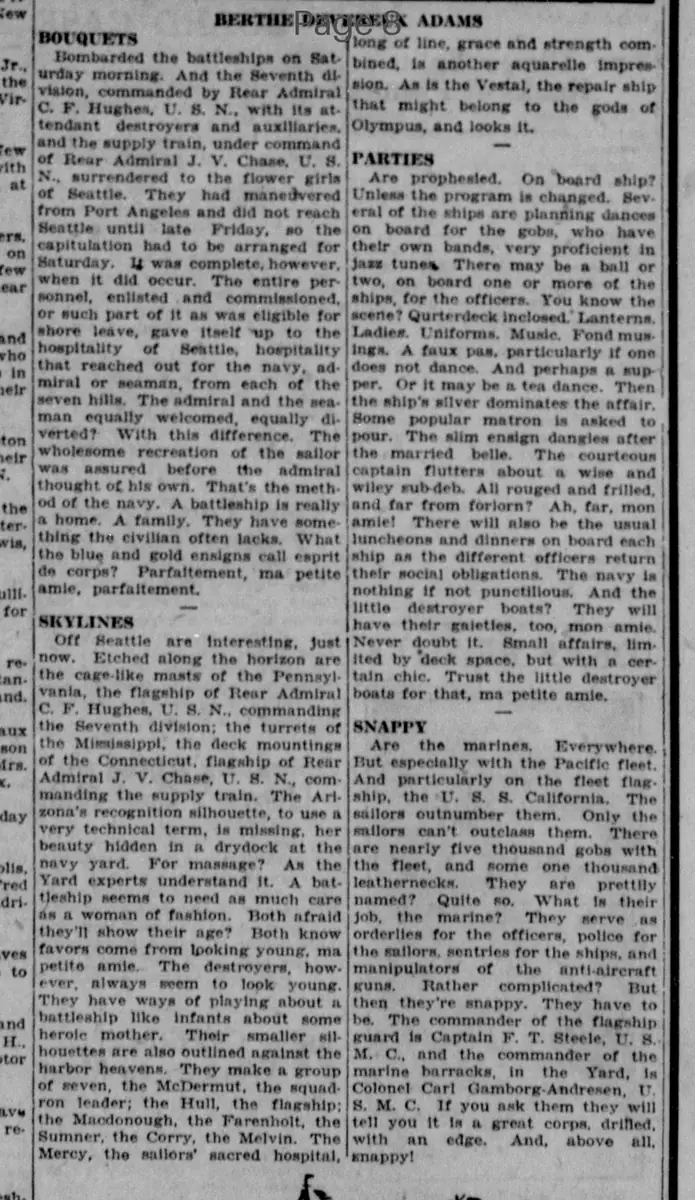
Off Seattle are interesting, just now. Etched along the horizon are the cage-like masts of the Pennsylvania, the flagship of Rear Admiral C. F. Hughes, U. S. N., commanding the Seventh division; the turrets of the Mississippi, the deck mountings of the Connecticut, flagship of Rear Admiral J. V. Chase, U. S. N., commanding the supply train. The Arizona's recognition silhouette, to use a very technical term, is missing, her beauty hidden in a drydock at the navy yard. For massage? As the yard experts understand it. A battleship seems to need as much care as a woman of fashion. Both afraid they'll show their age? Both know favors come from looking young, ma petite amie. The destroyers, however, always seem to look young. They have ways of playing about a battleship like infants about some heroic mother. Their smaller silhouettes are also outlined against the harbor heavens. They make a group of seven, the McDermut, the squadron leader; the Hull, the flagship; the Macdonough, the Farenholt, the Sumner, the Corry, the Melvin. The Mercy, the sailors' sacred hospital, long of line, grace and strength combined, is another aquarelle impression. And is the Vestal, the repair ship that might belong to the gods of Olympus, and looks it.
Parties Are Prophesied
On board ship?
Unless the program is changed. Several of the ships are planning dances on board for the gobs, who have their own bands, very proficient in jazz tunes. There may be a ball or two, on board one or more of the ships, for the officers. You know the scene? Quarterdeck inclosed. Lanterns. Ladies. Uniforms. Music. Fond musings. A faux pas, particularly if one does not dance. And perhaps a supper. Or it may be a tea dance. Then the ship's silver dominates the affair. Some popular matron is asked to pour. The slim ensign dallies after the married belle. The courteous captain flutters about a wise and wily sub-deb. All rouged and frilled, and far from forlorn? Ah, far, mon amie! There will also be the usual luncheons and dinners on board each ship as the different officers return their social obligations. The navy is nothing if not punctilious. And the little destroyer boats? They will have their gaieties, too, mon amie. Never doubt it. Small affairs, limited by deck space, but with a certain chic. Trust the little destroyer boats for that, ma petite amie.
Snappy Are the Marines, Everywhere.
But especially with the Pacific fleet. And particularly on the fleet flagship, the U. S. S. California. The sailors outnumber them. Only the sailors can't outclass them. There are nearly five thousand gobs with the fleet, and some one thousand leathernecks.
They are prettily named?
Quite so.
What is their job, the marine?
They serve as orderlies for the officers, police for the sailors, sentries for the ships, and manipulators of the anti-aircraft guns. Rather complicated? But then they're snappy. They have to be. The commander of the flagship guard is Captain F. T. Steele, U. S. M. C., and the commander of the marine barracks, in the Yard, is Colonel Carl Gamborg-Andresen, U. S. M. C. If you ask them they will tell you it is a great corps, drilled, with an edge. And, above all, snappy!
What sub-type of article is it?
What themes does it cover?
What keywords are associated?
What entities or persons were involved?
Where did it happen?
Story Details
Key Persons
Location
Seattle, Port Angeles
Event Date
Saturday Morning, Late Friday
Story Details
The Seventh Division of the US Navy, led by Rear Admiral Hughes, and supply train under Rear Admiral Chase, arrive in Seattle and surrender to local hospitality. Ships are described in the skyline, with planned dances, balls, and social events onboard. Marines on USS California are noted for their roles and snappiness.