Thank you for visiting SNEWPapers!
Sign up free
The New Hampshire Gazette
Portsmouth, Rockingham County, New Hampshire
What is this article about?
Philadelphia report on French officers establishing an unauthorized agricultural and military colony named Champ D'Azile on the Trinity River in Texas province, claiming sovereignty via a May 1818 manifesto, in territory under U.S. jurisdiction from the Louisiana Purchase.
Clipping
OCR Quality
Full Text
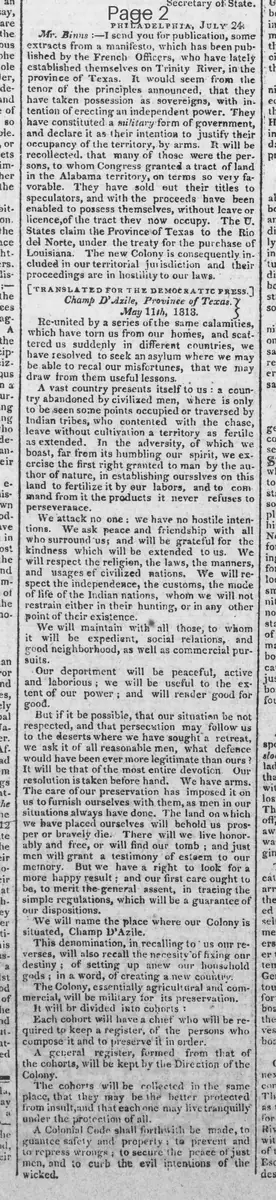
Mr. Binns:—I send you for publication, some extracts from a manifesto, which has been published by the French Officers, who have lately established themselves on Trinity River, in the province of Texas. It would seem from the tenor of the principles announced, that they have taken possession as sovereigns, with intention of erecting an independent power. They have constituted a military form of government, and declare it as their intention to justify their occupancy of the territory, by arms. It will be recollected, that many of those were the persons, to whom Congress granted a tract of land in the Alabama territory, on terms so very favorable. They have sold out their titles to speculators, and with the proceeds have been enabled to possess themselves, without leave or licence, of the tract they now occupy. The U. States claim the Province of Texas to the Rio del Norte, under the treaty for the purchase of Louisiana. The new Colony is consequently included in our territorial jurisdiction and their proceedings are in hostility to our laws.
TRANSLATED FOR THE DEMOCRATIC PRESS.
Champ D'Azile, Province of Texas.
May 11th, 1818.
S.
Re-united by a series of the same calamities, which have torn us from our homes, and scattered us suddenly in different countries, we have resolved to seek an asylum where we may be able to recal our misfortunes, that we may draw from them useful lessons.
A vast country presents itself to us: a country abandoned by civilized men, where is only to be seen some points occupied or traversed by Indian tribes, who contented with the chase, leave without cultivation a territory as fertile as extended. In the adversity, of which we boast, far from its humbling our spirit, we exercise the first right granted to man by the author of nature, in establishing ourselves on this land to fertilize it by our labors, and to command from it the products it never refuses to perseverance.
We attack no one: we have no hostile intentions. We ask peace and friendship with all who surround us; and will be grateful for the kindness which will be extended to us. We will respect the religion, the laws, the manners, and usages of civilized nations. We will respect the independence, the customs, the mode of life of the Indian nations, whom we will not restrain either in their hunting, or in any other point of their existence.
We will maintain with all those, to whom it will be expedient, social relations, and good neighborhood, as well as commercial pursuits.
Our deportment will be peaceful, active and laborious; we will be useful to the extent of our power; and will render good for good.
But if it be possible, that our situation be not respected, and that persecution may follow us to the deserts where we have sought a retreat, we ask it of all reasonable men, what defence would have been ever more legitimate than ours? It will be that of the most entire devotion. Our resolution is taken before hand. We have arms. The care of our preservation has imposed it on us to furnish ourselves with them, as men in our situations always have done. The land on which we have placed ourselves will behold us prosper or bravely die. There will we live honorably and free, or will find our tomb; and just men will grant a testimony of esteem to our memory. But we have a right to look for a more happy result; and our first care ought to be, to merit the general assent, in tracing the simple regulations, which will be a guarantee of our dispositions.
We will name the place where our Colony is situated, Champ D'Azile. This denomination, in recalling to us our reverses, will also recall the necessity of fixing our destiny; of setting up anew our household gods; in a word, of creating a new country.
The Colony, essentially agricultural and commercial, will be military for its preservation. It will be divided into cohorts:
Each cohort will have a chef who will be required to keep a register, of the persons who compose it and to preserve it in order.
A general register, formed from that of the cohorts, will be kept by the Direction of the Colony.
The cohorts will be collected in the same place, that they may be the better protected from insult, and that each one may live tranquilly under the protection of all.
A Colonial Code shall forthwith be made, to guarantee safety and property: to prevent and to repress wrongs; to secure the peace of just men, and to curb the evil intentions of the wicked.
What sub-type of article is it?
What keywords are associated?
What entities or persons were involved?
Where did it happen?
Domestic News Details
Primary Location
Champ D'azile, Province Of Texas
Event Date
May 11th, 1818
Key Persons
Event Details
French officers, previously granted land in Alabama territory by Congress but sold titles to speculators, have established an independent agricultural, commercial, and military colony on Trinity River in Texas, naming it Champ D'Azile. They issued a manifesto declaring peaceful intentions, respect for Indians and civilized nations, but readiness to defend by arms if persecuted. The colony is divided into cohorts with registers and plans a Colonial Code. This settlement is in U.S.-claimed territory under Louisiana Purchase treaty, constituting hostility to U.S. laws.