Thank you for visiting SNEWPapers!
Sign up free
Story
May 25, 1900
Marietta Daily Leader
Marietta, Washington County, Ohio
What is this article about?
Clara Morris, a successful American actress, warns young women aspiring to the stage about the harsh realities of the profession, requiring fortune, high influence, or exceptional beauty to break in, and detailing the lonely, enduring hardships of low pay, isolation, and minor roles.
Clipping
OCR Quality
97%
Excellent
Full Text
An Actress's Warning
"A Word of Warning to Young Actresses" is uttered in the May Century by Clara Morris, one of the most successful actresses America has produced, and author of "Little Jim Crow," "The Silent Singer," etc.
I know, she says, of but three powers that can open the stage door to a girl who comes straight from private life—a fortune, great influence, or superlative beauty. With a large amount of money a girl can unquestionably tempt a manager whose business is not too good to give her an engagement. If influence is used it must indeed be of a high social order to be strong enough to affect favorably the box office receipts, and thus win an opening for the young debutante. As for beauty, it must be something very, very remarkable that will on its strength alone secure a girl an engagement. Mere prettiness will not do; nearly all American girls are pretty. It must be a radiant and compelling beauty, and every one knows that there are not many such beauties, stagestruck or otherwise.
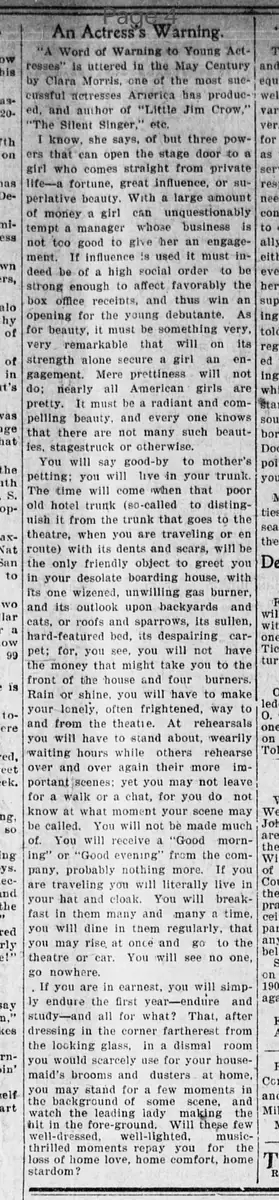
You will say good-by to mother's petting; you will live in your trunk. The time will come when that poor old hotel trunk (so-called to distinguish it from the trunk that goes to the theatre, when you are traveling or en route) with its dents and scars, will be the only friendly object to greet you in your desolate boarding house, with its one wizened, unwilling gas burner, and its outlook upon backyards and cats, or roofs and sparrows, its sullen, hard-featured bed, its despairing carpet; for, you see, you will not have the money that might take you to the front of the house and four burners. Rain or shine, you will have to make your lonely, often frightened, way to and from the theatre. At rehearsals you will have to stand about, wearily waiting hours while others rehearse over and over again their more important scenes; yet you may not leave for a walk or a chat, for you do not know at what moment your scene may be called. You will not be made much of. You will receive a "Good morning" or "Good evening" from the company, probably nothing more. If you are traveling you will literally live in your hat and cloak. You will breakfast in them many and many a time, you will dine in them regularly, that you may rise at once and go to the theatre or car. You will see no one, go nowhere. If you are in earnest, you will simply endure the first year—endure and study—and all for what? That, after dressing in the corner farthest from the looking glass, in a dismal room you would scarcely use for your housemaid's brooms and dusters at home, you may stand for a few moments in the background of some scene, and watch the leading lady making the hit in the foreground. Will these few well-dressed, well-lighted, music-thrilled moments repay you for the loss of home love, home comfort, home stardom?
"A Word of Warning to Young Actresses" is uttered in the May Century by Clara Morris, one of the most successful actresses America has produced, and author of "Little Jim Crow," "The Silent Singer," etc.
I know, she says, of but three powers that can open the stage door to a girl who comes straight from private life—a fortune, great influence, or superlative beauty. With a large amount of money a girl can unquestionably tempt a manager whose business is not too good to give her an engagement. If influence is used it must indeed be of a high social order to be strong enough to affect favorably the box office receipts, and thus win an opening for the young debutante. As for beauty, it must be something very, very remarkable that will on its strength alone secure a girl an engagement. Mere prettiness will not do; nearly all American girls are pretty. It must be a radiant and compelling beauty, and every one knows that there are not many such beauties, stagestruck or otherwise.
You will say good-by to mother's petting; you will live in your trunk. The time will come when that poor old hotel trunk (so-called to distinguish it from the trunk that goes to the theatre, when you are traveling or en route) with its dents and scars, will be the only friendly object to greet you in your desolate boarding house, with its one wizened, unwilling gas burner, and its outlook upon backyards and cats, or roofs and sparrows, its sullen, hard-featured bed, its despairing carpet; for, you see, you will not have the money that might take you to the front of the house and four burners. Rain or shine, you will have to make your lonely, often frightened, way to and from the theatre. At rehearsals you will have to stand about, wearily waiting hours while others rehearse over and over again their more important scenes; yet you may not leave for a walk or a chat, for you do not know at what moment your scene may be called. You will not be made much of. You will receive a "Good morning" or "Good evening" from the company, probably nothing more. If you are traveling you will literally live in your hat and cloak. You will breakfast in them many and many a time, you will dine in them regularly, that you may rise at once and go to the theatre or car. You will see no one, go nowhere. If you are in earnest, you will simply endure the first year—endure and study—and all for what? That, after dressing in the corner farthest from the looking glass, in a dismal room you would scarcely use for your housemaid's brooms and dusters at home, you may stand for a few moments in the background of some scene, and watch the leading lady making the hit in the foreground. Will these few well-dressed, well-lighted, music-thrilled moments repay you for the loss of home love, home comfort, home stardom?
What sub-type of article is it?
Biography
What themes does it cover?
Misfortune
Moral Virtue
What keywords are associated?
Acting Career
Hardships Of Acting
Advice To Actresses
Stage Debut
Theatrical Life
What entities or persons were involved?
Clara Morris
Story Details
Key Persons
Clara Morris
Event Date
May Century
Story Details
Clara Morris advises that only fortune, great influence, or superlative beauty can secure a stage debut for a young woman from private life, and describes the grueling, isolating daily life of a beginning actress, questioning if minor roles justify losing home comforts.