Thank you for visiting SNEWPapers!
Sign up free
Editorial
June 17, 1826
Phenix Gazette
Alexandria, Virginia
What is this article about?
An editorial outlining five general principles of education for mothers: emphasizing prevention over cure, example over precept, habit formation over rules, long-term character development, and prioritizing religious and virtuous habits rooted in Christianity.
Clipping
OCR Quality
95%
Excellent
Full Text
HINTS FOR MOTHERS.
GENERAL PRINCIPLES OF EDUCATION.
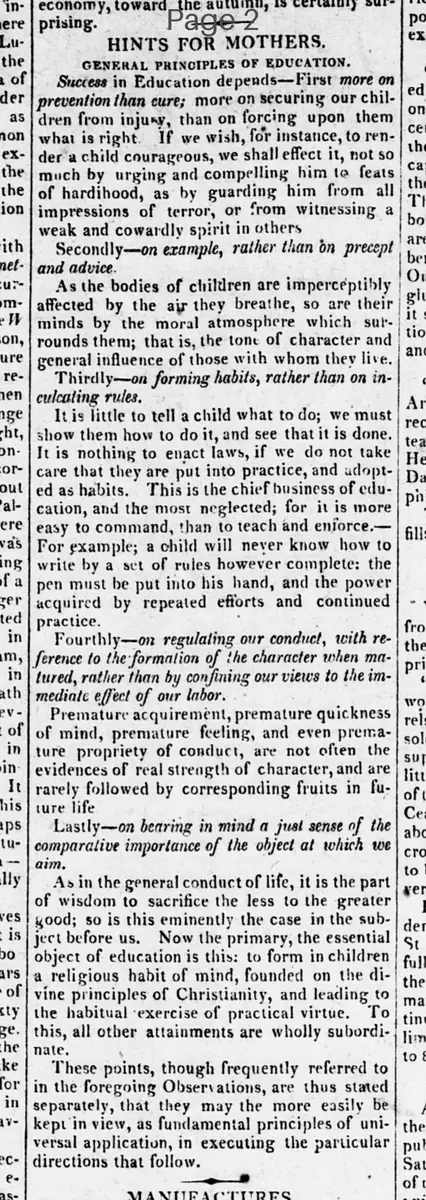
Success in Education depends—First more on prevention than cure; more on securing our children from injury, than on forcing upon them what is right. If we wish, for instance, to render a child courageous, we shall effect it, not so much by urging and compelling him to feats of hardihood, as by guarding him from all impressions of terror, or from witnessing a weak and cowardly spirit in others Secondly—on example, rather than on precept and advice. As the bodies of children are imperceptibly affected by the air they breathe, so are their minds by the moral atmosphere which surrounds them; that is, the tone of character and general influence of those with whom they live. Thirdly—on forming habits, rather than on inculcating rules. It is little to tell a child what to do; we must show them how to do it, and see that it is done. It is nothing to enact laws, if we do not take care that they are put into practice, and adopted as habits. This is the chief business of education, and the most neglected; for it is more easy to command, than to teach and enforce.— For example; a child will never know how to write by a set of rules however complete: the pen must be put into his hand, and the power acquired by repeated efforts and continued practice. Fourthly—on regulating our conduct, with reference to the formation of the character when matured, rather than by confining our views to the immediate effect of our labor. Premature acquirement, premature quickness of mind. premature feeling, and even premature propriety of conduct, are not often the evidences of real strength of character, and are rarely followed by corresponding fruits in future life Lastly—on bearing in mind a just sense of the comparative importance of the object at which we aim. As in the general conduct of life, it is the part of wisdom to sacrifice the less to the greater good; so is this eminently the case in the subject before us. Now the primary, the essential object of education is this: to form in children a religious habit of mind, founded on the divine principles of Christianity, and leading to the habitual exercise of practical virtue. To this, all other attainments are wholly subordinate. These points, though frequently referred to in the foregoing Observations, are thus stated separately, that they may the more easily be kept in view, as fundamental principles of universal application, in executing the particular directions that follow.
GENERAL PRINCIPLES OF EDUCATION.
Success in Education depends—First more on prevention than cure; more on securing our children from injury, than on forcing upon them what is right. If we wish, for instance, to render a child courageous, we shall effect it, not so much by urging and compelling him to feats of hardihood, as by guarding him from all impressions of terror, or from witnessing a weak and cowardly spirit in others Secondly—on example, rather than on precept and advice. As the bodies of children are imperceptibly affected by the air they breathe, so are their minds by the moral atmosphere which surrounds them; that is, the tone of character and general influence of those with whom they live. Thirdly—on forming habits, rather than on inculcating rules. It is little to tell a child what to do; we must show them how to do it, and see that it is done. It is nothing to enact laws, if we do not take care that they are put into practice, and adopted as habits. This is the chief business of education, and the most neglected; for it is more easy to command, than to teach and enforce.— For example; a child will never know how to write by a set of rules however complete: the pen must be put into his hand, and the power acquired by repeated efforts and continued practice. Fourthly—on regulating our conduct, with reference to the formation of the character when matured, rather than by confining our views to the immediate effect of our labor. Premature acquirement, premature quickness of mind. premature feeling, and even premature propriety of conduct, are not often the evidences of real strength of character, and are rarely followed by corresponding fruits in future life Lastly—on bearing in mind a just sense of the comparative importance of the object at which we aim. As in the general conduct of life, it is the part of wisdom to sacrifice the less to the greater good; so is this eminently the case in the subject before us. Now the primary, the essential object of education is this: to form in children a religious habit of mind, founded on the divine principles of Christianity, and leading to the habitual exercise of practical virtue. To this, all other attainments are wholly subordinate. These points, though frequently referred to in the foregoing Observations, are thus stated separately, that they may the more easily be kept in view, as fundamental principles of universal application, in executing the particular directions that follow.
What sub-type of article is it?
Education
Moral Or Religious
What keywords are associated?
Child Education
Parental Guidance
Moral Habits
Religious Upbringing
Character Formation
Editorial Details
Primary Topic
General Principles Of Education For Mothers
Stance / Tone
Instructional And Advisory
Key Arguments
Success In Education Depends More On Prevention Than Cure, Securing Children From Injury Rather Than Forcing Right Behavior.
Education Relies On Example Rather Than Precept, As Children's Minds Are Shaped By The Moral Atmosphere Around Them.
Forming Habits Is Key, Not Just Inculcating Rules; Show And Enforce Practice.
Focus On Long Term Character Formation Over Immediate Effects, Avoiding Premature Attainments.
Prioritize Forming A Religious Habit Of Mind Based On Christianity And Practical Virtue Above All Other Goals.