Thank you for visiting SNEWPapers!
Sign up free
Editorial
August 10, 1953
Trainman News
Indianapolis, Marion County, Indiana
What is this article about?
Editorial criticizes Treasury Secretary George M. Humphrey's claim that high interest rates benefit millions of savers over borrowers, arguing it misleads by ignoring disproportionate benefits to few large holders and uses flawed statistics to justify hard money policy.
Clipping
OCR Quality
98%
Excellent
Full Text
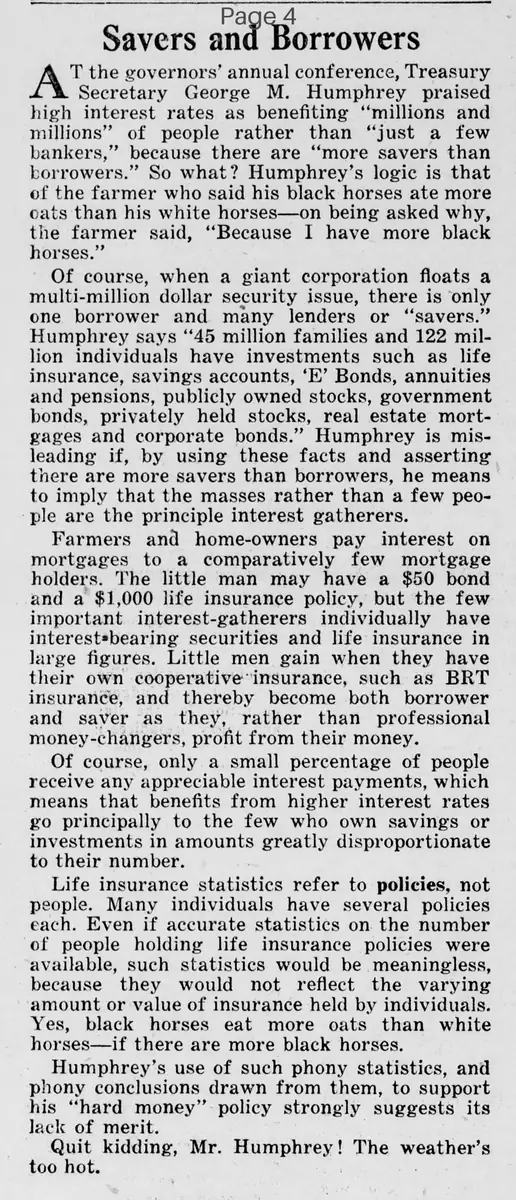
Savers and Borrowers
At the governors' annual conference, Treasury Secretary George M. Humphrey praised high interest rates as benefiting "millions and millions" of people rather than "just a few bankers," because there are "more savers than borrowers." So what? Humphrey's logic is that of the farmer who said his black horses ate more oats than his white horses--on being asked why, the farmer said, "Because I have more black horses."
Of course, when a giant corporation floats a multi-million dollar security issue, there is only one borrower and many lenders or "savers."
Humphrey says "45 million families and 122 million individuals have investments such as life insurance, savings accounts, 'E' Bonds, annuities and pensions, publicly owned stocks, government bonds, privately held stocks, real estate mortgages and corporate bonds."
Humphrey is misleading if, by using these facts and asserting there are more savers than borrowers, he means to imply that the masses rather than a few people are the principle interest gatherers.
Farmers and home-owners pay interest on mortgages to a comparatively few mortgage holders. The little man may have a $50 bond and a $1,000 life insurance policy, but the few important interest-gatherers individually have interest-bearing securities and life insurance in large figures. Little men gain when they have their own cooperative insurance, such as BRT insurance, and thereby become both borrower and saver as they, rather than professional money-changers, profit from their money.
Of course, only a small percentage of people receive any appreciable interest payments, which means that benefits from higher interest rates go principally to the few who own savings or investments in amounts greatly disproportionate to their number.
Life insurance statistics refer to policies, not people. Many individuals have several policies each. Even if accurate statistics on the number of people holding life insurance policies were available, such statistics would be meaningless, because they would not reflect the varying amount or value of insurance held by individuals.
Yes, black horses eat more oats than white horses if there are more black horses.
Humphrey's use of such phony statistics, and phony conclusions drawn from them, to support his "hard money" policy strongly suggests its lack of merit.
Quit kidding, Mr. Humphrey! The weather's too hot.
At the governors' annual conference, Treasury Secretary George M. Humphrey praised high interest rates as benefiting "millions and millions" of people rather than "just a few bankers," because there are "more savers than borrowers." So what? Humphrey's logic is that of the farmer who said his black horses ate more oats than his white horses--on being asked why, the farmer said, "Because I have more black horses."
Of course, when a giant corporation floats a multi-million dollar security issue, there is only one borrower and many lenders or "savers."
Humphrey says "45 million families and 122 million individuals have investments such as life insurance, savings accounts, 'E' Bonds, annuities and pensions, publicly owned stocks, government bonds, privately held stocks, real estate mortgages and corporate bonds."
Humphrey is misleading if, by using these facts and asserting there are more savers than borrowers, he means to imply that the masses rather than a few people are the principle interest gatherers.
Farmers and home-owners pay interest on mortgages to a comparatively few mortgage holders. The little man may have a $50 bond and a $1,000 life insurance policy, but the few important interest-gatherers individually have interest-bearing securities and life insurance in large figures. Little men gain when they have their own cooperative insurance, such as BRT insurance, and thereby become both borrower and saver as they, rather than professional money-changers, profit from their money.
Of course, only a small percentage of people receive any appreciable interest payments, which means that benefits from higher interest rates go principally to the few who own savings or investments in amounts greatly disproportionate to their number.
Life insurance statistics refer to policies, not people. Many individuals have several policies each. Even if accurate statistics on the number of people holding life insurance policies were available, such statistics would be meaningless, because they would not reflect the varying amount or value of insurance held by individuals.
Yes, black horses eat more oats than white horses if there are more black horses.
Humphrey's use of such phony statistics, and phony conclusions drawn from them, to support his "hard money" policy strongly suggests its lack of merit.
Quit kidding, Mr. Humphrey! The weather's too hot.
What sub-type of article is it?
Economic Policy
What keywords are associated?
Interest Rates
Savers Borrowers
Hard Money Policy
Economic Misleading Statistics
Life Insurance Investments
What entities or persons were involved?
George M. Humphrey
Treasury Secretary
Editorial Details
Primary Topic
Critique Of High Interest Rates And Misleading Statistics On Savers Vs Borrowers
Stance / Tone
Critical Of Treasury Secretary Humphrey's Hard Money Policy
Key Figures
George M. Humphrey
Treasury Secretary
Key Arguments
High Interest Rates Benefit Few Large Interest Gatherers More Than Many Small Savers
Statistics On Number Of Savers Mislead By Ignoring Amounts Held
Farmers And Homeowners Pay Interest To Few Mortgage Holders
Life Insurance Stats Count Policies Not People Or Values
Phony Statistics Support Flawed Hard Money Policy