Thank you for visiting SNEWPapers!
Sign up free
Jenks's Portland Gazette
Portland, Cumberland County, Maine
What is this article about?
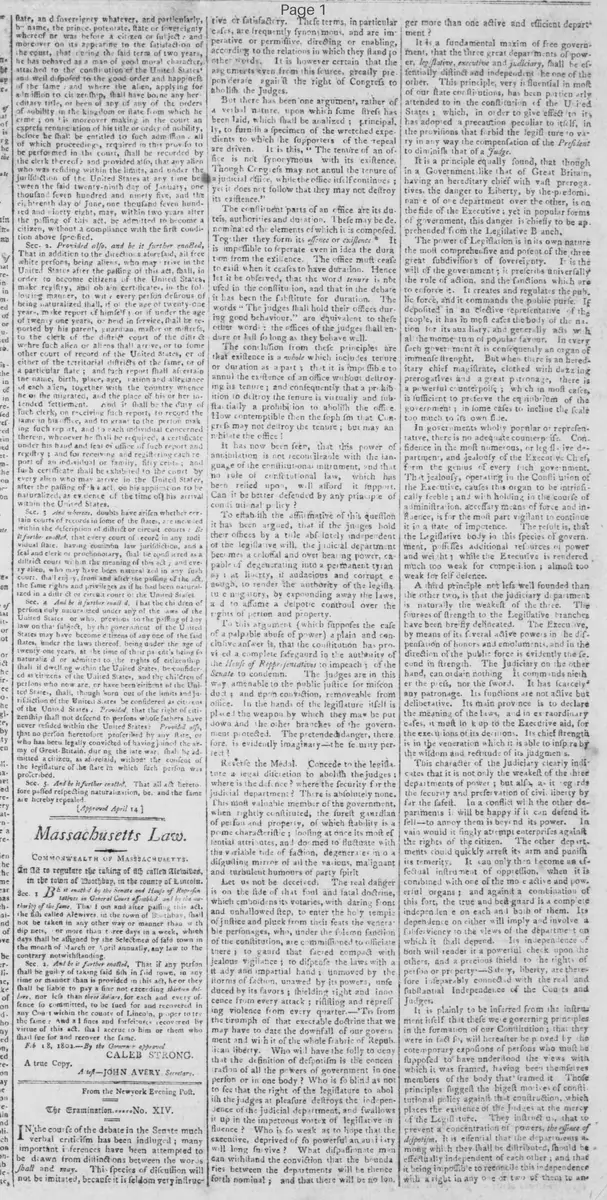
This editorial from the New-York Evening Post, part of 'The Examination' series, argues against Congress's right to abolish judicial offices, defending judicial independence and separation of powers under the U.S. Constitution to prevent legislative overreach and despotism.
Merged-components note: Continuation of the 'The Examination--No. XIV' essay from the New-York Evening Post across pages 1 and 2, based on sequential reading order and thematic flow.
Clippings
1 of 2
OCR Quality
Full Text
The Examination.--No. XIV.
In the course of the debate in the Senate much verbal criticism has been indulged; many important inferences have been attempted to be drawn from distinctions between the words shall and may. This species of discussion will not be imitated, because it is seldom very instructive or satisfactory. These terms, in particular cases, are frequently synonymous, and are imperative or permissive, directing or enabling, according to the relations in which they stand to other words. It is however certain that the arguments even from this source, greatly preponderate against the right of Congress to abolish the Judges.
But there has been one argument, rather of a verbal nature, upon which some stress has been laid, which shall be analyzed; principally, to furnish a specimen of the wretched expedients to which the supporters of the Repeal are driven. It is this, "The tenure of an office is not synonymous with its existence. Though Congress may not annul the tenure of a judicial office, while the office itself continues; yet it does not follow that they may not destroy its existence."
The constituent parts of an office are its duties, authorities and duration. These may be denominated the elements of which it is composed. Together they form its essence or existence. It is impossible to separate even in idea the duration from the existence. The office must cease to exist when it ceases to have duration. Hence let it be observed, that the word tenure is not used in the constitution, and that in the debate it has been the substitute for duration. The words "The judges shall hold their offices during good behaviour." are equivalent to these other words: the offices of the judges shall endure or last so long as they behave well.
The conclusions from these principles are that existence is a whole which includes tenure or duration as a part; that it is impossible to annul the existence of an office without destroying its tenure; and consequently that a prohibition to destroy the tenure is virtually and substantially a prohibition to abolish the office.
How contemptible then the sophism that Congress may not destroy the tenure; but may annihilate the office!
It has now been seen, that this power of annihilation is not reconcilable with the language of the constitutional instrument, and that no rule of constitutional law, which has been relied upon, will afford it support.
Can it be better defended by any principle of constitutional policy?
To establish the affirmative of this question it has been argued, that if the judges hold their offices by a tenure absolutely independent of the legislative will, the judicial department becomes a colossal and overbearing power, capable of degenerating into a permanent tyranny; at liberty, if audacious and corrupt enough, to render the authority of the legislature nugatory, by expounding away the laws, and to assume a despotic controul over the rights of person and property.
To this argument (which supposes the case of a palpable abuse of power) a plain and conclusive answer is, that the constitution has provided a complete safeguard to the authority of the House of Representatives to impeach; of the Senate to condemn. The judges are in this way amenable to the public justice for misconduct: and on conviction, removeable from office. In the hands of the legislature itself is placed the weapon by which they may be put down and the other branches of the government protected. The pretended danger, therefore, is evidently imaginary--the security perfect!
Reverse the Medal. Concede to the legislature a legal discretion to abolish the judges; where is the defence? where the security for the judicial department? There is absolutely none. This most valuable member of the government, when rightly constituted, the surest guardian of person and property, of which stability is a prime characteristic: looking at once its most essential attributes, and doomed to fluctuate with the variable tide of faction, degenerates into a disgusting mirror of all the various, malignant and turbulent humours of party spirit.
Let us not be deceived. The real danger is on the side of that foul and fatal doctrine, which emboldens its votaries, with daring front and unhallowed step, to enter the holy temple of justice and pluck from their seats the venerable personages, who, under the solemn sanction of the constitution, are commissioned to officiate there; to guard that sacred compact with jealous vigilance; to dispense the laws with a steady and impartial hand: unmoved by the storms of faction, unawed by its powers, unduced by its favors; shielding right and innocence from every attack; repilling and repressing violence from every quarter. 'Tis from the triumph of that execrable doctrine that we may have to date the downfall of our government and with it of the whole fabric of Republican liberty. Who will have the folly to deny that the definition of despotism is the concentration of all the powers of government in one person or in one body? Who is so blind as not to see that the right of the legislature to abolish the judges at pleasure destroys the independence of the judicial department, and swallows it up in the impetuous vortex of legislative influence? Who is so weak as to hope that the executive, deprived of so powerful an auxiliary will long survive? What dispassionate mind can withstand the conviction that the boundaries between the departments will be thenceforth nominal; and that there will be no longer more than one active and efficient department?
It is a fundamental maxim of free government, that the three great departments of power, legislative, executive and judiciary, shall be essentially distinct and independent the one of the other. This principle, very influential in most of our state constitutions, has been particularly attended to in the constitution of the United States; which, in order to give effect to it has adopted a precaution peculiar to itself, in the provisions that forbid the legislature to vary in any way the compensation of the President or to diminish that of a Judge.
It is a principle equally sound, that though in a Government like that of Great Britain, having an hereditary chief with vast prerogatives, the danger to Liberty, by the predominance of one department over the other, is on the side of the Executive: yet in popular forms of government, this danger is chiefly to be apprehended from the Legislative Branch.
The power of Legislation is in its own nature the most comprehensive and potent of the three great subdivisions of sovereignty. It is the will of the government; it prescribes universally the rule of action, and the sanctions which are to enforce it. It creates and regulates the public force, and it commands the public purse. If deposited in an elective representative of the people, it has in most cases the body of the nation for its auxiliary, and generally acts with the momentary momentum of popular favour. In every such government it is consequently an organ of immense strength. But when there is an hereditary chief magistrate, clothed with dazzling prerogatives and a great patronage, there is a powerful counterpoise; which in most cases, is sufficient to preserve the equilibrium of the government; in some cases to incline the scale too much to its own side.
In governments wholly popular or representative, there is no adequate counterpoise. Confidence in the most numerous, or legislative department, and jealousy of the Executive Chief, form the genius of every such government. That jealousy, operating in the Constitution of the Executive, causes this organ to be intrinsically feeble; and with holding in the course of administration, necessary means of force and influence, is for the most part vigilant to continue it in a state of impotence. The result is, that the Legislative body in this species of government, possesses additional resources of power and weight: while the Executive is rendered much too weak for competition; almost too weak for self defence.
A third principle not less well founded than the other two, is that the judiciary department is naturally the weakest of the three. The sources of strength to the Legislative branches have been briefly delineated. The Executive, by means of its several active powers in the distribution of honors and emoluments, and in the direction of the public force is evidently the second in strength. The Judiciary on the other hand, can ordain nothing It commands neither the purse, nor the sword. It has scarcely any patronage. Its functions are not active but deliberative. Its main province is to declare the meaning of the laws, and in extraordinary cases, it must look up to the Executive aid, for the execution of its decisions. Its chief strength is in the veneration which it is able to inspire by the wisdom and rectitude of its judgments.
This character of the Judiciary clearly indicates that it is not only the weakest of the three departments of power; but also, as it regards the security and preservation of civil liberty by far the safest. In a conflict with the other departments it will be happy if it can defend itself--to annoy them is beyond its power. In vain would it singly attempt enterprises against the rights of the citizen. The other departments could quickly arrest its arm and punish its temerity. It can only then become an effectual instrument of oppression, when it is combined with one of the more active and powerful organs; and against a combination of this sort, the true and best guard is a complete independence on each and both of them. Its dependence on either will imply and involve a subserviency to the views of the department on which it shall depend. Its independence of both will render it a powerful check upon the others, and a precious shield to the rights of person or property--State, liberty, are therefore inseparably connected with the real and substantial Independence of the Courts and Judges.
It is plainly to be inferred from the instrument itself that these were governing principles in the formation of our Constitution; that they were in fact so, will hereafter be proved by the contemporary expositions of persons who must be supposed to have understood the views with which it was framed, having been themselves members of the body that framed it. Those principles suggest the highest motives of constitutional policy against that construction, which places the existence of the Judges at the mercy of the Legislature. They intimate, that to prevent a concentration of powers, the essence of despotism, it is essential that the departments among which they shall be distributed, should be effectually independent of each other; and that it being impossible to reconcile this independence with a right in any one or two of them to annul the acts of the others, without a previous reference to the people at large, the latter are the only legitimate means of changing the government.
nihil te at discretion the organs of the other. it is contrary to all just reasoning to imply or infer such a right. So far from its being correct. that an express interdiction is equivalent to deprive the Legislature of the power to abolish the Judges, that the very reverse is the true position. I would require a most express provision, susceptible of no other interpretation, to confer on that branch of the government an authority so dangerous to the others. in opposition to the strong presumptions, which in conformity with the fundamental maxims of free government, arise from the care taken in the constitution, to establish and preserve the reciprocal and complete independence of the respective branches, first by a separate organization of the departments, next by a precise definition of the powers of each, lastly by precautions to secure to each a permanent support.
LUCIUS CRASSUS.
What sub-type of article is it?
What keywords are associated?
What entities or persons were involved?
Editorial Details
Primary Topic
Judicial Independence And Congressional Power To Abolish Judges
Stance / Tone
Strongly Defends Judicial Independence Against Legislative Abolition
Key Figures
Key Arguments