Thank you for visiting SNEWPapers!
Sign up free
Editorial
March 21, 1933
The Times News
Hendersonville, Henderson County, North Carolina
What is this article about?
The editorial criticizes democracy's promotion of unfit leaders, arguing that excluding business-minded individuals has led to inefficient government, expanded functions, and rising taxes. It highlights North Carolina's tax revolt as self-imposed and contrasts 19th-century American self-reliance (per Tocqueville) with modern government dependency (per Siegfried), urging business acumen in governance.
Clipping
OCR Quality
95%
Excellent
Full Text
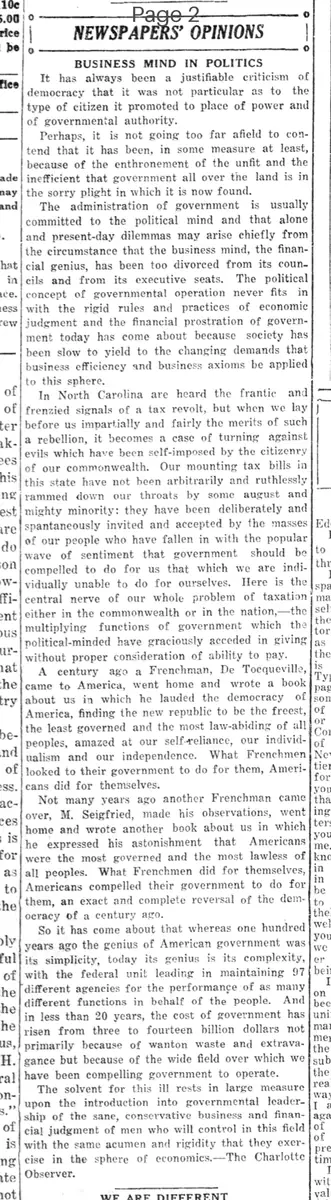
NEWSPAPERS' OPINIONS
BUSINESS MIND IN POLITICS
It has always been a justifiable criticism of democracy that it was not particular as to the type of citizen it promoted to place of power and of governmental authority
Perhaps, it is not going too far afield to contend that it has been, in some measure at least because of the enthronement of the unfit and the inefficient that government all over the land is in the sorry plight in which it is now found.
The administration of government is usually committed to the political mind and that alone and present-day dilemmas may arise chiefly from the circumstance that the business mind. the financial genius, has been too divorced from its councils and from its executive seats. The political concept of governmental operation never fits in with the rigid rules and practices of economic judgment and the financial prostration of government today has come about because society has been slow to yield to the changing demands that business efficiency and business axioms be applied to this sphere.
In North Carolina are heard the frantic and frenzied signals of a tax revolt, but when we lay before us impartially and fairly the merits of such a rebellion, it becomes a case of turning against evils which have been self-imposed by the citizenry of our commonwealth. Our mounting tax bills in this state have not been arbitrarily and ruthlessly rammed down our throats by some august and mighty minority: they have been deliberately and spontaneously invited and accepted by the masses of our people who have fallen in with the popular wave of sentiment that government should be compelled to do for us that which we are individually unable to do for ourselves. Here is the central nerve of our whole problem of taxation either in the commonwealth or in the nation,-the multiplying functions of government which the political-minded have graciously acceded in giving without proper consideration of ability to pay.
A century ago a Frenchman, De Tocqueville, came to America, went home and wrote a book about us in which he lauded thc democracy of America, finding the new republic to be the freest the least governed and the most law-abiding of all peoples, amazed at our self reliance. our individualism and our independence. What Frenchmen looked to their government to do for them, Americans did for themselves.
Not many years ago another Frenchman came over, M. Seigfried, made his observations, went home and wrote another book about us in which he expressed his astonishment that Americans were the most governed and the most lawless of all peoples. What Frenchmen did for themselves. Americans compelled their government to do for them, an exact and complete reversal of the democracy of a century ago.
So it has come about that whereas one hundred years ago the genius of American government was its simplicity, today its genius is its complexity. with the federal unit leading in maintaining 97 different agencies for the performance of as many different functions in behalf of the people. And in less than 20 years. the cost of government has risen from three to fourteen billion dollars not primarily because of wanton waste and extravagance but because of the wide field over which we have been compelling government to operate.
The solvent for this ill rests in large measure upon the introduction into governmental leadership of the sane, conservative business and financial judgment of men who will control in this field with the same acumen and rigidity that they exercise in the sphere of economics.-The Charlotte Observer.
BUSINESS MIND IN POLITICS
It has always been a justifiable criticism of democracy that it was not particular as to the type of citizen it promoted to place of power and of governmental authority
Perhaps, it is not going too far afield to contend that it has been, in some measure at least because of the enthronement of the unfit and the inefficient that government all over the land is in the sorry plight in which it is now found.
The administration of government is usually committed to the political mind and that alone and present-day dilemmas may arise chiefly from the circumstance that the business mind. the financial genius, has been too divorced from its councils and from its executive seats. The political concept of governmental operation never fits in with the rigid rules and practices of economic judgment and the financial prostration of government today has come about because society has been slow to yield to the changing demands that business efficiency and business axioms be applied to this sphere.
In North Carolina are heard the frantic and frenzied signals of a tax revolt, but when we lay before us impartially and fairly the merits of such a rebellion, it becomes a case of turning against evils which have been self-imposed by the citizenry of our commonwealth. Our mounting tax bills in this state have not been arbitrarily and ruthlessly rammed down our throats by some august and mighty minority: they have been deliberately and spontaneously invited and accepted by the masses of our people who have fallen in with the popular wave of sentiment that government should be compelled to do for us that which we are individually unable to do for ourselves. Here is the central nerve of our whole problem of taxation either in the commonwealth or in the nation,-the multiplying functions of government which the political-minded have graciously acceded in giving without proper consideration of ability to pay.
A century ago a Frenchman, De Tocqueville, came to America, went home and wrote a book about us in which he lauded thc democracy of America, finding the new republic to be the freest the least governed and the most law-abiding of all peoples, amazed at our self reliance. our individualism and our independence. What Frenchmen looked to their government to do for them, Americans did for themselves.
Not many years ago another Frenchman came over, M. Seigfried, made his observations, went home and wrote another book about us in which he expressed his astonishment that Americans were the most governed and the most lawless of all peoples. What Frenchmen did for themselves. Americans compelled their government to do for them, an exact and complete reversal of the democracy of a century ago.
So it has come about that whereas one hundred years ago the genius of American government was its simplicity, today its genius is its complexity. with the federal unit leading in maintaining 97 different agencies for the performance of as many different functions in behalf of the people. And in less than 20 years. the cost of government has risen from three to fourteen billion dollars not primarily because of wanton waste and extravagance but because of the wide field over which we have been compelling government to operate.
The solvent for this ill rests in large measure upon the introduction into governmental leadership of the sane, conservative business and financial judgment of men who will control in this field with the same acumen and rigidity that they exercise in the sphere of economics.-The Charlotte Observer.
What sub-type of article is it?
Economic Policy
Taxation
What keywords are associated?
Business Mind Politics
Government Efficiency
Tax Revolt
North Carolina Taxes
American Governance Shift
Tocqueville Observations
What entities or persons were involved?
De Tocqueville
M. Siegfried
North Carolina
The Charlotte Observer
Editorial Details
Primary Topic
Business Mind In Politics To Address Government Inefficiency And Taxation
Stance / Tone
Critical Of Political Minded Governance; Advocates For Business Efficiency
Key Figures
De Tocqueville
M. Siegfried
North Carolina
The Charlotte Observer
Key Arguments
Democracy Promotes Unfit And Inefficient Leaders To Power
Exclusion Of Business Mind From Government Causes Financial Prostration
Tax Revolt In North Carolina Stems From Self Imposed Government Expansion
Americans Have Shifted From Self Reliance To Compelling Government Intervention
Government Costs Have Risen Due To Multiplied Functions, Not Just Waste
Solution Lies In Introducing Conservative Business Judgment To Leadership