Thank you for visiting SNEWPapers!
Sign up free
The Columbia Democrat
Bloomsburg, Columbia County, Pennsylvania
What is this article about?
Ezra S. Hayhurst presented an essay to the Union Club in Catawissa on November 2, 1838, discussing the best times to cut and season timber based on moon phases to minimize shrinkage, insect damage, and rot, attributing effects to lunar influence on fluids and insect reproduction. Published in the Columbia Democrat on November 10, 1838.
Clipping
OCR Quality
Full Text
"TRUTH WITHOUT FEAR"
BLOOMSBURG:
SATURDAY: NOVEMBER 10, 1838.
For the Columbia Democrat.
FOR THE UNION CLUB
ON SEASONING TIMBER.
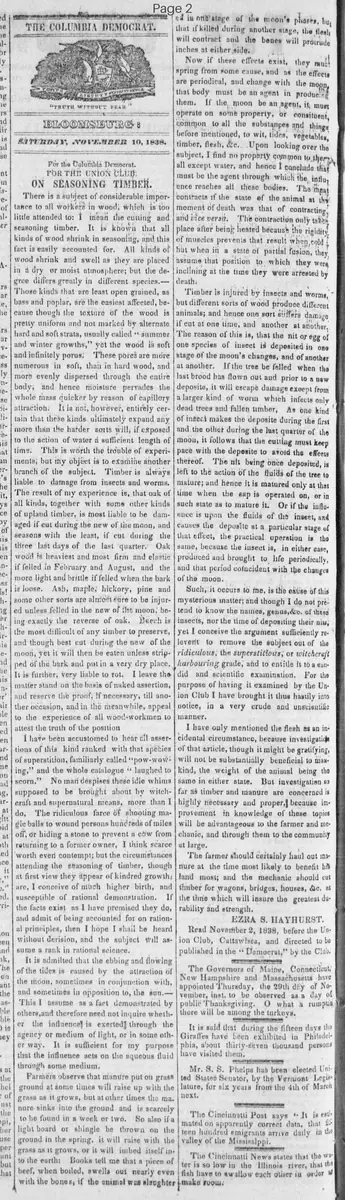
There is a subject of considerable importance to all workers in wood; which is too little attended to: I mean the cutting and seasoning timber. It is known that all kinds of wood shrink in seasoning, and this fact is easily accounted for. All kinds of wood shrink and swell as they are placed in a dry or moist atmosphere; but the degree differs greatly in different species.--Those kinds that are least open grained, as bass and poplar, are the easiest affected, because though the texture of the wood is pretty uniform and not marked by alternate hard and soft strata, usually called "summer and winter growths," yet the wood is soft and infinitely porous. These pores are more numerous in soft, than in hard wood, and more evenly dispersed through the entire body, and hence moisture pervades the whole mass quicker by reason of capillary attraction. It is not, however, entirely certain that these kinds ultimately expand any more than the harder sorts will, if exposed to the action of water a sufficient length of time. This is worth the trouble of experiments, but my object is to examine another branch of the subject. Timber is always liable to damage from insects and worms. The result of my experience is, that oak of all kinds, together with some other kinds of upland timber, is most liable to be damaged if cut during the new of the moon, and seasons with the least, if cut during the three last days of the last quarter. Oak wood is heaviest and most firm and elastic if felled in February and August, and the more light and brittle if felled when the bark is loose. Ash, maple, hickory, pine and some other sorts are almost sure to be injured unless felled in the new of the moon; being exactly the reverse of oak. Beech is the most difficult of any timber to preserve, and though best cut during the new of the moon, yet it will then be eaten unless stripped of the bark and put in a very dry place. It is further, very liable to rot. I leave the matter stand on the basis of naked assertion, and reserve the proof, if necessary, till another occasion, and in the meanwhile, appeal to the experience of all wood-workmen to attest the truth of the position I have been accustomed to hear all assertions of this kind ranked with that species of superstition, familiarly called "pow-wowing," and the whole catalogue "laughed to scorn." No man despises these idle whims supposed to be brought about by witchcraft and supernatural means, more than I do. The ridiculous farce of shooting maple balls to wound persons hundreds of miles off, or hiding a stone to prevent a cow from returning to a former owner, I think scarce worth even contempt; but the circumstances attending the seasoning of timber, though at first view they appear of kindred growth are, I conceive of much higher birth, and susceptible of rational demonstration. If the facts exist as I have premised they do, and admit of being accounted for on rational principles, then I hope I shall be heard without derision, and the subject will assume a rank in rational science. It is admitted that the ebbing and flowing of the tides is caused by the attraction of the moon, sometimes in conjunction with, and sometimes in opposition to, the sun.—This I assume as a fact demonstrated by others, and therefore need not inquire whether the influence is exerted through the agency or medium of light, or in some other way. It is sufficient for my purpose that the influence acts on the aqueous fluid through some medium. Farmers observe that manure put on grass ground at some times will raise up with the grass as it grows, but at other times the manure sinks into the ground and is scarcely to be found in a week or two. So also if a light board or shingle be thrown on the ground in the spring, it will raise with the grass as it grows, or it will imbed itself into the earth: Books tell me that a piece of beef, when boiled, swells out nearly even with the bones, if the animal was slaughtered in one stage of the moon's phases, but that if killed during another stage, the flesh will contract and the bones will protrude inches at either side. Now if these effects exist, they must spring from some cause, and as the effects are periodical, and change with the moon, that body must be an agent in producing them. If the moon be an agent, it must operate on some property, or constituent, common to all the substances and things before mentioned, to wit, tides, vegetables, timber, flesh, &c. Upon looking over the subject, I find no property common to them all except water, and hence I conclude that must be the agent through which the influence reaches all these bodies. The meat contracts if the state of the animal at the moment of death was that of contracting and vice versa. The contraction only takes place after being heated because the rigidity of muscles prevents that result when cold but when in a state of partial fusion, they assume that position to which they were inclining at the time they were arrested by death. Timber is injured by insects and worms, but different sorts of wood produce different animals; and hence one sort suffers damage if cut at one time, and another at another. The reason of this is, that the nit or egg of one species of insect is deposited in one stage of the moon's changes, and of another at another. If the tree be felled when the last brood has flown out and prior to a new deposite, it will escape damage except from a larger kind of worm which infects only dead trees and fallen timber. As one kind of insect makes the deposite during the first and the other during the last quarter of the moon, it follows that the cutting must keep pace with the deposite to avoid the effects thereof. The nit being once deposited, is left to the action of the fluids of the tree to mature; and hence it is matured only at that time when the sap is operated on, or in such state as to mature it. Or if the influence is upon the fluids of the insect, and causes the deposite at a particular stage of that effect, the practical operation is the same, because the insect is, in either case produced and brought to life periodically and that period coincident with the changes of the moon. Such, it occurs to me, is the cause of this mysterious matter; and though I do not pretend to know the names, genus, &c. of these insects, nor the time of depositing their nits, yet I conceive the argument sufficiently relevant to remove the subject out of the ridiculous, the superstitious; or witchcraft harbouring grade, and to entitle it to a candid and scientific examination. For the purpose of having it examined by the Union Club I have brought it thus hastily into notice, in a very crude and unscientific manner. I have only mentioned the flesh as an incidental circumstance, because investigation of that article, though it might be gratifying will not be substantially beneficial to mankind, the weight of the animal being the same in either state. But investigation so far as timber and manure are concerned is highly necessary and proper, because improvement in knowledge of these topics will be advantageous to the farmer and mechanic, and through them to the community at large. The farmer should certainly haul out manure at the time most likely to benefit his land most; and the mechanic should cut timber for wagons, bridges, houses, &c. at the time which will insure the greatest durability and strength.
EZRA S. HAYHURST.
Read November 2, 1838, before the Union Club, Catawissa, and directed to be published in the "Democrat," by the Club.
What sub-type of article is it?
What keywords are associated?
What entities or persons were involved?
Where did it happen?
Domestic News Details
Primary Location
Catawissa
Event Date
November 2, 1838
Key Persons
Event Details
Ezra S. Hayhurst presented an essay on the importance of cutting and seasoning timber according to moon phases to avoid shrinkage, insect damage, and rot, explaining effects through lunar influence on water and insect reproduction cycles, applicable to woods like oak, ash, beech; also touching on manure and meat; aimed at benefiting farmers and mechanics.