Thank you for visiting SNEWPapers!
Sign up free
The Wilmington Morning Star
Wilmington, New Hanover County, North Carolina
What is this article about?
George Tucker's report from Millau, France, on Oct. 29 details the F.F.I.'s post-liberation administration in southern France: commendable restraint against collaborators but excessive resource requisitions causing shortages, black markets, and public discontent over a new 'occupation.'
Clipping
OCR Quality
Full Text
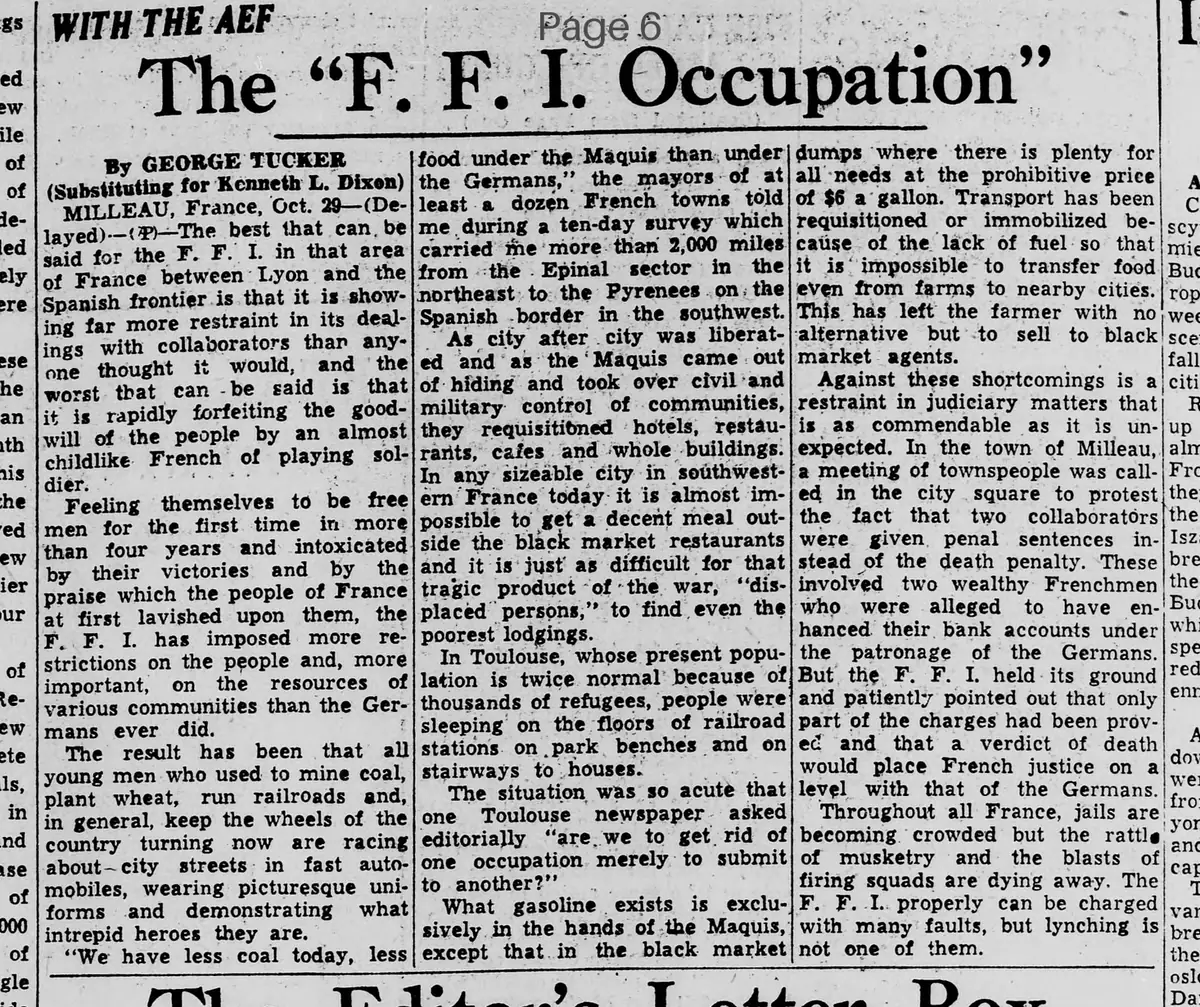
By GEORGE TUCKER
(Substituting for Kenneth L. Dixon)
Millau, France, Oct. 29—(Delayed)—(AP)—The best that can be said for the F. F. I. in that area of France between Lyon and the Spanish frontier is that it is showing far more restraint in its dealings with collaborators than anyone thought it would, and the worst that can be said is that it is rapidly forfeiting the good-will of the people by an almost childlike French of playing soldier.
Feeling themselves to be free men for the first time in more than four years and intoxicated by their victories and by the praise which the people of France at first lavished upon them, the F. F. I. has imposed more restrictions on the people and, more important, on the resources of various communities than the Germans ever did.
The result has been that all young men who used to mine coal, plant wheat, run railroads and, in general, keep the wheels of the country turning now are racing about city streets in fast automobiles, wearing picturesque uniforms and demonstrating what intrepid heroes they are.
"We have less coal today, less food, under its yoke than the Germans," the mayors of at least a dozen French towns told me during a ten-day survey which carried me more than 2,000 miles from the Epinal sector in the northeast to the Pyrenees on the Spanish border in the southwest.
"As city after city was liberated and as the Maquis came out of hiding and took over civil and military control of communities, they requisitioned hotels, restaurants, cafes and whole buildings.
In any sizeable city in southwestern France today it is almost impossible to get a decent meal outside the black market restaurants and it is just as difficult for that tragic product of the war, "displaced" persons, to find even the poorest lodgings.
In Toulouse, whose present population is twice normal because of thousands of refugees, people were sleeping on the floors of railroad stations, on park benches and on stairways to houses.
The situation was so acute that one Toulouse newspaper asked editorially "are we to get rid of one occupation merely to submit to another?"
What gasoline exists is exclusively in the hands of the Maquis, except that in the black market dumps where there is plenty for all needs at the prohibitive price of $6 a gallon. Transport has been requisitioned or immobilized because of the lack of fuel so that it is impossible to transfer food even from farms to nearby cities.
This has left the farmer with no alternative but to sell to black market agents.
Against these shortcomings is a restraint in judiciary matters that is as commendable as it is unexpected. In the town of Millau, a meeting of townspeople was called in the city square to protest the fact that two collaborators were given penal sentences instead of the death penalty. These involved two wealthy Frenchmen who were alleged to have enhanced their bank accounts under the patronage of the Germans.
But the F. F. I. held its ground and patiently pointed out that only part of the charges had been proved and that a verdict of death would place French justice on a level with that of the Germans.
Throughout all France, jails are becoming crowded but the rattle of musketry and the blasts of firing squads are dying away. The F. F. I. properly can be charged with many faults, but lynching is not one of them.
What sub-type of article is it?
What keywords are associated?
Where did it happen?
Foreign News Details
Primary Location
France (Between Lyon And Spanish Frontier)
Event Date
As Of Late October 1944
Outcome
restraint in judiciary matters; jails crowded but no recent executions or lynching
Event Details
The F.F.I. shows restraint in dealing with collaborators but imposes restrictions on resources, leading to shortages of coal, food, fuel, and lodging; young men prioritize soldiering over essential work; black market thrives; transport immobilized; in Toulouse, acute housing crisis; in Millau, upheld lighter sentences for two collaborators.