Thank you for visiting SNEWPapers!
Sign up free
Literary
June 15, 1871
Nebraska Advertiser
Auburn, Brownville, Calvert, Nemaha County, Nebraska
What is this article about?
Biographical reflection on Margaret Fuller as America's premier conversationalist, thinker, and advocate for women's issues. Describes her intellectual subtlety, influence on peers like Emerson and Thoreau, and recommends her work 'Woman in the Nineteenth Century' for insights on womankind.
Clipping
OCR Quality
95%
Excellent
Full Text
MARGARET FULLER.
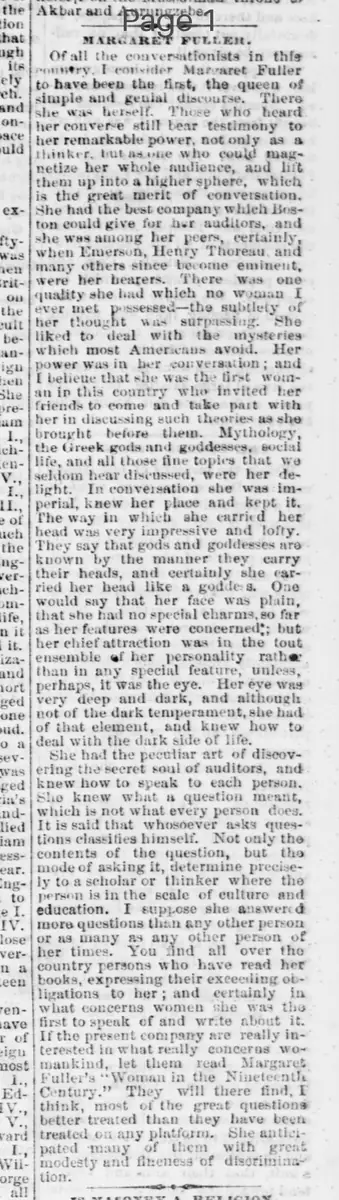
Of all the conversationalists in this country, I consider Margaret Fuller to have been the first, the queen of simple and genial discourse. There she was herself. Those who heard her converse still bear testimony to her remarkable power, not only as a thinker, but as one who could magnetize her whole audience, and lift them up into a higher sphere, which is the great merit of conversation. She had the best company which Boston could give for her auditors, and she was among her peers, certainly, when Emerson, Henry Thoreau and many others since become eminent, were her hearers. There was one quality she had which no woman I ever met possessed-the subtlety of her thought was surpassing. She liked to deal with the mysteries which most Americans avoid. Her power was in her conversation; and I believe that she was the first woman in this country who invited her friends to come and take part with her in discussing such theories as she brought before them. Mythology, the Greek gods and goddesses, social life, and all those fine topics that we seldom hear discussed, were her delight. In conversation she was imperial, knew her place and kept it. The way in which she carried her head was very impressive and lofty. They say that gods and goddesses are known by the manner they carry their heads, and certainly she carried her head like a goddess. One would say that her face was plain, that she had no special charms, so far as her features were concerned; but her chief attraction was in the tout ensemble of her personality rather than in any special feature, unless, perhaps, it was the eye. Her eye was very deep and dark, and although not of the dark temperament, she had of that element, and knew how to deal with the dark side of life. She had the peculiar art of discovering the secret soul of auditors, and knew how to speak to each person. She knew what a question meant, which is not what every person does. It is said that whosoever asks questions classifies himself. Not only the contents of the question, but the mode of asking it, determine precisely to a scholar or thinker where the person is in the scale of culture and education. I suppose she answered more questions than any other person or as many as any other person of her times. You find all over the country persons who have read her books, expressing their exceeding obligations to her; and certainly in what concerns women she was the first to speak of and write about it. If the present company are really interested in what really concerns womankind, let them read Margaret Fuller's "Woman in the Nineteenth Century." They will there find, I think, most of the great questions better treated than they have been treated on any platform. She anticipated many of them with great modesty and fineness of discrimination.
Of all the conversationalists in this country, I consider Margaret Fuller to have been the first, the queen of simple and genial discourse. There she was herself. Those who heard her converse still bear testimony to her remarkable power, not only as a thinker, but as one who could magnetize her whole audience, and lift them up into a higher sphere, which is the great merit of conversation. She had the best company which Boston could give for her auditors, and she was among her peers, certainly, when Emerson, Henry Thoreau and many others since become eminent, were her hearers. There was one quality she had which no woman I ever met possessed-the subtlety of her thought was surpassing. She liked to deal with the mysteries which most Americans avoid. Her power was in her conversation; and I believe that she was the first woman in this country who invited her friends to come and take part with her in discussing such theories as she brought before them. Mythology, the Greek gods and goddesses, social life, and all those fine topics that we seldom hear discussed, were her delight. In conversation she was imperial, knew her place and kept it. The way in which she carried her head was very impressive and lofty. They say that gods and goddesses are known by the manner they carry their heads, and certainly she carried her head like a goddess. One would say that her face was plain, that she had no special charms, so far as her features were concerned; but her chief attraction was in the tout ensemble of her personality rather than in any special feature, unless, perhaps, it was the eye. Her eye was very deep and dark, and although not of the dark temperament, she had of that element, and knew how to deal with the dark side of life. She had the peculiar art of discovering the secret soul of auditors, and knew how to speak to each person. She knew what a question meant, which is not what every person does. It is said that whosoever asks questions classifies himself. Not only the contents of the question, but the mode of asking it, determine precisely to a scholar or thinker where the person is in the scale of culture and education. I suppose she answered more questions than any other person or as many as any other person of her times. You find all over the country persons who have read her books, expressing their exceeding obligations to her; and certainly in what concerns women she was the first to speak of and write about it. If the present company are really interested in what really concerns womankind, let them read Margaret Fuller's "Woman in the Nineteenth Century." They will there find, I think, most of the great questions better treated than they have been treated on any platform. She anticipated many of them with great modesty and fineness of discrimination.
What sub-type of article is it?
Essay
What themes does it cover?
Social Manners
Liberty Freedom
What keywords are associated?
Margaret Fuller
Conversation
Women Rights
Transcendentalism
Intellectual Discourse
Woman Nineteenth Century
Literary Details
Subject
Margaret Fuller As Conversationalist And Advocate For Women
Key Lines
Of All The Conversationalists In This Country, I Consider Margaret Fuller To Have Been The First, The Queen Of Simple And Genial Discourse.
She Was The First Woman In This Country Who Invited Her Friends To Come And Take Part With Her In Discussing Such Theories As She Brought Before Them.
If The Present Company Are Really Interested In What Really Concerns Womankind, Let Them Read Margaret Fuller's "Woman In The Nineteenth Century."