Thank you for visiting SNEWPapers!
Sign up free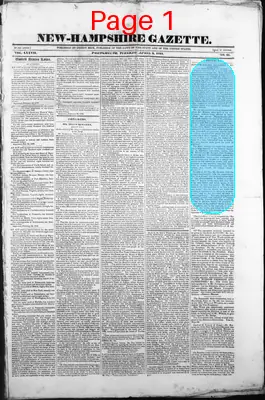
The New Hampshire Gazette
Portsmouth, Rockingham County, New Hampshire
What is this article about?
U.S. Senator John Holmes of Maine announces his decision to decline re-election as his term expires on March 3, 1833, in an address to his constituents, amid criticism for acting against their wishes in opposition to the administration.
Clipping
OCR Quality
Full Text
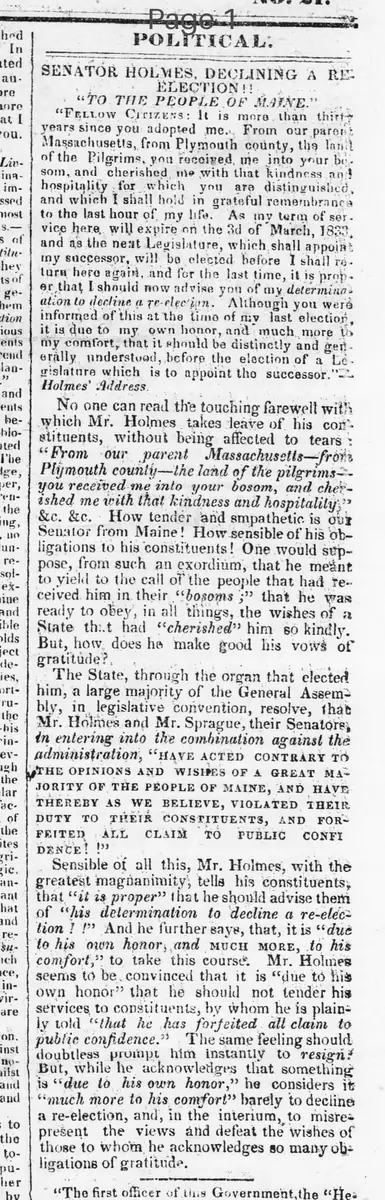
SENATOR HOLMES. DECLINING A RE-ELECTION!!
"TO THE PEOPLE OF MAINE."
"Fellow Citizens: It is more than thirty years since you adopted me. From our parent Massachusetts, from Plymouth county, the land of the Pilgrims, you received me into your bosom, and cherished me with that kindness and hospitality for which you are distinguished, and which I shall hold in grateful remembrance to the last hour of my life. As my term of service here, will expire on the 3d of March, 1833, and as the next Legislature, which shall appoint my successor, will be elected before I shall return here again, and for the last time, it is proper that I should now advise you of my determination to decline a re-election. Although you were informed of this at the time of my last election, it is due to my own honor, and much more to my comfort, that it should be distinctly and generally understood, before the election of a Legislature which is to appoint the successor."
Holmes' Address.
No one can read the touching farewell with which Mr. Holmes takes leave of his constituents, without being affected to tears:
"From our parent Massachusetts—from Plymouth county—the land of the pilgrims—you received me into your bosom, and cherished me with that kindness and hospitality," &c. &c. How tender and sympathetic is our Senator from Maine! How sensible of his obligations to his constituents! One would suppose, from such an exordium, that he meant to yield to the call of the people that had received him in their "bosoms;" that he was ready to obey, in all things, the wishes of a State that had "cherished" him so kindly.
But, how, does he make good his vows of gratitude?.
The State, through the organ that elected him, a large majority of the General Assembly, in legislative convention, resolve, that Mr. Holmes and Mr. Sprague, their Senators in entering into the combination against the administration, "HAVE ACTED CONTRARY TO THE OPINIONS AND WISHES OF A GREAT MAJORITY OF THE PEOPLE OF MAINE, AND HAVE THEREBY AS WE BELIEVE, VIOLATED THEIR DUTY TO THEIR CONSTITUENTS, AND FORFEITED ALL CLAIM TO PUBLIC CONFIDENCE!"
Sensible of all this, Mr. Holmes, with the greatest magnanimity, tells his constituents, that "it is proper" that he should advise them of "his determination to decline a re-election!!" And he further says, that, it is "due to his own honor, and MUCH MORE, to his comfort," to take this course. Mr. Holmes seems to be convinced that it is "due to his own honor" that he should not tender his services to constituents, by whom he is plainly told "that he has forfeited all claim to public confidence." The same feeling should doubtless prompt him instantly to resign.
But, while he acknowledges that something is "due to his own honor," he considers it "much more to his comfort" barely to decline a re-election, and, in the interim, to misrepresent the views and defeat the wishes of those to whom he acknowledges so many obligations of gratitude.
What sub-type of article is it?
What keywords are associated?
What entities or persons were involved?
Where did it happen?
Domestic News Details
Primary Location
Maine
Event Date
Term Expires On The 3d Of March, 1833
Key Persons
Outcome
decline a re-election; forfeited all claim to public confidence
Event Details
Senator Holmes addresses the people of Maine, announcing his determination to decline re-election as his term expires on March 3, 1833, citing honor and comfort; criticized for acting contrary to constituents' wishes against the administration alongside Mr. Sprague.