Thank you for visiting SNEWPapers!
Sign up free
Kansas Agitator
Garnett, Greeley, Topeka, Anderson County, Shawnee County, Kansas
What is this article about?
Biographical account of William Alfred Peffer: Pennsylvania farm boy, California miner, Midwest farmer-teacher, Civil War lieutenant in Illinois regiment, Tennessee lawyer, Kansas pioneer, journalist, Republican senator, Farmers' Alliance advocate, and author at age 60.
Clipping
OCR Quality
Full Text
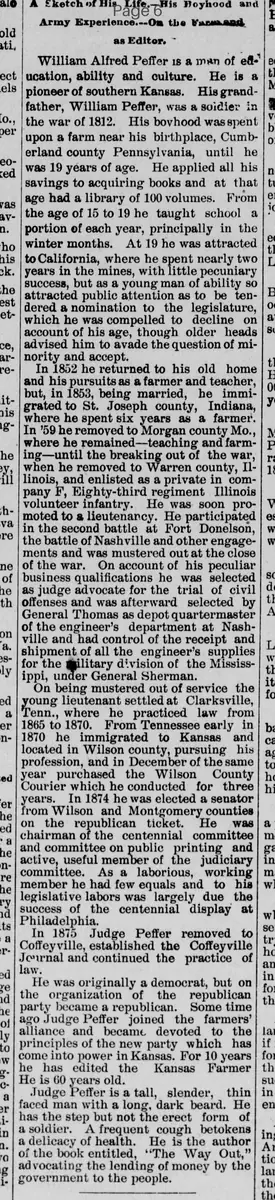
William Alfred Peffer is a man of education, ability and culture. He is a pioneer of southern Kansas. His grandfather, William Peffer, was a soldier in the war of 1812. His boyhood was spent upon a farm near his birthplace, Cumberland county Pennsylvania, until he was 19 years of age. He applied all his savings to acquiring books and at that age had a library of 100 volumes. From the age of 15 to 19 he taught school a portion of each year, principally in the winter months. At 19 he was attracted to California, where he spent nearly two years in the mines, with little pecuniary success, but as a young man of ability so attracted public attention as to be tendered a nomination to the legislature, which he was compelled to decline on account of his age. though older heads advised him to evade the question of minority and accept.
In 1852 he returned to his old home and his pursuits as a farmer and teacher. but, in 1853, being married, he immigrated to St. Joseph county, Indiana, where he spent six years as a farmer. In '59 he removed to Morgan county Mo., where he remained--teaching and farming--until the breaking out of the war, when he removed to Warren county, Illinois, and enlisted as a private in company F, Eighty-third regiment Illinois volunteer infantry. He was soon promoted to a lieutenancy. He participated in the second battle at Fort Donelson, the battle of Nashville and other engagements and was mustered out at the close of the war. On account of his peculiar business qualifications he was selected as judge advocate for the trial of civil offenses and was afterward selected by General Thomas as depot quartermaster of the engineer's department at Nashville and had control of the receipt and shipment of all the engineer's supplies for the military division of the Mississippi, under General Sherman.
On being mustered out of service the young lieutenant settled at Clarksville, Tenn., where he practiced law from 1865 to 1870. From Tennessee early in 1870 he immigrated to Kansas and located in Wilson county, pursuing his profession, and in December of the same year purchased the Wilson County Courier which he conducted for three years. In 1874 he was elected a senator from Wilson and Montgomery counties on the republican ticket. He was chairman of the centennial committee and committee on public printing and active, useful member of the judiciary committee. As a laborious, working member he had few equals and to his legislative labors was largely due the success of the centennial display at Philadelphia.
In 1875 Judge Peffer removed to Coffeyville, established the Coffeyville Journal and continued the practice of law.
He was originally a democrat, but on the organization of the republican party became a republican. Some time ago Judge Peffer joined the farmers alliance and became devoted to the principles of the new party which has come into power in Kansas. For 10 years he has edited the Kansas Farmer. He is 60 years old.
Judge Peffer is a tall, slender, thin faced man with a long, dark beard. He has the step but not the erect form of a soldier. A frequent cough betokens a delicacy of health. He is the author of the book entitled, "The Way Out," advocating the lending of money by the government to the people.
What sub-type of article is it?
What themes does it cover?
What keywords are associated?
What entities or persons were involved?
Where did it happen?
Story Details
Key Persons
Location
Pennsylvania, California, Indiana, Missouri, Illinois, Tennessee, Kansas
Story Details
William Alfred Peffer, educated and cultured, spent boyhood on a farm in Pennsylvania, taught school, mined in California, farmed and taught in Indiana and Missouri, enlisted in Civil War, served in Illinois regiment with promotions, practiced law in Tennessee, moved to Kansas, edited newspapers, served as senator, joined Farmers' Alliance, edited Kansas Farmer, authored 'The Way Out'.