Thank you for visiting SNEWPapers!
Sign up free
Story
June 21, 1850
The Southern Press
Washington, District Of Columbia
What is this article about?
Article quotes poet and editor W. C. Bryant on slavery in the South, describing enslaved Black workers in a Richmond tobacco factory who sing hymns while laboring, portrayed as content and religious, contrasting abolitionist views.
Clipping
OCR Quality
98%
Excellent
Full Text
Slavery in Virginia and South Carolina.
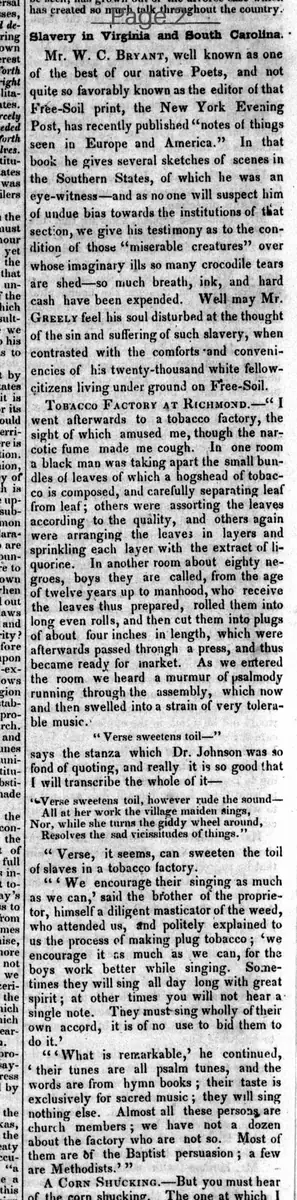
Mr. W. C. Bryant, well known as one of the best of our native Poets, and not quite so favorably known as the editor of that Free-Soil print, the New York Evening Post, has recently published "notes of things seen in Europe and America." In that book he gives several sketches of scenes in the Southern States, of which he was an eye-witness—and as no one will suspect him of undue bias towards the institutions of that section, we give his testimony as to the condition of those "miserable creatures" over whose imaginary ills so many crocodile tears are shed—so much breath, ink, and hard cash have been expended. Well may Mr. Greeley feel his soul disturbed at the thought of the sin and suffering of such slavery, when contrasted with the comforts and conveniences of his twenty-thousand white fellow-citizens living under ground on Free-Soil.
Tobacco Factory at Richmond.—"I went afterwards to a tobacco factory, the sight of which amused me, though the narcotic fume made me cough. In one room a black man was taking apart the small bundles of leaves of which a hogshead of tobacco is composed, and carefully separating leaf from leaf; others were assorting the leaves according to the quality, and others again were arranging the leaves in layers and sprinkling each layer with the extract of liquorice. In another room about eighty negroes, boys they are called, from the age of twelve years up to manhood, who receive the leaves thus prepared, rolled them into long even rolls, and then cut them into plugs of about four inches in length, which were afterwards passed through a press, and thus became ready for market. As we entered the room we heard a murmur of psalmody running through the assembly, which now and then swelled into a strain of very tolerable music.
"Verse sweetens toil"
says the stanza which Dr. Johnson was so fond of quoting, and really it is so good that I will transcribe the whole of it—
Verse sweetens toil, however rude the sound;
All at her work the village maiden sings,
Nor, while she turns the giddy wheel around,
Resolves the sad vicissitudes of things.'
"Verse, it seems, can sweeten the toil of slaves in a tobacco factory
"We encourage their singing as much as we can,' said the brother of the proprietor, himself a diligent masticator of the weed, who attended us, and politely explained to us the process of making plug tobacco; 'we encourage it as much as we can, for the boys work better while singing. Sometimes they will sing all day long with great spirit; at other times you will not hear a single note. They must sing wholly of their own accord, it is of no use to bid them to do it.'
"What is remarkable,' he continued, 'their tunes are all psalm tunes, and the words are from hymn books; their taste is exclusively for sacred music; they will sing nothing else. Almost all these persons are church members; we have not a dozen about the factory who are not so. Most of them are of the Baptist persuasion; a few are Methodists."
Mr. W. C. Bryant, well known as one of the best of our native Poets, and not quite so favorably known as the editor of that Free-Soil print, the New York Evening Post, has recently published "notes of things seen in Europe and America." In that book he gives several sketches of scenes in the Southern States, of which he was an eye-witness—and as no one will suspect him of undue bias towards the institutions of that section, we give his testimony as to the condition of those "miserable creatures" over whose imaginary ills so many crocodile tears are shed—so much breath, ink, and hard cash have been expended. Well may Mr. Greeley feel his soul disturbed at the thought of the sin and suffering of such slavery, when contrasted with the comforts and conveniences of his twenty-thousand white fellow-citizens living under ground on Free-Soil.
Tobacco Factory at Richmond.—"I went afterwards to a tobacco factory, the sight of which amused me, though the narcotic fume made me cough. In one room a black man was taking apart the small bundles of leaves of which a hogshead of tobacco is composed, and carefully separating leaf from leaf; others were assorting the leaves according to the quality, and others again were arranging the leaves in layers and sprinkling each layer with the extract of liquorice. In another room about eighty negroes, boys they are called, from the age of twelve years up to manhood, who receive the leaves thus prepared, rolled them into long even rolls, and then cut them into plugs of about four inches in length, which were afterwards passed through a press, and thus became ready for market. As we entered the room we heard a murmur of psalmody running through the assembly, which now and then swelled into a strain of very tolerable music.
"Verse sweetens toil"
says the stanza which Dr. Johnson was so fond of quoting, and really it is so good that I will transcribe the whole of it—
Verse sweetens toil, however rude the sound;
All at her work the village maiden sings,
Nor, while she turns the giddy wheel around,
Resolves the sad vicissitudes of things.'
"Verse, it seems, can sweeten the toil of slaves in a tobacco factory
"We encourage their singing as much as we can,' said the brother of the proprietor, himself a diligent masticator of the weed, who attended us, and politely explained to us the process of making plug tobacco; 'we encourage it as much as we can, for the boys work better while singing. Sometimes they will sing all day long with great spirit; at other times you will not hear a single note. They must sing wholly of their own accord, it is of no use to bid them to do it.'
"What is remarkable,' he continued, 'their tunes are all psalm tunes, and the words are from hymn books; their taste is exclusively for sacred music; they will sing nothing else. Almost all these persons are church members; we have not a dozen about the factory who are not so. Most of them are of the Baptist persuasion; a few are Methodists."
What sub-type of article is it?
Journey
Curiosity
Historical Event
What themes does it cover?
Social Manners
Moral Virtue
What keywords are associated?
Slavery
Tobacco Factory
Richmond
Singing Slaves
Bryant
Psalm Tunes
Church Members
What entities or persons were involved?
W. C. Bryant
Mr. Greeley
Where did it happen?
Tobacco Factory At Richmond, Virginia
Story Details
Key Persons
W. C. Bryant
Mr. Greeley
Location
Tobacco Factory At Richmond, Virginia
Story Details
W. C. Bryant describes visiting a tobacco factory in Richmond where enslaved Black workers separate, assort, and roll tobacco leaves while singing psalm tunes and hymns; the overseer encourages their singing as it improves work, and most workers are church members.