Thank you for visiting SNEWPapers!
Sign up free
Editorial
November 11, 1807
Norfolk Gazette And Publick Ledger
Norfolk, Virginia
What is this article about?
The editorial criticizes inconsistencies in President Jefferson's messages to Congress regarding negotiations with Great Britain in 1806-1807, accusing the executive of misleading the public and merchants, leading to economic stagnation after a treaty was rejected without ratification.
Clipping
OCR Quality
98%
Excellent
Full Text
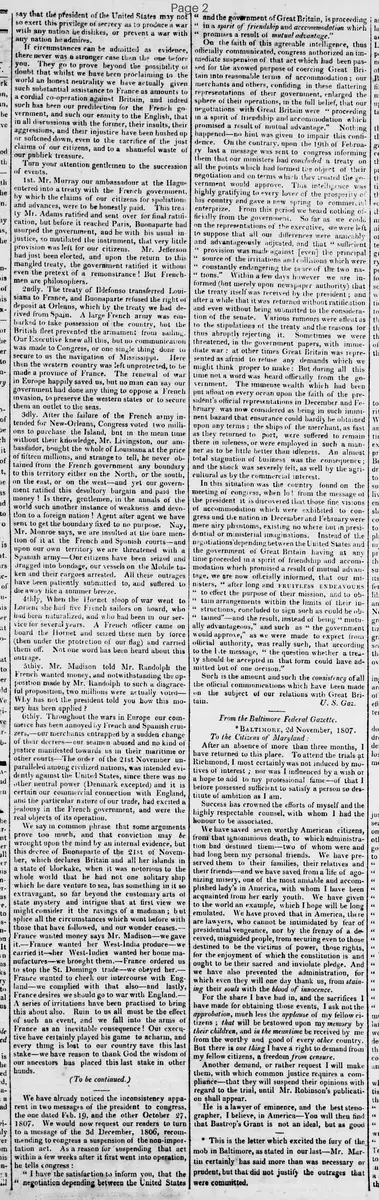
We have already noticed the inconsistency apparent in two messages of the president to congress, the one dated Feb. 19, and the other October 27, 1807. We would now request our readers to turn to a message of the 3d December, 1806, recommending to congress a suspension of the non-importation act. As a reason for suspending that act within a few weeks after it first went into operation, he tells congress :
" I have the satisfaction to inform you, that the negotiation depending between the United States and the government of Great Britain, is proceeding in a spirit of friendship and accommodation which promises a result of mutual advantage."
On the faith of this agreeable intelligence, thus officially communicated, congress authorized an immediate suspension of that act which had been passed for the avowed purpose of coercing Great Britain into reasonable terms of accommodation; our merchants and others, confiding in these flattering representations of their government, enlarged the sphere of their operations, in the full belief, that our negotiations with Great Britain were "proceeding in a spirit of friendship and accommodation which promised a result of mutual advantage." Nothing happened—no hint was given to impair this confidence. On the contrary, upon the 19th of February last a message was sent to congress informing them that our ministers had concluded a treaty on all the points which had formed the object of their negotiation and on terms which they trusted the government would approve. This intelligence was highly gratifying to every lover of the prosperity of his country and gave a new spring to commercial enterprize. From this period we heard nothing officially from the government. So far as we could on the representations of the executive, we were left to suppose that all our differences were amicably and advantageously adjusted, and that "sufficient provision was made against even the principal source of the irritations and collisions which were constantly endangering the peace of the two nations." Within a few days however we are informed (but merely upon newspaper authority) that the treaty itself was received by the president; and after a while that it was returned without ratification and even without being submitted to the consideration of the senate. Various rumours were afloat as to the stipulations of the treaty and the reasons for thus abruptly rejecting it. Sometimes we were threatened, in the government papers, with immediate war : at other times Great Britain was represented as afraid to refuse any demands which we might think proper to make: But during all this time not a word was heard officially from the government. The immense wealth which had been put afloat on every ocean upon the faith of the president's official representations in December and February was now considered as being in such imminent hazard that insurance could hardly be obtained upon any terms ; the ships of the merchant, as fast as they returned to port, were suffered to remain there in idleness, or were employed in such a manner as to be little better than idleness. An almost total stagnation of business was the consequence; and the shock was severely felt, as well by the agricultural as by the commercial interest.
In this situation was the country found on the meeting of congress, when lo! from the message of the president it is discovered that those fine visions of accommodation which were exhibited to congress and the nation in December and February were mere airy phantoms, existing no where but in presidential or ministerial imaginations. Instead of the negotiations depending between the United States and the government of Great Britain having at any time proceeded in a spirit of friendship and accommodation which promised a result of mutual advantage, we are now officially informed, that our ministers, "after long and FRUITLESS ENDEAVOURS to effect the purpose of their mission, and to obtain arrangements within the limits of their instructions, concluded to sign such as could be obtained"—and the result, instead of being "mutually advantageous," and such as "the government would approve," as we were made to expect from official authority, was really such, that according to the late message, "the question whether a treaty should be accepted in that form could have admitted but of one decision."
Such is the amount and such the consistency of all the official communications which have been made on the subject of our relations with Great Britain.
U. S. Gaz.
" I have the satisfaction to inform you, that the negotiation depending between the United States and the government of Great Britain, is proceeding in a spirit of friendship and accommodation which promises a result of mutual advantage."
On the faith of this agreeable intelligence, thus officially communicated, congress authorized an immediate suspension of that act which had been passed for the avowed purpose of coercing Great Britain into reasonable terms of accommodation; our merchants and others, confiding in these flattering representations of their government, enlarged the sphere of their operations, in the full belief, that our negotiations with Great Britain were "proceeding in a spirit of friendship and accommodation which promised a result of mutual advantage." Nothing happened—no hint was given to impair this confidence. On the contrary, upon the 19th of February last a message was sent to congress informing them that our ministers had concluded a treaty on all the points which had formed the object of their negotiation and on terms which they trusted the government would approve. This intelligence was highly gratifying to every lover of the prosperity of his country and gave a new spring to commercial enterprize. From this period we heard nothing officially from the government. So far as we could on the representations of the executive, we were left to suppose that all our differences were amicably and advantageously adjusted, and that "sufficient provision was made against even the principal source of the irritations and collisions which were constantly endangering the peace of the two nations." Within a few days however we are informed (but merely upon newspaper authority) that the treaty itself was received by the president; and after a while that it was returned without ratification and even without being submitted to the consideration of the senate. Various rumours were afloat as to the stipulations of the treaty and the reasons for thus abruptly rejecting it. Sometimes we were threatened, in the government papers, with immediate war : at other times Great Britain was represented as afraid to refuse any demands which we might think proper to make: But during all this time not a word was heard officially from the government. The immense wealth which had been put afloat on every ocean upon the faith of the president's official representations in December and February was now considered as being in such imminent hazard that insurance could hardly be obtained upon any terms ; the ships of the merchant, as fast as they returned to port, were suffered to remain there in idleness, or were employed in such a manner as to be little better than idleness. An almost total stagnation of business was the consequence; and the shock was severely felt, as well by the agricultural as by the commercial interest.
In this situation was the country found on the meeting of congress, when lo! from the message of the president it is discovered that those fine visions of accommodation which were exhibited to congress and the nation in December and February were mere airy phantoms, existing no where but in presidential or ministerial imaginations. Instead of the negotiations depending between the United States and the government of Great Britain having at any time proceeded in a spirit of friendship and accommodation which promised a result of mutual advantage, we are now officially informed, that our ministers, "after long and FRUITLESS ENDEAVOURS to effect the purpose of their mission, and to obtain arrangements within the limits of their instructions, concluded to sign such as could be obtained"—and the result, instead of being "mutually advantageous," and such as "the government would approve," as we were made to expect from official authority, was really such, that according to the late message, "the question whether a treaty should be accepted in that form could have admitted but of one decision."
Such is the amount and such the consistency of all the official communications which have been made on the subject of our relations with Great Britain.
U. S. Gaz.
What sub-type of article is it?
Foreign Affairs
Economic Policy
Partisan Politics
What keywords are associated?
British Negotiations
Presidential Messages
Treaty Rejection
Commercial Stagnation
Non Importation Act
Economic Impact
What entities or persons were involved?
President
Congress
Great Britain
U.S. Ministers
Editorial Details
Primary Topic
Inconsistency In Presidential Communications On British Negotiations
Stance / Tone
Critical Of Executive Misleading The Public
Key Figures
President
Congress
Great Britain
U.S. Ministers
Key Arguments
Presidential Messages In Dec 1806 And Feb 1807 Falsely Promised Successful Negotiations With Britain
Suspension Of Non Importation Act Based On Misleading Assurances Led To Expanded Commerce
Treaty Concluded But Rejected Without Senate Review, Causing Economic Uncertainty
Lack Of Official Communication After Feb Message Resulted In Commercial Stagnation
October 1807 Message Reveals Fruitless Endeavors, Contradicting Prior Optimism