Thank you for visiting SNEWPapers!
Sign up free
Literary
February 11, 1789
The New Hampshire Gazette And General Advertiser
Portsmouth, Rockingham County, New Hampshire
What is this article about?
An essay decrying idleness as the root of evil, drawing on Hebrew, Parthian, Roman, and Athenian examples. It criticizes professed idlers, those masking idleness with vices, and advocates laws enforcing productive lives, quoting Seneca on time's misuse and societal obligations.
Clipping
OCR Quality
98%
Excellent
Full Text
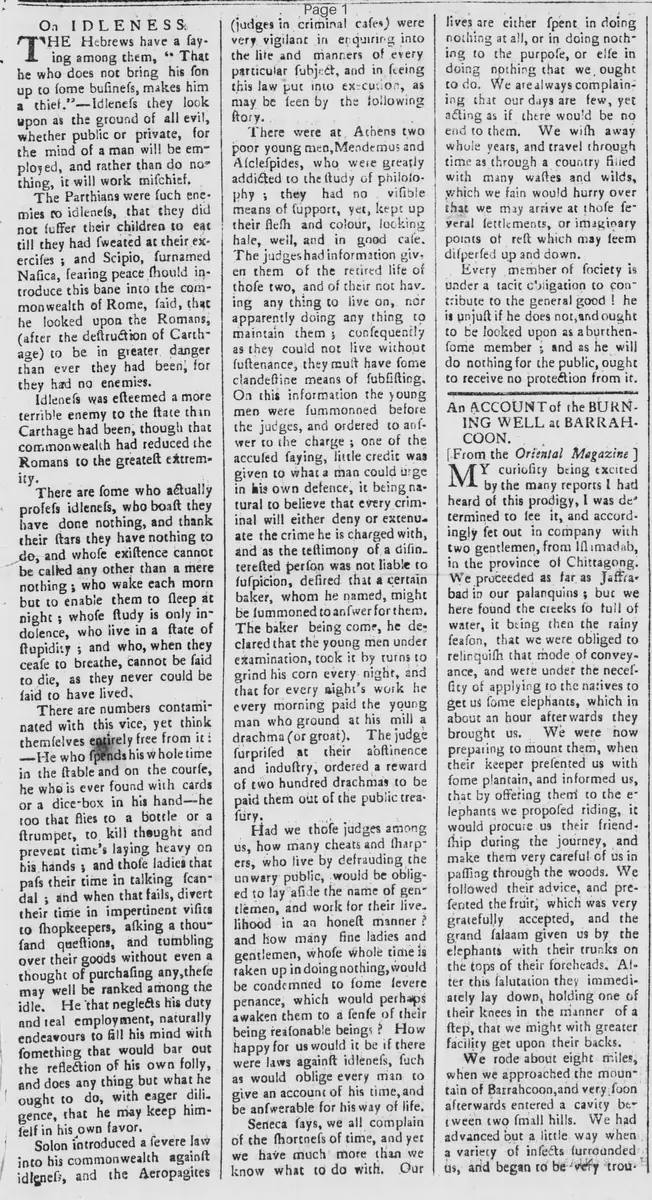
On IDLENESS
THE Hebrews have a saying among them: That he who does not bring his son up to some business, makes him a thief. Idleness they look upon as the ground of all evil, whether public or private, for the mind of a man will be employed, and rather than do nothing, it will work mischief. The Parthians were such enemies to idleness, that they did not suffer their children to eat till they had sweated at their exercises; and Scipio, surnamed Nasica, fearing peace should introduce this bane into the commonwealth of Rome, said, that he looked upon the Romans (after the destruction of Carthage) to be in greater danger than ever they had been, for they had no enemies. Idleness was esteemed a more terrible enemy to the state than Carthage had been, though that commonwealth had reduced the Romans to the greatest extremity.
There are some who actually profess idleness, who boast they have done nothing, and thank their stars they have nothing to do, and whose existence cannot be called any other than a mere nothing; who wake each morn but to enable them to sleep at night; whose study is only indolence, who live in a state of stupidity; and who, when they cease to breathe, cannot be said to die, as they never could be said to have lived.
There are numbers contaminated with this vice, yet think themselves entirely free from it: He who spends his whole time in the stable and on the course, he who is ever found with cards or a dice-box in his hand—he too that flies to a bottle or a strumpet, to kill thought and prevent time's laying heavy on his hands: and those ladies that pass their time in talking scandal; and when that fails, divert their time in impertinent visits to shopkeepers, asking a thousand questions, and tumbling over their goods without even a thought of purchasing any, these may well be ranked among the idle.
He that neglects his duty and real employment, naturally endeavours to fill his mind with something that would bar out the reflection of his own folly, and does any thing but what he ought to do, with eager diligence, that he may keep himself in his own favor.
Solon introduced a severe law into his commonwealth against idleness, and the Areopagites (judges in criminal cases) were very vigilant in enquiring into the life and manners of every particular subject, and in seeing this law put into execution, as may be seen by the following story.
There were at Athens two poor young men, Memdemus and Asclepiades, who were greatly addicted to the study of philosophy; they had no visible means of support, yet kept up their flesh and colour, looking hale, well, and in good case. The judges had information given them of the retired life of those two, and of their not having any thing to live on, nor apparently doing any thing to maintain them; consequently as they could not live without sustenance, they must have some clandestine means of subsisting. On this information the young men were summoned before the judges, and ordered to answer to the charge; one of the accused saying, little credit was given to what a man could urge in his own defence, it being natural to believe that every criminal will either deny or extenuate the crime he is charged with, and as the testimony of a disinterested person was not liable to suspicion, desired that a certain baker, whom he named, might be summoned to answer for them. The baker being come, he declared that the young men under examination, took it by turns to grind his corn every night, and that for every night's work he every morning paid the young man who ground at his mill a drachma (or groat). The judges surprised at their abstinence and industry, ordered a reward of two hundred drachmas to be paid them out of the public treasury.
Had we those judges among us, how many cheats and sharpers, who live by defrauding the unwary public, would be obliged to lay aside the name of gentlemen, and work for their livelihood in an honest manner? and how many fine ladies and gentlemen, whose whole time is taken up in doing nothing, would be condemned to some severe penance, which would perhaps awaken them to a sense of their being reasonable beings? How happy for us would it be if there were laws against idleness, such as would oblige every man to give an account of his time, and be answerable for his way of life.
Seneca says, we all complain of the shortness of time, and yet we have much more than we know what to do with. Our lives are either spent in doing nothing at all, or in doing nothing to the purpose, or else in doing nothing that we ought to do. We are always complaining that our days are few, yet acting as if there would be no end to them. We wish away whole years, and travel through time as through a country filled with many wastes and wilds, which we fain would hurry over that we may arrive at those several settlements, or imaginary points of rest which may seem dispersed up and down.
Every member of society is under a tacit obligation to contribute to the general good! he is unjust if he does not, and ought to be looked upon as a burdensome member: and as he will do nothing for the public, ought to receive no protection from it.
THE Hebrews have a saying among them: That he who does not bring his son up to some business, makes him a thief. Idleness they look upon as the ground of all evil, whether public or private, for the mind of a man will be employed, and rather than do nothing, it will work mischief. The Parthians were such enemies to idleness, that they did not suffer their children to eat till they had sweated at their exercises; and Scipio, surnamed Nasica, fearing peace should introduce this bane into the commonwealth of Rome, said, that he looked upon the Romans (after the destruction of Carthage) to be in greater danger than ever they had been, for they had no enemies. Idleness was esteemed a more terrible enemy to the state than Carthage had been, though that commonwealth had reduced the Romans to the greatest extremity.
There are some who actually profess idleness, who boast they have done nothing, and thank their stars they have nothing to do, and whose existence cannot be called any other than a mere nothing; who wake each morn but to enable them to sleep at night; whose study is only indolence, who live in a state of stupidity; and who, when they cease to breathe, cannot be said to die, as they never could be said to have lived.
There are numbers contaminated with this vice, yet think themselves entirely free from it: He who spends his whole time in the stable and on the course, he who is ever found with cards or a dice-box in his hand—he too that flies to a bottle or a strumpet, to kill thought and prevent time's laying heavy on his hands: and those ladies that pass their time in talking scandal; and when that fails, divert their time in impertinent visits to shopkeepers, asking a thousand questions, and tumbling over their goods without even a thought of purchasing any, these may well be ranked among the idle.
He that neglects his duty and real employment, naturally endeavours to fill his mind with something that would bar out the reflection of his own folly, and does any thing but what he ought to do, with eager diligence, that he may keep himself in his own favor.
Solon introduced a severe law into his commonwealth against idleness, and the Areopagites (judges in criminal cases) were very vigilant in enquiring into the life and manners of every particular subject, and in seeing this law put into execution, as may be seen by the following story.
There were at Athens two poor young men, Memdemus and Asclepiades, who were greatly addicted to the study of philosophy; they had no visible means of support, yet kept up their flesh and colour, looking hale, well, and in good case. The judges had information given them of the retired life of those two, and of their not having any thing to live on, nor apparently doing any thing to maintain them; consequently as they could not live without sustenance, they must have some clandestine means of subsisting. On this information the young men were summoned before the judges, and ordered to answer to the charge; one of the accused saying, little credit was given to what a man could urge in his own defence, it being natural to believe that every criminal will either deny or extenuate the crime he is charged with, and as the testimony of a disinterested person was not liable to suspicion, desired that a certain baker, whom he named, might be summoned to answer for them. The baker being come, he declared that the young men under examination, took it by turns to grind his corn every night, and that for every night's work he every morning paid the young man who ground at his mill a drachma (or groat). The judges surprised at their abstinence and industry, ordered a reward of two hundred drachmas to be paid them out of the public treasury.
Had we those judges among us, how many cheats and sharpers, who live by defrauding the unwary public, would be obliged to lay aside the name of gentlemen, and work for their livelihood in an honest manner? and how many fine ladies and gentlemen, whose whole time is taken up in doing nothing, would be condemned to some severe penance, which would perhaps awaken them to a sense of their being reasonable beings? How happy for us would it be if there were laws against idleness, such as would oblige every man to give an account of his time, and be answerable for his way of life.
Seneca says, we all complain of the shortness of time, and yet we have much more than we know what to do with. Our lives are either spent in doing nothing at all, or in doing nothing to the purpose, or else in doing nothing that we ought to do. We are always complaining that our days are few, yet acting as if there would be no end to them. We wish away whole years, and travel through time as through a country filled with many wastes and wilds, which we fain would hurry over that we may arrive at those several settlements, or imaginary points of rest which may seem dispersed up and down.
Every member of society is under a tacit obligation to contribute to the general good! he is unjust if he does not, and ought to be looked upon as a burdensome member: and as he will do nothing for the public, ought to receive no protection from it.
What sub-type of article is it?
Essay
What themes does it cover?
Moral Virtue
Political
What keywords are associated?
Idleness
Vice
Moral Instruction
Ancient Laws
Societal Duty
Time Misuse
Philosophy
Athenian Judges
Literary Details
Title
On Idleness
Key Lines
The Hebrews Have A Saying Among Them: That He Who Does Not Bring His Son Up To Some Business, Makes Him A Thief.
Idleness Was Esteemed A More Terrible Enemy To The State Than Carthage Had Been, Though That Commonwealth Had Reduced The Romans To The Greatest Extremity.
Seneca Says, We All Complain Of The Shortness Of Time, And Yet We Have Much More Than We Know What To Do With.
Every Member Of Society Is Under A Tacit Obligation To Contribute To The General Good!