Thank you for visiting SNEWPapers!
Sign up free
Herald Of The Times
Newport, Newport County, Rhode Island
What is this article about?
Former Treasury Secretary William J. Duane defends his resistance to President Jackson's order to remove public deposits from the Bank of the United States, denies accusations of corruption or ties to the bank, and criticizes the administration's vindictive attacks on his reputation via the official paper. He recounts his past support for Jackson and asserts his duty-bound actions.
Clipping
OCR Quality
Full Text
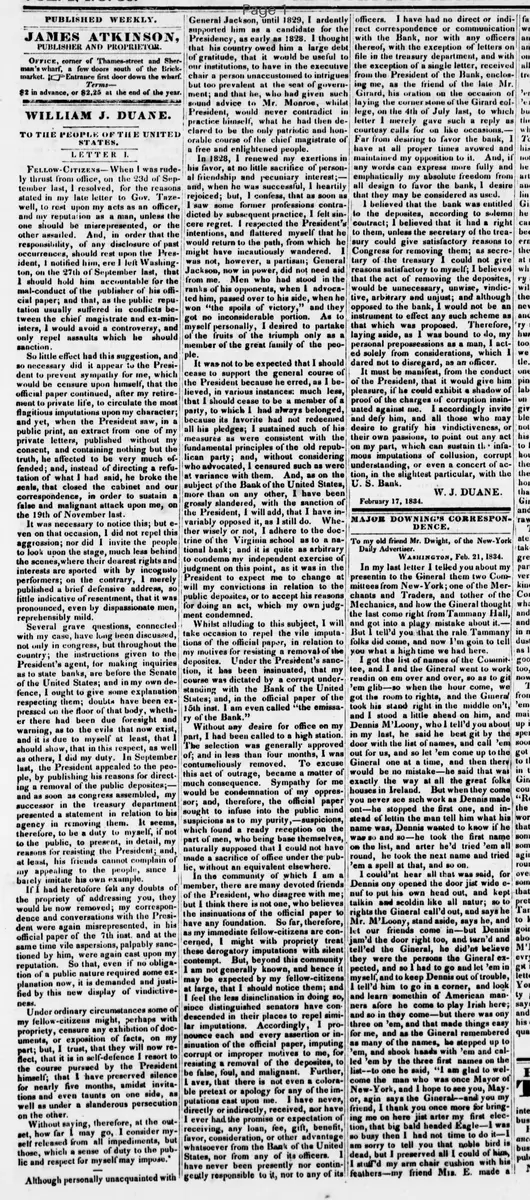
TO THE PEOPLE OF THE UNITED STATES.
LETTER I.
Fellow-Citizens—When I was rudely thrust from office, on the 23d of September last, I resolved, for the reasons stated in my late letter to Gov. Taney, to rest upon my acts as an officer, and my reputation as a man, unless the one should be misrepresented, or the other assailed. And, in order that the responsibility of any disclosure of past occurrences, should rest upon the President, I notified him, ere I left Washington, on the 27th of September last, that I should hold him accountable for the mal-conduct of the publisher of his official paper; and that, as the public reputation usually suffered in conflicts between the chief magistrate and ex-ministers, I would avoid a controversy, and only repel assaults which he should sanction.
So little effect had this suggestion, and so necessary did it appear to the President to prevent sympathy for me, which would be censure upon himself, that the official paper continued, after my retirement to private life, to circulate the most flagitious imputations upon my character; and yet, when the President saw, in a public print, an extract from one of my private letters, published without my consent, and containing nothing but the truth, he affected to be very much offended; and, instead of directing a refutation of what I had said, he broke the seals, that closed the cabinet and our correspondence, in order to sustain a false and malignant attack upon me, on the 19th of November last.
It was necessary to notice this; but even on that occasion, I did not repel this aggression; nor did I invite the people to look upon the stage, much less behind the scenes, where their dearest rights and interests are sported with by incognito performers; on the contrary, I merely published a brief defensive address, so little indicative of resentment, that it was pronounced, even by dispassionate men, reprehensibly mild.
Several grave questions, connected with my case, have long been discussed, not only in congress, but throughout the country; the instructions given to the President's agent, for making inquiries as to state banks, are before the Senate of the United States; and in my own defence, I ought to give some explanation respecting them; doubts have been expressed on the floor of that body, whether there had been due foresight and warning, as to the evils that now exist, and it is due to myself at least, that I should show, that in this respect, as well as others, I did my duty. In September last, the President appealed to the people, by publishing his reasons for directing a removal of the public deposites; and as soon as congress assembled, my successor in the treasury department presented a statement in relation to his agency in removing them. It seems, therefore, to be a duty to myself, if not to the public, to present, in detail, my reasons for resisting the President; and, at least, his friends cannot complain of my appealing to the people, since I barely imitate his own example.
If I had heretofore felt any doubts of the propriety of addressing you, they would be now removed; my correspondence and conversations with the President were again misrepresented, in his official paper of the 7th inst. and at the same time vile aspersions, palpably sanctioned by him, were again cast upon my reputation. So that, even if no obligation of a public nature required some explanation now, it is demanded and justified by this new display of vindictiveness.
Under ordinary circumstances some of my fellow-citizens might, perhaps with propriety, censure any exhibition of documents, or exposition of facts, on my part; but, I trust, that they will now reflect, that it is in self-defence I resort to the course pursued by the President himself; that I have preserved silence for nearly five months, amidst invitations and even taunts on one side, as well as under a slanderous persecution on the other.
Without saying, therefore, at the outset, how far I may go, I consider myself released from all impediments, but those, which a sense of duty to the public and respect for myself may impose.
Although personally unacquainted with General Jackson, until 1829, I ardently supported him as a candidate for the Presidency, as early as 1828. I thought that his country owed him a large debt of gratitude, that it would be useful to our institutions, to have in the executive chair a person unaccustomed to intrigues but too prevalent at the seat of government; and that he, who had given such sound advice to Mr. Monroe, whilst President, would never contradict in practice himself, what he had then declared to be the only patriotic and honorable course of the chief magistrate of a free and enlightened people.
In 1828, I renewed my exertions in his favor, at no little sacrifice of personal friendship and pecuniary interest; and, when he was successful, I heartily rejoiced; but, I confess, that as soon as I saw some former professions contradicted by subsequent practice, I felt sincere regret. I respected the President's intentions, and flattered myself that he would return to the path, from which he might have incautiously wandered. I was not, however, a partisan; General Jackson, now in power, did not need aid from me. Men who had stood in the ranks of his opponents, when I advocated him, passed over to his side, when he won "the spoils of victory," and they got no inconsiderable portion. As to myself personally, I desired to partake of the fruits of the triumph only as a member of the great family of the people.
It was not to be expected that I should cease to support the general course of the President because he erred, as I believed, in various instances: much less, that I should cease to be a member of a party, to which I had always belonged, because its favorite had not redeemed all his pledges; I sustained such of his measures as were consistent with the fundamental principles of the old republican party; and, without considering who advocated, I censured such as were at variance with them. And, as on the subject of the Bank of the United States, more than on any other, I have been grossly slandered, with the sanction of the President, I will add, that I have invariably opposed it, as I still do. Whether wisely or not, I adhere to the doctrine of the Virginia school as to a national bank; and it is quite as arbitrary to condemn my independent exercise of judgment on this point, as it was in the President to expect me to change at will my convictions in relation to the public deposites, or to accept his reasons for doing an act, which my own judgment condemned.
Whilst alluding to this subject, I will take occasion to repel the vile imputations of the official paper, in relation to my motives for resisting a removal of the deposites. Under the President's sanction, it has been insinuated, that my course was dictated by a corrupt understanding with the Bank of the United States; and, in the official paper of the 15th inst. I am even called "the emissary of the Bank."
Without any desire for office on my part, I had been called to a high station. The selection was generally approved of; and in less than four months, I was contumeliously removed. To excuse this act of outrage, became a matter of much consequence. Sympathy for me would be condemnation of my oppressor; and, therefore, the official paper sought to infuse into the public mind suspicions as to my purity,—suspicions, which found a ready reception on the part of men, who being base themselves, naturally supposed that I could not have made a sacrifice of office under the public, without an equivalent elsewhere.
In the community of which I am a member, there are many devoted friends of the President, who disagree with me: but I think there is not one, who believes the insinuations of the official paper to have any foundation. So far, therefore, as my immediate fellow-citizens are concerned, I might with propriety treat these derogatory imputations with silent contempt. "But, beyond this community I am not generally known, and hence it may be expected by my fellow-citizens at large, that I should notice them; and I feel the less disinclination in doing so, since distinguished senators have condescended in their places to repel similar imputations. Accordingly, I pronounce each and every assertion or insinuation of the official paper, imputing corrupt or improper motives to me, for resisting a removal of the deposites, to be false, foul, and malignant. Further, I aver, that there is not even a colorable pretext or apology for any of the imputations cast upon me. I have never, directly or indirectly, received, nor have I ever had the promise or expectation of receiving, any loan, fee, gift, benefit, favor, consideration, or other advantage whatsoever from the Bank of the United States, nor from any of its officers. I have never been presently nor contingently responsible to it, nor to any of its officers. I have had no direct or indirect correspondence or communication with the Bank, nor with any officers thereof, with the exception of letters on file in the treasury department, and with the exception of a single letter, received from the President of the Bank, enclosing me, as the friend of the late Mr. Girard, his oration on the occasion of laying the corner stone of the Girard college, on the 4th of July last, to which letter I merely gave such a reply as courtesy calls for on like occasions.
Far from desiring to favor the bank, I have at all proper times avowed and maintained my opposition to it. And, if any words can express more fully and emphatically my absolute freedom from all design to favor the bank, I desire that they may be considered as used.
I believed that the bank was entitled to the deposites, according to solemn contract; I believed that it had a right to them, unless the secretary of the treasury could give satisfactory reasons to Congress for removing them; as secretary of the treasury I could not give reasons satisfactory to myself; I believed that the act of removing the deposites, would be unnecessary, unwise, vindictive, arbitrary and unjust; and although opposed to the bank, I would not be an instrument to effect any such scheme as that which was proposed. Therefore, laying aside, as I was bound to do, my personal prepossessions as a man, I acted solely from considerations, which I dared not to disregard, as an officer.
It must be manifest, from the conduct of the President, that it would give him pleasure, if he could exhibit a shadow of proof of the charges of corruption insinuated against me. I accordingly invite and defy him, and all those who may desire to gratify his vindictiveness, or their own passions, to point out any act on my part, which can sustain the infamous imputations of collusion, corrupt understanding, or even a concert of action, in the slightest particular, with the U. S. Bank.
W. J. DUANE.
February 17, 1834.
What sub-type of article is it?
What themes does it cover?
What keywords are associated?
What entities or persons were involved?
Letter to Editor Details
Author
W. J. Duane
Recipient
To The People Of The United States
Main Argument
duane defends his refusal to remove public deposits from the bank of the united states, asserting it was unnecessary, unwise, and unjust, denies any corrupt ties to the bank, and criticizes president jackson's vindictive attacks on his character through the official paper.
Notable Details