Thank you for visiting SNEWPapers!
Sign up free
Editorial
November 28, 1794
Gazette Of The United States And Daily Evening Advertiser
Philadelphia, Philadelphia County, Pennsylvania
What is this article about?
Editorial from a correspondent defends the congressional duty on pleasure carriages as a fair, constitutional indirect tax on luxury items, criticizing opposition amid insurrection. Provides House of Representatives vote: 49 in favor (mostly Federalists), 22 against (Republicans).
Merged-components note: The vote list is a direct continuation of the editorial discussing the carriage tax duty, providing supporting evidence.
Clipping
OCR Quality
98%
Excellent
Full Text
From a Correspondent.
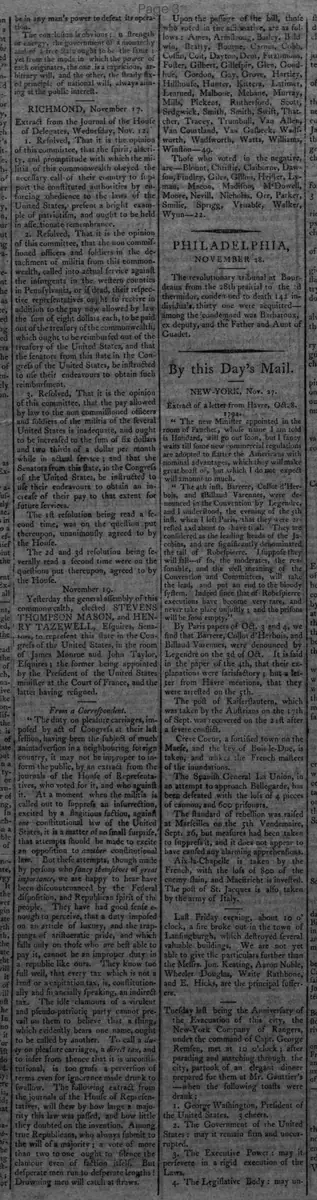
The duty on pleasure carriages, imposed by act of Congress at their last session, having been the subject of much animadversion in a neighbouring foreign country, it may not be improper to inform the public, by an extract from the journals of the House of Representatives, who voted for it, and who against it. At a moment when the militia is called out to suppress an insurrection, excited by a flagitious faction, against one constitutional law of the United States, it is a matter of no small surprise, that attempts should be made to excite an opposition to another constitutional law. But these attempts, though made by persons who fancy themselves of great importance, we are happy to hear have been discountenanced by the Federal disposition, and Republican spirit of the people. They have had good sense enough to perceive, that a duty imposed on an article of luxury, and the trappings of aristocratic pride, and which falls only on those who are best able to pay it, cannot be an improper duty in a republic like ours. They know too full well, that every tax which is not a land or a capitation tax, is, constitutionally and financially speaking, an indirect tax. The idle clamours of a virulent and pseudo-patriotic party cannot prevail on them to believe that a thing, which evidently bears one name, ought to be called by another. To call a duty on pleasure carriages, a direct tax, and to infer from thence that it is unconstitutional, is too gross a perversion of terms even for ignorance made drunk to swallow. The following extract from the journals of the House of Representatives, will show by how large a majority this law was passed, and how little they doubted on the invention. Among true Republicans, who always submit to the will of a majority; a vote of more than two to one ought to silence the clamour even of faction itself. But desperate men run to desperate lengths! Drowning men will catch at straws.
Upon the passage of the bill, those who voted in the affirmative, are as follows: Ames, Armstrong, Bailey, Baldwin, Beatty, Bourne, Carnes, Cobb, Coffin, Coit, Dayton, Dent, Fitzsimons, Foster, Gilbert, Gillespie, Glen, Goodhue, Gordon, Gray, Grove, Hartley, Hillhouse, Hunter, Kittera, Latimer, Learned, Malbone, Mebane, Murray, Mills, Pickens, Rutherford, Scott, Sedgwick, Smith (of South Carolina), Smith (of New-Jersey), Swift, Thatcher, Tracy, Trumbull, Van Allen, Van Cortlandt, Van Gansevoort, Wadsworth, Wadsworth, Watts, Williams, Winston—49.
Those who voted in the negative, are Blount, Christie, Claiborne, Dawson, Findley, Giles, Gillispie, Heller, Lyman, Macon, Madison, M'Dowell, Moore, Neville, Nicholas, Orr, Parker, Smilie, Springer, Venable, Walker, Wynns—22.
The duty on pleasure carriages, imposed by act of Congress at their last session, having been the subject of much animadversion in a neighbouring foreign country, it may not be improper to inform the public, by an extract from the journals of the House of Representatives, who voted for it, and who against it. At a moment when the militia is called out to suppress an insurrection, excited by a flagitious faction, against one constitutional law of the United States, it is a matter of no small surprise, that attempts should be made to excite an opposition to another constitutional law. But these attempts, though made by persons who fancy themselves of great importance, we are happy to hear have been discountenanced by the Federal disposition, and Republican spirit of the people. They have had good sense enough to perceive, that a duty imposed on an article of luxury, and the trappings of aristocratic pride, and which falls only on those who are best able to pay it, cannot be an improper duty in a republic like ours. They know too full well, that every tax which is not a land or a capitation tax, is, constitutionally and financially speaking, an indirect tax. The idle clamours of a virulent and pseudo-patriotic party cannot prevail on them to believe that a thing, which evidently bears one name, ought to be called by another. To call a duty on pleasure carriages, a direct tax, and to infer from thence that it is unconstitutional, is too gross a perversion of terms even for ignorance made drunk to swallow. The following extract from the journals of the House of Representatives, will show by how large a majority this law was passed, and how little they doubted on the invention. Among true Republicans, who always submit to the will of a majority; a vote of more than two to one ought to silence the clamour even of faction itself. But desperate men run to desperate lengths! Drowning men will catch at straws.
Upon the passage of the bill, those who voted in the affirmative, are as follows: Ames, Armstrong, Bailey, Baldwin, Beatty, Bourne, Carnes, Cobb, Coffin, Coit, Dayton, Dent, Fitzsimons, Foster, Gilbert, Gillespie, Glen, Goodhue, Gordon, Gray, Grove, Hartley, Hillhouse, Hunter, Kittera, Latimer, Learned, Malbone, Mebane, Murray, Mills, Pickens, Rutherford, Scott, Sedgwick, Smith (of South Carolina), Smith (of New-Jersey), Swift, Thatcher, Tracy, Trumbull, Van Allen, Van Cortlandt, Van Gansevoort, Wadsworth, Wadsworth, Watts, Williams, Winston—49.
Those who voted in the negative, are Blount, Christie, Claiborne, Dawson, Findley, Giles, Gillispie, Heller, Lyman, Macon, Madison, M'Dowell, Moore, Neville, Nicholas, Orr, Parker, Smilie, Springer, Venable, Walker, Wynns—22.
What sub-type of article is it?
Economic Policy
Constitutional
Partisan Politics
What keywords are associated?
Pleasure Carriages Duty
Congressional Vote
Indirect Tax
Constitutional Law
Federalist Republicans
Tax Opposition
What entities or persons were involved?
House Of Representatives
Federalists
Republicans
Editorial Details
Primary Topic
Defense Of Duty On Pleasure Carriages
Stance / Tone
Supportive Of The Tax Law And Critical Of Opposition
Key Figures
House Of Representatives
Federalists
Republicans
Key Arguments
Duty On Pleasure Carriages Is An Indirect Tax On Luxury, Constitutional And Fair
Opposition Is Factional And Ignores Majority Vote
Tax Falls On Those Able To Pay, Fitting For A Republic
Calling It A Direct Tax Is A Perversion Of Terms